
A state university's campus network gains new printer, sensor and lab-device models every term, yet its profiling rules still recognize most of them only by MAC prefix and sort them into a generic profile. The team wants the knowledge base to keep pace with vendors without staff upkeep, SNMP replies from the instrument subnet fail to reach ISE, and ISE can reach Cisco's update servers. Which profiling feature should the team enable to raise classification accuracy?
Select an answer to reveal the explanation.
Short Explanation
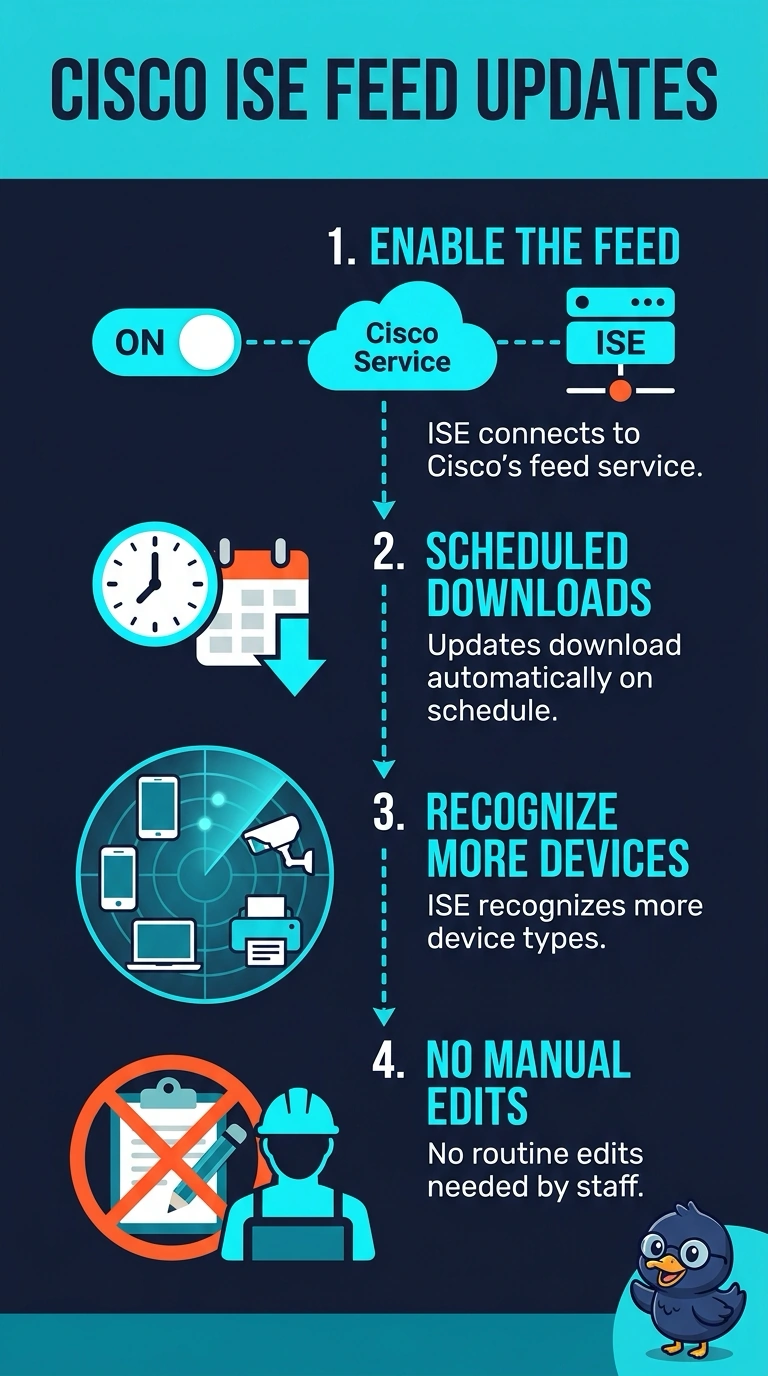
Enable the feed service so ISE automatically downloads Cisco’s updated profiling data and recognizes new devices—like a directory that keeps itself current. SNMP probing won’t help while replies can’t reach ISE, and device sensor doesn’t update the feed.
Full Explanation
The ISE feed service is the best fit because it supplies Cisco’s updated profiling data, allowing ISE’s knowledge base to recognize newer devices without the team maintaining model-specific rules. The university’s direct reachability to Cisco’s update servers also supports this approach. SNMP probing is a widely used way to gather useful endpoint attributes, but it depends on ISE being able to receive SNMP replies; the scenario explicitly says replies from the instrument subnet cannot reach ISE, so enabling probes alone will not provide that data. DHCP fingerprinting can classify devices from vendor-class and option fields and may improve on MAC-prefix-only matching, but keeping model-specific rules current requires staff upkeep, contrary to the stated goal. Switch device sensor telemetry can enrich the attributes available for profiling, but collecting endpoint data is not the same as refreshing ISE’s vendor profiling knowledge base, so it does not meet the requirement to keep recognition current without rule maintenance. Exam caveat: distinguish methods that collect local endpoint attributes from a feed that updates profiling knowledge; both can improve accuracy, but they solve different problems. Practical check: confirm that ISE can reach the update servers and that the feed is enabled and successfully updating, then verify classifications for representative newly added device models.