
A warehouse has profiled scanners and IP phones correctly for years, but a new shipment of handhelds from a second vendor lands in the generic default profile. The team wants ISE to recognize new hardware when Cisco publishes matching profile updates, without anyone hand-editing classifier rules for every model. Which profiler capability should they enable?
Select an answer to reveal the explanation.
Short Explanation
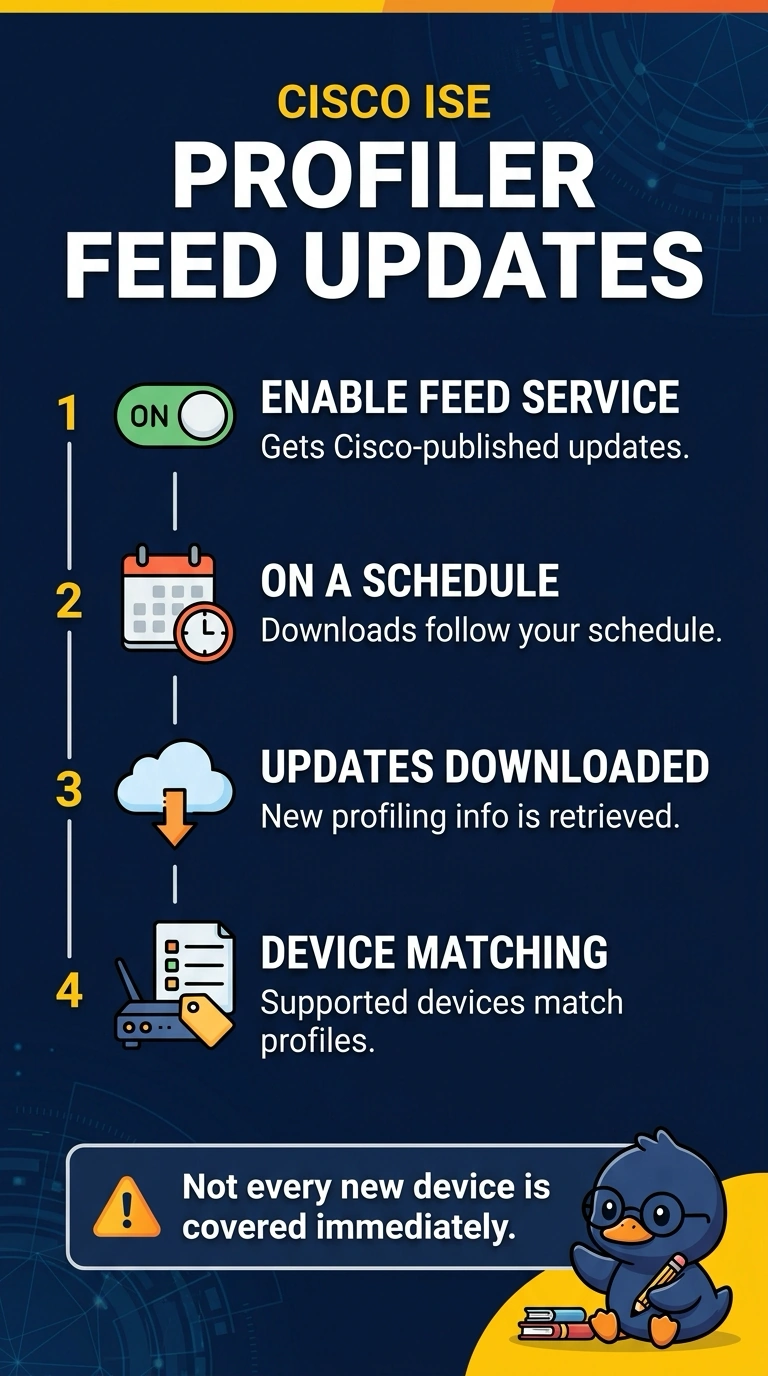
Enable the feed service so ISE can download Cisco-published profiling updates on a schedule and recognize your handhelds when matching profiles become available. That saves you from hand-editing classifier rules for every model; probes gather endpoint attributes, but they do not import those updates.
Full Explanation
The feed service imports Cisco-published profiling updates into ISE on a schedule. When Cisco adds or revises a profile that matches the new handhelds, the updates can give ISE the classifiers to recognize them without your team writing rules for each model. DHCP, RADIUS, and HTTP probes collect endpoint attributes from network traffic; they provide evidence for profiling but do not import Cisco’s updated profile definitions. MAC OUI-based profiling can identify a manufacturer from an address prefix and support broad vendor-level policy, but an OUI identifies an address allocation, not necessarily a specific handheld model, so it may not provide the model-level recognition sought here. MDM integration can supply device-type attributes for enrolled handhelds and automate policy assignment, but it relies on enrollment and MDM inventory data rather than importing Cisco profiling updates into ISE. Exam caveat: a feed helps only when Cisco has published a relevant profile; it does not guarantee identification of every new device. In practice, check the feed’s status and last successful update, then confirm that a test handheld matches the expected profile in ISE.