
A regional hospital requires three posture outcomes for clinician laptops: Compliant receives full EMR access, Unknown receives a restricted VLAN with internet only, and Non-Compliant is sent to the remediation portal. Which authorization design enforces all three posture outcomes exactly as stated?
Select an answer to reveal the explanation.
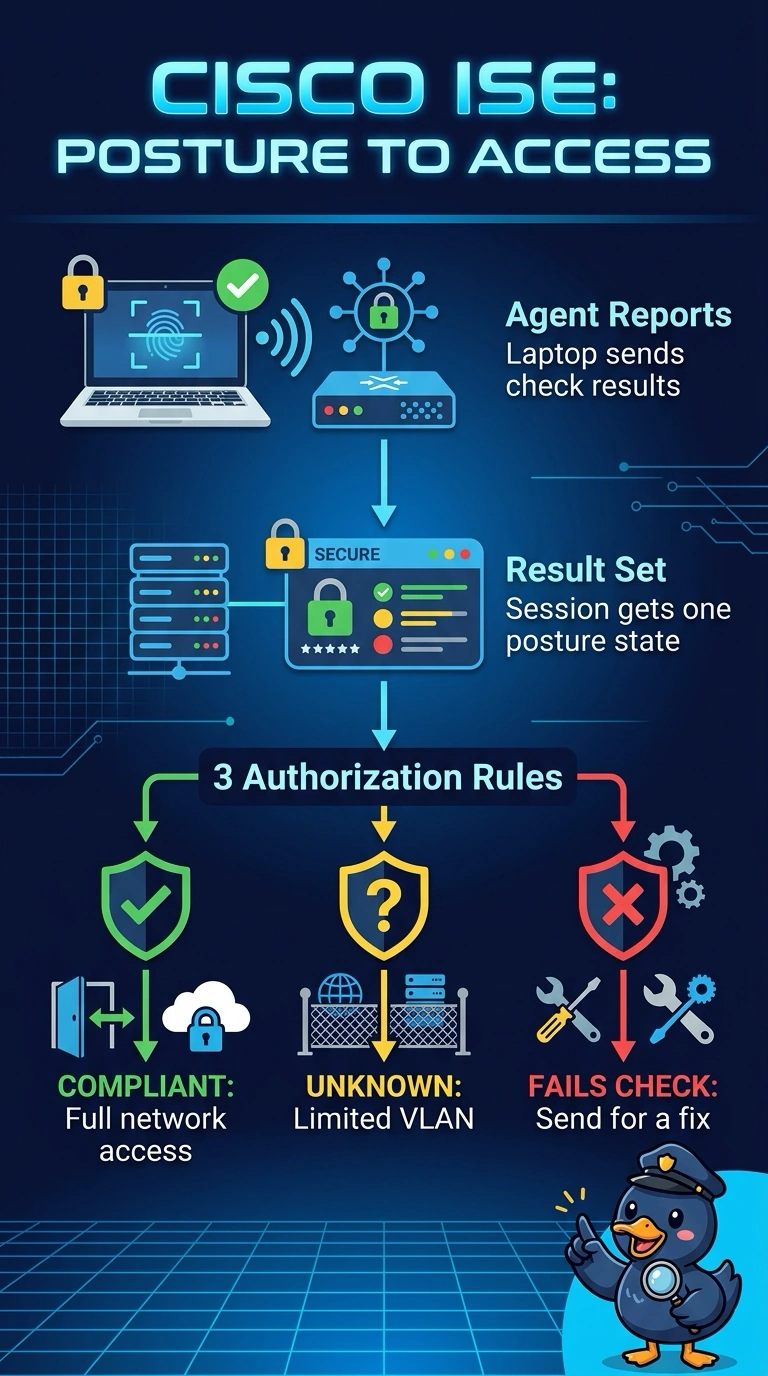
Short Explanation
Think of posture as the signal that guides access, and authorization as the rule that sends each result to the right place. You’ll enforce the requirement with three rules: Compliant gets full EMR access, Unknown gets the internet-only restricted VLAN, and Non-Compliant goes to the remediation portal.
Full Explanation
The design that creates three explicit authorization rules is correct because it maps each posture result to its required outcome: Compliant receives full EMR access, Unknown is assigned to the internet-only restricted VLAN, and Non-Compliant is sent to the remediation portal. Explicit mapping makes the intended access clear for every posture state. A design that creates rules for Compliant and Non-Compliant but lets the default policy grant Unknown full EMR access fails because Unknown must have restricted internet-only access, not EMR access. A design that maps Compliant and Unknown correctly but sends Non-Compliant devices to quarantine fails because the specified destination is the remediation portal; quarantine is not interchangeable with that portal. A design that uses posture-triggered ACLs while keeping endpoints on one VLAN fails because the requirement explicitly places Unknown devices on a restricted VLAN, even if an ACL limits them to internet access. Exam caveat: distinguish the required outcome from a potentially similar enforcement method; an ACL or quarantine does not satisfy a specified VLAN assignment or portal destination. Practical check: test Compliant, Unknown, and Non-Compliant devices, then verify each authorization rule, assigned VLAN, reachable destinations, and redirect behavior against the stated requirements.