
A state university runs ISE on two virtual machines: one hosting the administration and monitoring personas, and one hosting the policy service persona. At 8 a.m. about 4,000 wireless users authenticate within minutes, RADIUS replies slow to a crawl, and clients start retrying. Which performance specification should the team re-size first to protect authentication throughput?
Select an answer to reveal the explanation.
Short Explanation
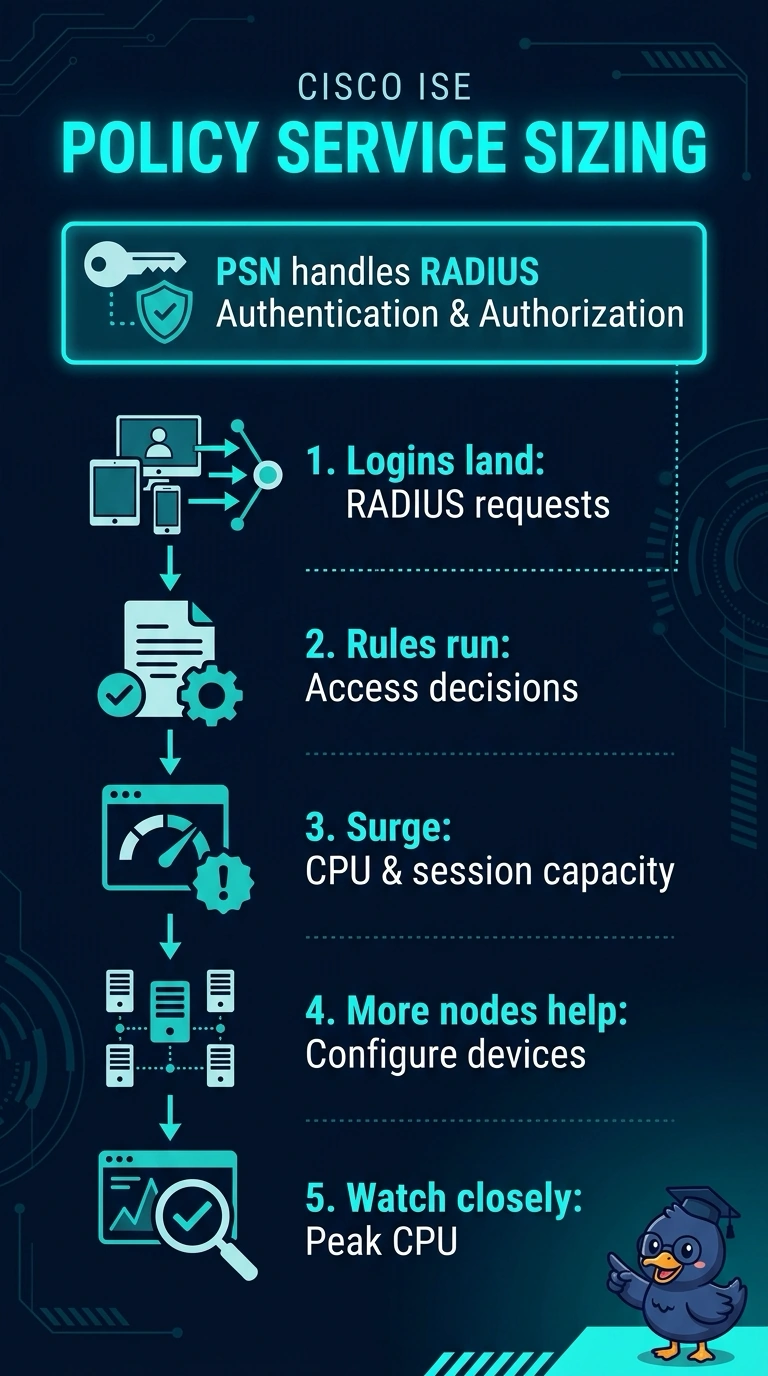
You should first re-size the policy service persona’s CPU and session capacity, because it handles RADIUS authentication and authorization. It’s like adding staff at a busy front desk rather than enlarging the management office.
Full Explanation
The policy service persona handles RADIUS authentication and authorization, so its CPU and session capacity are the first sizing areas to investigate during an authentication surge. Additional administration-node memory may help management tasks, but it does not move RADIUS processing off the policy service node. Monitoring storage is important for retaining logs, but it is not the first throughput specification to resize for slow RADIUS replies. ISE does not distribute RADIUS processing across every persona: policy service nodes handle that work, and adding policy service capacity may help when the deployment and network devices are configured to use those nodes. Check policy service CPU, authentication rate, and RADIUS latency during the peak, and compare them with the sizing guidance for the deployed ISE version and endpoint load.