
A campus team is moving 40 access switches from enable passwords to ISE for TACACS+ device administration, with shell profiles granting privilege 15 to the network operations group. Operations requires that administrators can still log in over SSH when an ISE node is unreachable during a maintenance window. Which switch AAA configuration delivers ISE device administration with local fallback?
Select an answer to reveal the explanation.
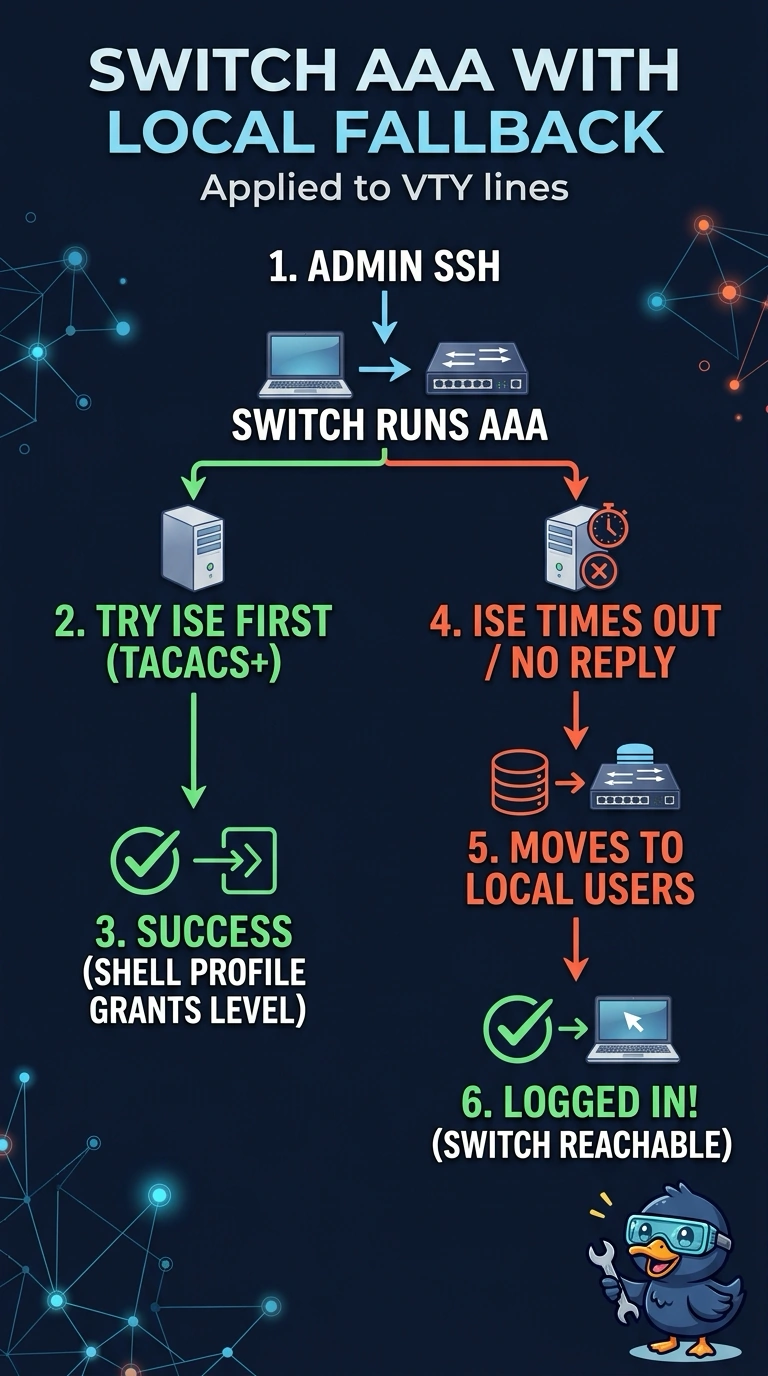
Short Explanation
Configure ISE-first TACACS+ login and exec authorization on the VTY lines, with local users as the fallback, so your SSH access can continue during an ISE outage. You get the network operations group’s privilege-15 shell profile from ISE during normal operation, while local accounts provide a backup when ISE is unavailable; an ISE rejection does not trigger fallback.
Full Explanation
ISE device administration requires TACACS+ login and exec authorization, with both method lists applied to the VTY lines used for SSH. This lets ISE provide the network operations group’s privilege-15 shell profile during normal operation, while the local method allows a switch to authenticate a configured local user if ISE is unreachable or returns an error. Using ISE-first login with local fallback but assigning privilege locally omits ISE exec authorization, so it does not meet the shell-profile requirement. Applying the correct login and exec-authorization services only to console lines leaves SSH administration without those lists. Using an enable secret as the outage fallback also fails: the secret is used to enter privileged mode after login, not to authenticate an SSH session when ISE is unavailable. Exam caveat: AAA method lists generally try the next method when the preceding server is unavailable or returns an error, not when it explicitly rejects a user, so local fallback does not bypass an ISE denial. Practical check: in a controlled test, confirm a valid ISE login receives privilege 15, then make ISE unreachable and verify that a configured local account can still SSH in with the intended privilege.