
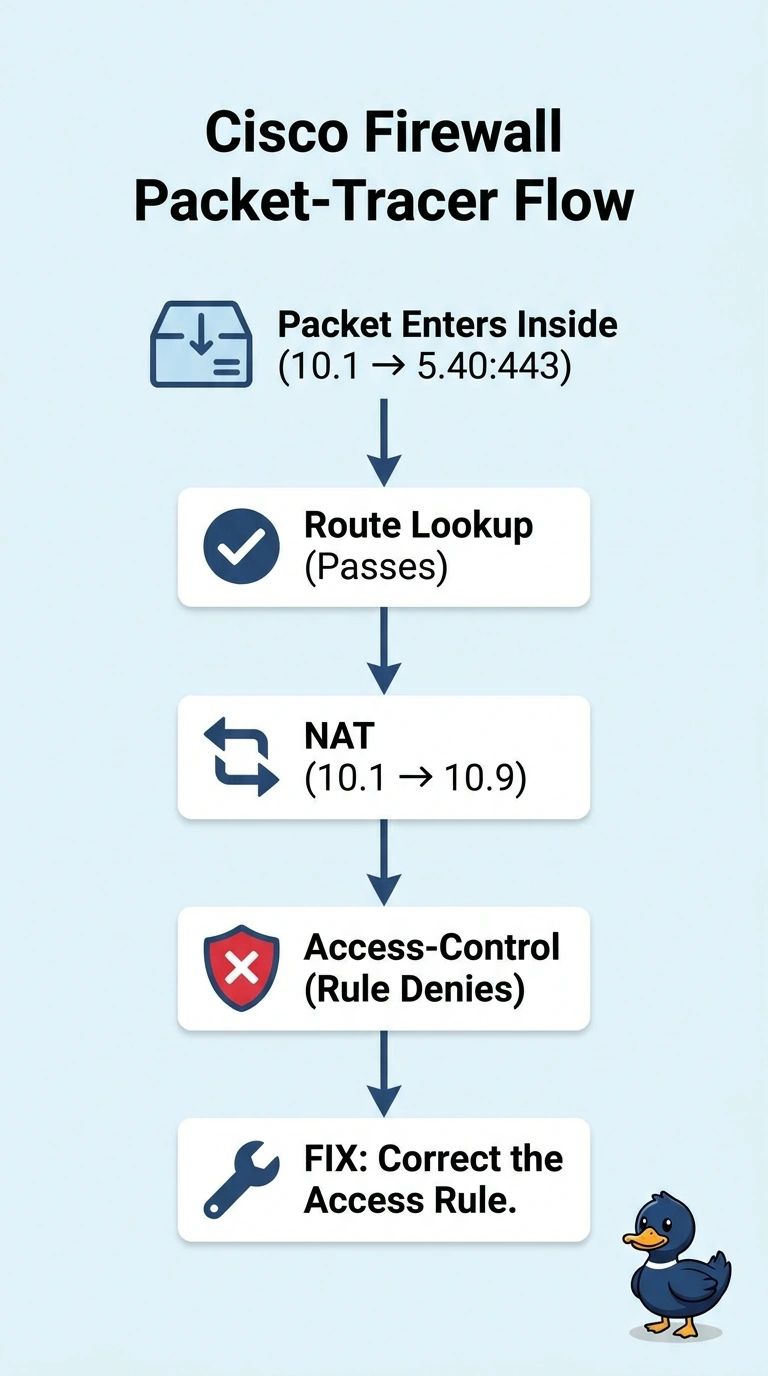
A SOC analyst traces a packet from 10.1.5.40 to the database server at 10.9.2.15 over TCP 443 because transactions keep timing out. The output shows the packet entering on the inside interface, a successful route lookup, translation applied by the NAT rule, and a drop whose reason names the access-list phase. How should the analyst interpret this packet tracer result?
Select an answer to reveal the explanation.
Short Explanation
You can rule out routing and NAT as the stage that dropped this packet: the route lookup succeeded and translation was applied. The drop reason identifies the access-control phase, so you should inspect the matching rule or policy rather than the route, translated tuple, or server-side service.
Full Explanation
The trace shows the packet entering on the inside interface, completing a successful route lookup, and having NAT applied before the drop reason names the access-list phase. You should therefore inspect the access-control policy and matching rule, and correct it if the intended flow to the database server is meant to be permitted. A successful route lookup does not prove the selected next hop is the desired one, so validating the egress path can be useful, but a wrong next hop does not explain this explicit access-list drop. NAT being applied does not prove that the translated address or port is correct, so verify the resulting tuple when translation is in question; here, however, the trace identifies access control as the dropping stage. A database listener or TLS issue can cause timeouts after traffic reaches the service, but it does not explain this packet being denied by the access-control policy. Exam caveat: packet tracer reports the disposition of the tested packet under the configuration and parameters used; it does not establish that every packet in the session follows the same path or matches the same rule. Practical check: record the original and translated tuples, identify the matching access-list rule, and verify any policy correction with a repeat trace and controlled connection test.