
A retail bank has budget for exactly two firewall appliances, one installed in each of its two buildings and joined by a dedicated Layer 2 link sized for failover and state traffic but far below the throughput a cluster control link would need. Peak traffic fits comfortably inside one appliance, the pair must fail over automatically with established sessions preserved, and only these two units are approved hardware. Which high availability option best fits this two-unit site?
Select an answer to reveal the explanation.
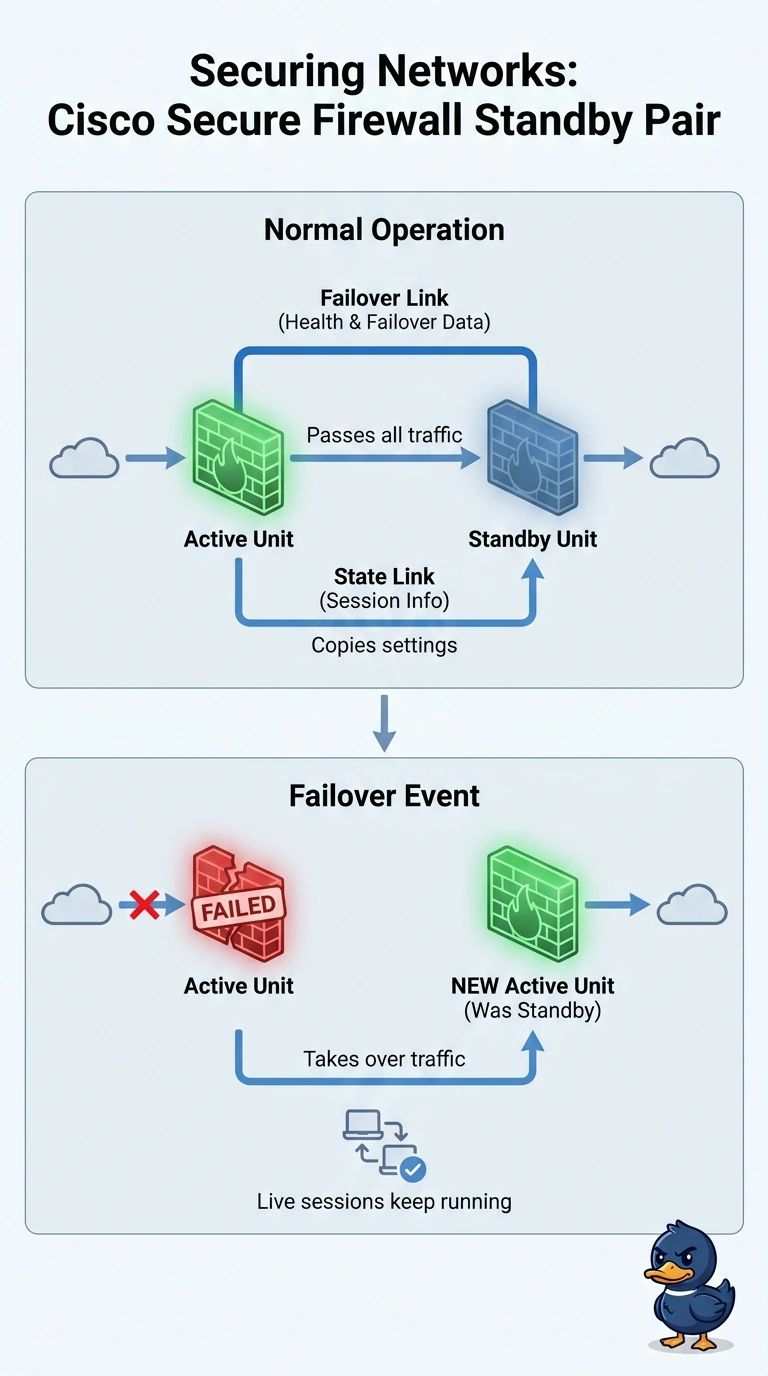
Short Explanation
Your load fits one box, so a failover pair is the right size and the standby takes over only when its partner fails. A cluster requires a high-bandwidth cluster control link, which this inter-building link does not provide. Gateway redundancy does not replicate firewall connection state, and a cable in one rack leaves the other building exposed.
Full Explanation
High availability on FTD is an active and standby arrangement: the second appliance mirrors configuration and receives connection state over the state link, then takes over the traffic role when the active unit fails health checks, so established sessions can survive the swap. The failover and state links must meet Cisco's bandwidth and latency requirements for the deployment, which the dedicated link in this scenario is sized to do. Clustering answers a different question. Members exchange cluster information and connection state over a cluster control link, which must be sized and engineered for the deployment; the inter-building link here is far below what a cluster control link would need, so a cluster is a poor fit for a load that fits one appliance. Gateway redundancy through a virtual router redundancy protocol shifts the next hop automatically, but it does not replicate firewall connection state, so sessions may be disrupted if traffic moves to a firewall without that state. A co-located pair joined by a direct cable gives a short interconnect, yet placing both units in one building discards the requirement that each building keeps a survivable appliance. Exam caveat: configure the failover and state links as required for the chosen platform and topology. Practical check: confirm the standby reports healthy and verify failover behavior before relying on it.