
A content provider's central data center sees sustained traffic peaks above one appliance's throughput, and a single node failure must leave supported established sessions running. The team also requires that inter-node state traffic stays off the production links. Which high availability design meets the throughput, session continuity and dedicated state-link requirements?
Select an answer to reveal the explanation.
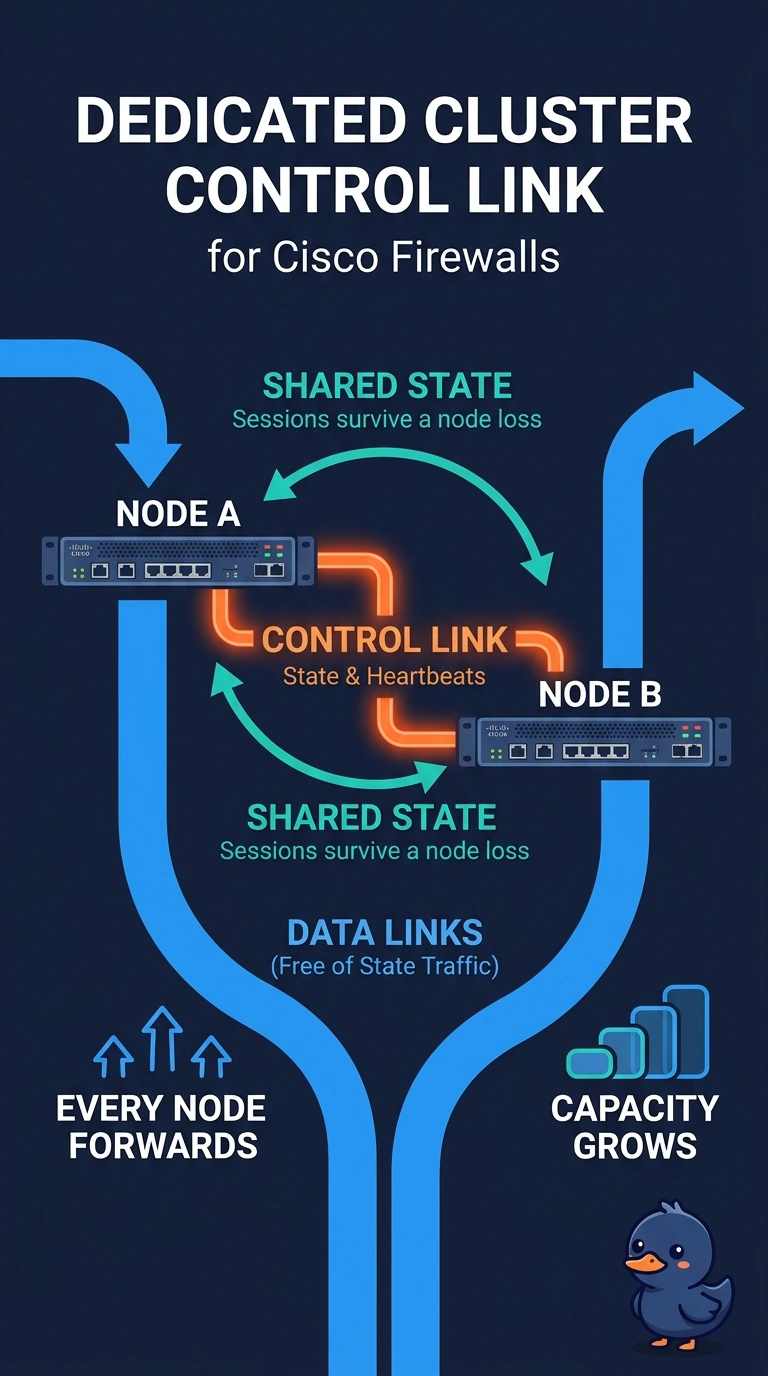
Short Explanation
Clustering is the only design here that adds capacity and preserves supported sessions when a node drops, and the cluster control link carries state on its own dedicated link. An HA pair fails over, but still caps you at one appliance's throughput. Independent boxes add capacity yet do not share a session table.
Full Explanation
Secure Firewall Threat Defense clustering meets all three requirements together: every member can forward production flows so throughput grows with the node count, connection state is replicated, and that replication plus heartbeats travels over the cluster control link, which should use its own dedicated interface so state does not compete with customer traffic. The active/standby high availability pair passes connection state over its failover and state links, but only one appliance forwards traffic, so it cannot lift the ceiling above a single box. Independent appliances running ECMP spread new flows across both devices, yet each keeps its own connection table, so sessions that lived on the failed node are lost. Clustering over the production data links does not meet the dedicated-link requirement, because heartbeats and connection updates would share those links with user flows. Exam caveat: decrypted TLS connections are an exception to session continuity, since their decryption state is not shared and they reset when the owning node fails. Practical check: once the cluster forms, watch counters on the dedicated control link during a traffic spike and confirm state traffic uses that link.