
A healthcare provider's internet edge runs a single FTD appliance that saturates during open enrollment. The design must push peak throughput past one appliance, keep one policy set under a single management center, and keep the edge serving if one appliance fails. Which high availability design meets all three requirements?
Select an answer to reveal the explanation.
Short Explanation
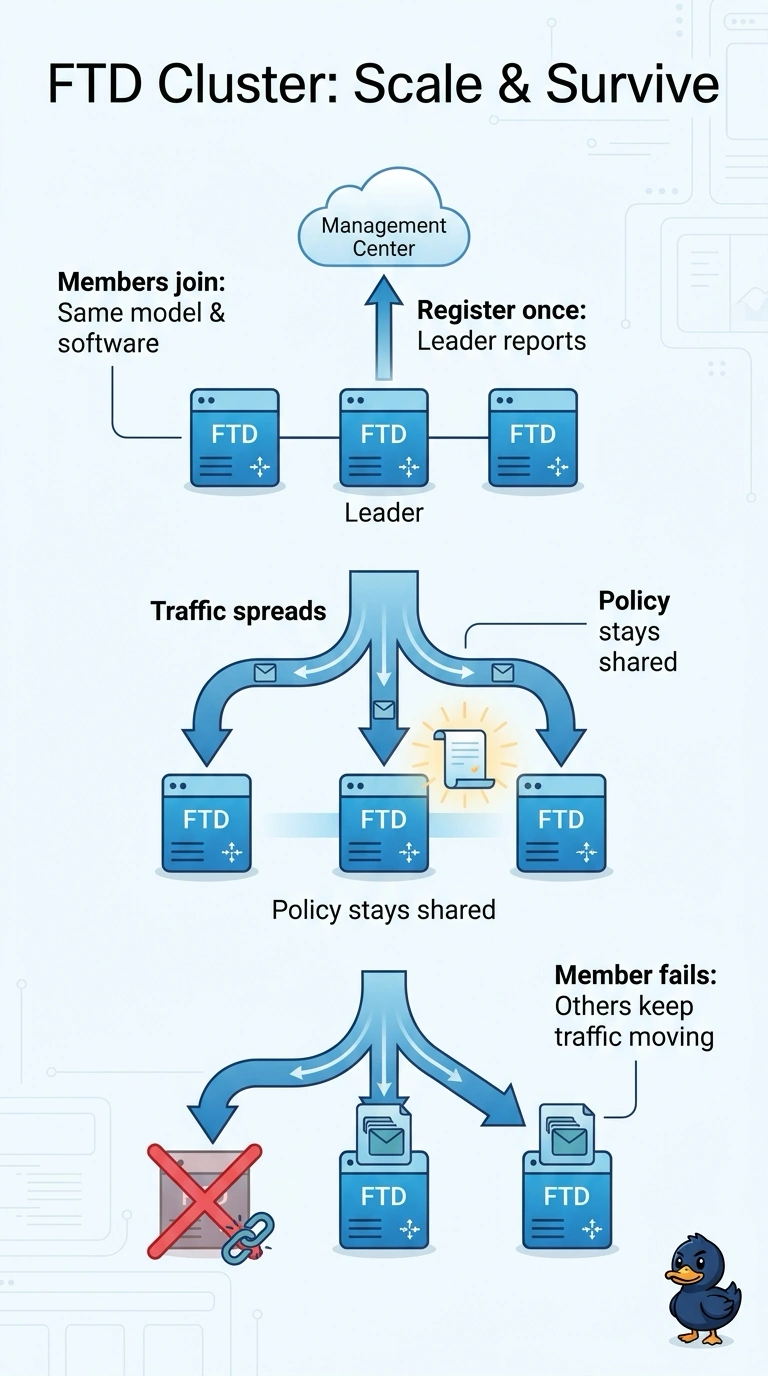
Capacity and failover pull in different directions, so you need one design that carries all three requirements at once. A cluster adds throughput, keeps one policy, and lets the edge continue serving if a member fails.
Full Explanation
Clustering and high availability answer two different questions in Secure Firewall Threat Defense, and this design needs scale and survival together. A cluster lets several appliances share the same traffic load, so aggregate throughput can grow with the cluster, the group registers and is managed as a single device so one policy set covers all members, and the remaining members continue forwarding traffic if one member fails. Connections handled by the failed member may need to be reestablished. An active and standby pair does not scale forwarding capacity, because the standby waits for a failure, so only one appliance forwards traffic and the second box buys resilience instead of capacity. Two FTDs with separate policy sets behind a load balancer can carry traffic together, but they do not provide the required single policy set. Moving to a bigger appliance fixes capacity under one policy yet leaves a single point of failure, so the edge can fail when it does. The exam caveat is that cluster members must match in model and software while an HA pair synchronizes configuration between two boxes. A practical check is to confirm the design states an aggregate throughput target, one policy source, and a member failure test.