
A regional insurance office runs a single Threat Defense appliance and needs the branch to survive a hardware failure automatically with only one extra identical appliance available. The design must stay stateful and simple to manage from the Management Center. Which high availability design fits the office best?
Select an answer to reveal the explanation.
Short Explanation
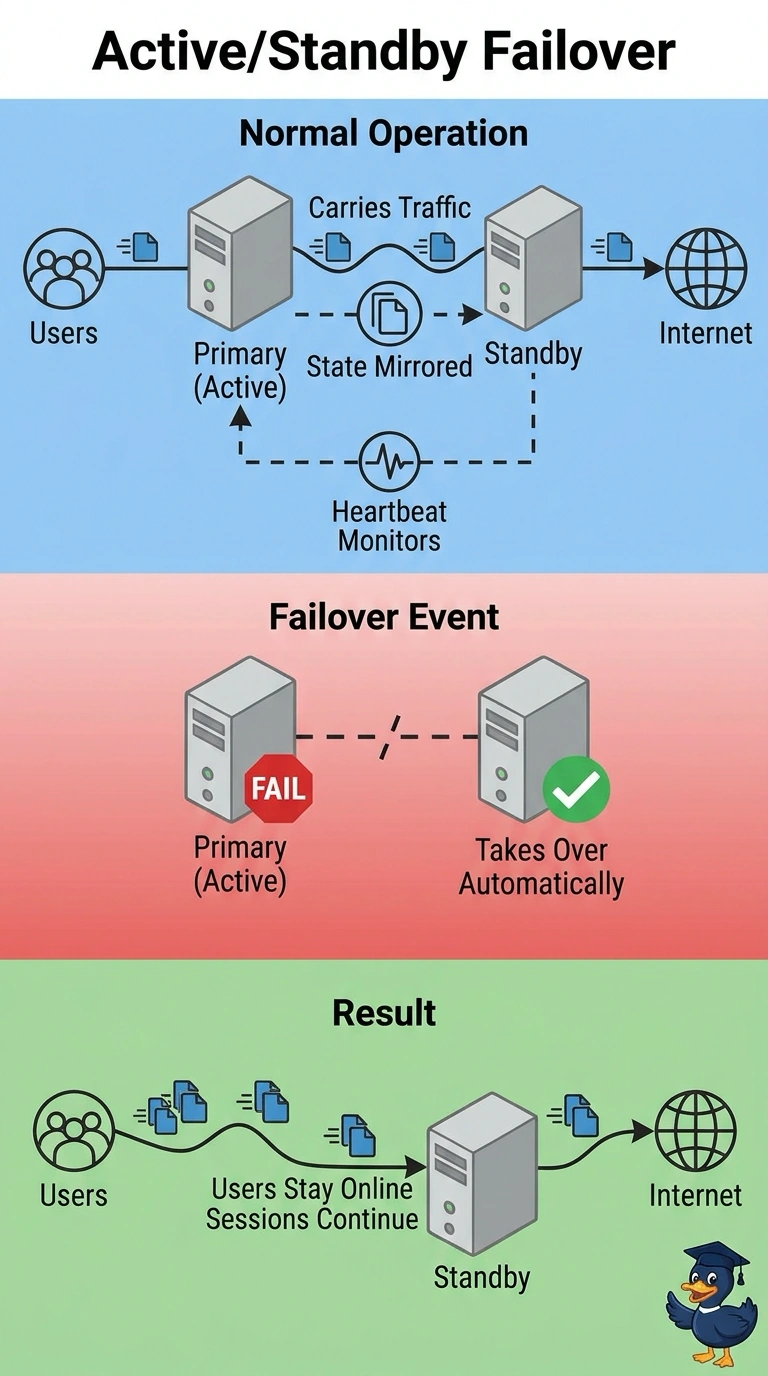
An active/standby pair fits your needs: one appliance handles traffic while the other stays ready with replicated session state, like a spare driver who knows the route. If the primary fails, the standby takes over automatically, giving you simple, stateful failover to manage from the Management Center.
Full Explanation
An active/standby pair is the best fit: with one identical spare, the appliances can provide automatic takeover after a primary failure, while state replication helps preserve established connections. The standby does not normally share traffic processing with the active unit, which keeps the design comparatively simple, and the pair can be managed through the Management Center. A two-node active/active cluster can provide synchronized sessions and centralized oversight, but its coordination, traffic distribution, and failure behavior add operational complexity, missing the stated simplicity requirement. A routed firewall pair with gateway failover and replicated policies is a recognized design, but policy replication is not connection-state replication; established sessions may need to reconnect, so it does not meet the stateful requirement. A locally configured active/standby pair can provide automatic takeover and state synchronization, but managing each appliance locally misses the requirement for Management Center control. Exam caveat: do not assume that “high availability” alone guarantees session continuity; confirm that the design replicates connection state and supports the required failover behavior. Practical check: before deployment, verify the appliance models, software versions, licensing, interface and cabling requirements, state-replication status, and Management Center support for the selected HA configuration.