
A branch FTD has two ISP uplinks, and the primary interface stays up when the provider's peering path fails, so the default route stays in the routing table. The architect still wants both ISP routes kept as static routes in the FMC and needs traffic to shift to the backup ISP when a probe beyond the local gateway stops replying. Which control should be bound to the primary static route to make that failover happen?
Select an answer to reveal the explanation.
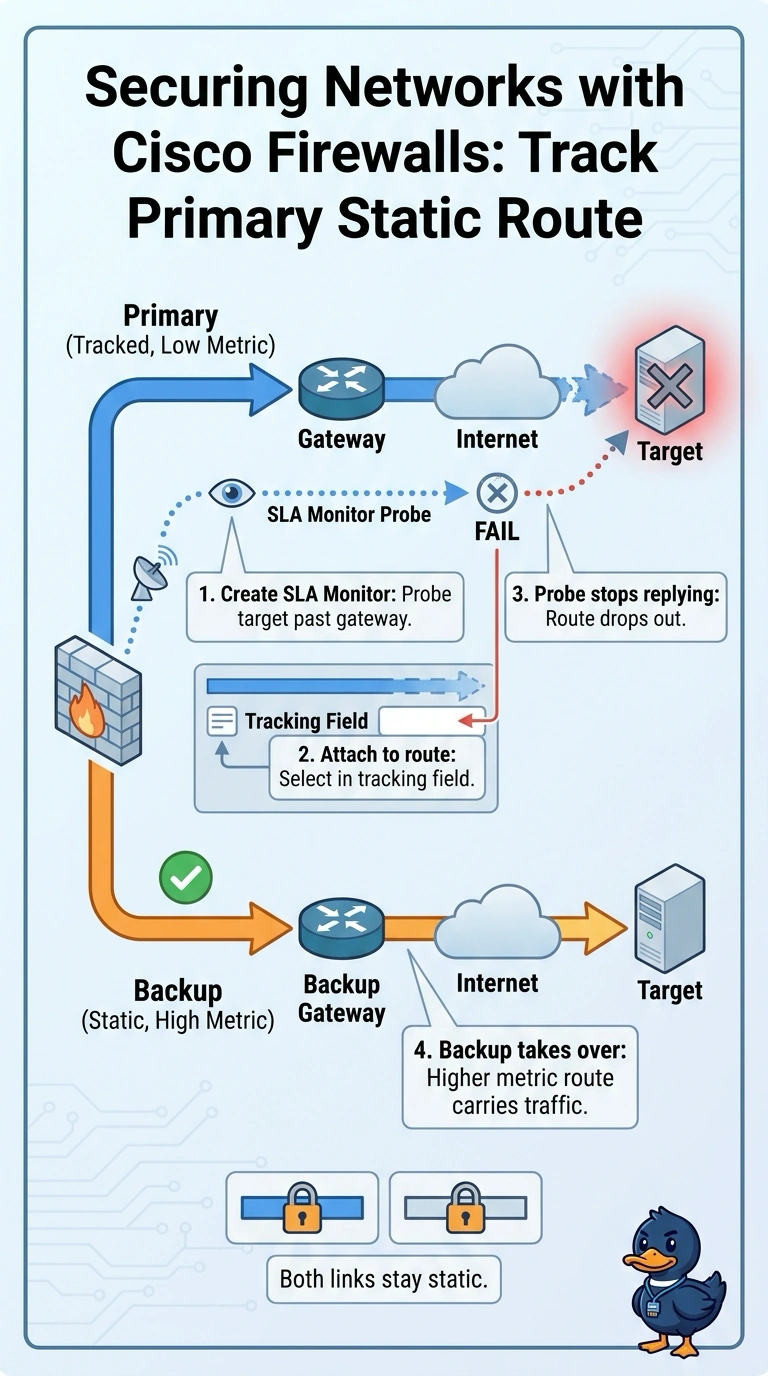
Short Explanation
You're still up locally while the provider's path beyond the gateway is dead, so the route table never notices. An SLA Monitor in the route tracking field keeps pinging a host past the gateway, and when replies stop the route simply drops out. It works like a smoke alarm for the path rather than just the cable.
Full Explanation
An SLA Monitor object referenced in the primary static route’s tracking field provides the required link between probe results and route installation. Because the probe targets a device beyond the local gateway, a failed upstream path can make the primary route unavailable even while the physical interface remains up; the backup static route can then be selected. A higher-distance backup route tracked only against the primary interface is a standard failover pattern, but it misses the key failure condition here: the interface stays up when the provider’s peering path fails, so that tracking signal would not trigger the backup. BFD with a provider routing adjacency can detect a failed neighbor quickly and withdraw a learned route, but it replaces the required static routes in FMC with dynamic routing. IP SLA coupled with EEM can probe the correct remote target and alter routing after failure, but it does not bind the monitor to the primary static route’s tracking field as requested; it relies on an external event-action mechanism. Exam caveat: distinguish route tracking from interface state, since an operational interface does not prove end-to-end reachability. Practical check: verify that the monitor’s target is reachable through the primary ISP, then simulate probe failure and confirm the primary route is removed and the backup route becomes active.