
A branch office runs an FTD whose default route points at ISP-A, with a floating backup route through ISP-B. The ISP-A first hop keeps answering while traffic beyond it black-holes, so the box keeps sending users into a dead path. The team wants failover driven by reachability of a stable target on the far side rather than by interface state. Which route-tracking design should be configured on the primary default route?
Select an answer to reveal the explanation.
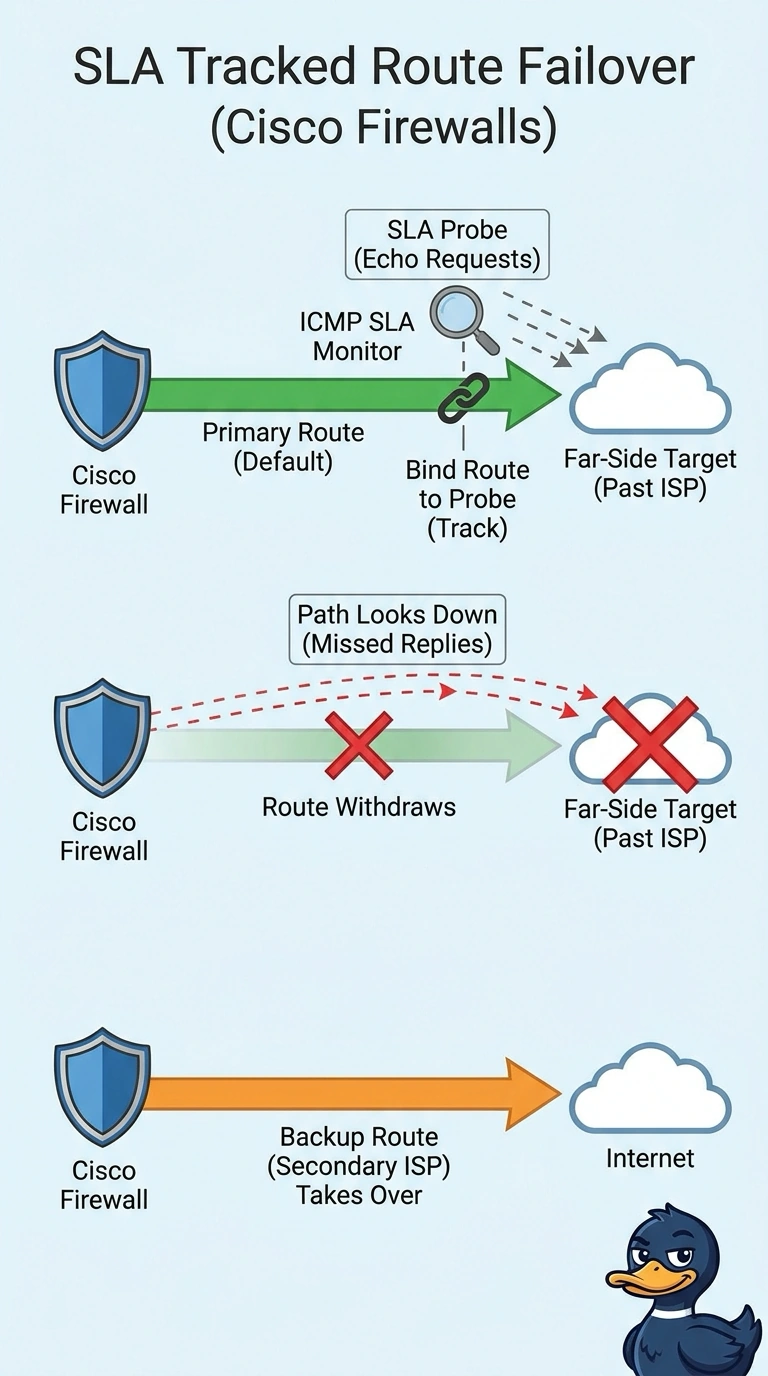
Short Explanation
You need the route to quit when the path quits, since an up cable doesn't prove much. An SLA monitor keeps checking a stable host beyond the ISP and withdraws the route the moment replies stop, like testing that the whole highway is passable instead of just your driveway.
Full Explanation
A static route stays in the routing table for as long as its exit interface is up, so reachability past that interface is never in question. Binding the route to a track object backed by an SLA monitor changes that: the monitor sends echo requests to a chosen target on a fixed interval, and while replies keep arriving the track stays up and the route remains eligible. Once replies stop for the configured failure count, the track goes down, the route is removed, and the floating backup with its higher administrative distance installs immediately. Tracking only the first hop misses upstream trouble, because a healthy router at the ISP edge still answers even when the path behind it is gone, so the probe has to sit beyond the provider. Interface state tracking reacts only to physical and data-link loss, which never occurs in this scenario, while equal-cost sharing simply keeps hashing packets into the black hole. Exam caveat: probe intervals, hold times and consecutive-failure counts vary by release, so memorise the concept rather than the numbers. Practical check: during a change window, block the tracked target on the far side and watch the routing table drop the primary route and install the backup.