
An FTD appliance connects to a campus access switch with two 10 GbE links bundled into one port channel running LACP. Before the design review, the team must state how traffic is actually spread across the member links. Which description of the EtherChannel forwarding behavior is accurate?
Select an answer to reveal the explanation.
Short Explanation
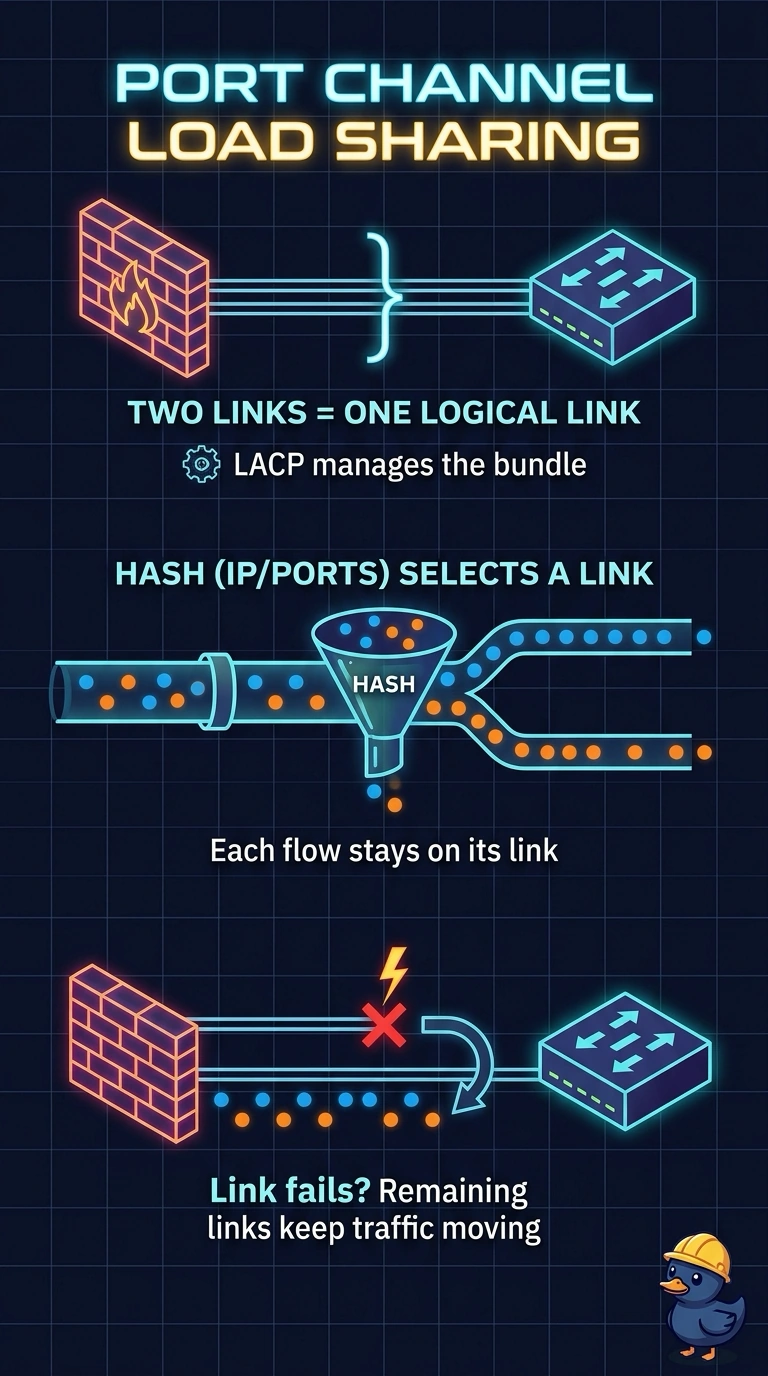
Your bundle passes traffic either way, but load sharing runs per flow, not per packet. The firewall and switch hash addresses and ports to pick one member link for each conversation. Cars pick a lane once at the ramp and stay in it while the next car spreads to another lane.
Full Explanation
An EtherChannel bundles physical interfaces into one logical link. LACP negotiates the bundle and exchanges control messages to maintain member state; forwarding is selected separately by a load-balancing hash that samples packet fields such as source and destination addresses and ports. With flow-based hashing, packets in a conversation use one member link while different conversations can spread across the bundle. A hash can map multiple conversations to the same member, so a few long-lived flows may not use all the links evenly. Keeping one member in standby while another carries everything describes a different active-and-backup design, not the usual forwarding behavior of this configured two-member bundle. Round-robin packet striping is not the flow-based forwarding behavior described here. Spanning Tree blocking one path describes separate, unbundled links; a configured port channel presents as one logical link to Spanning Tree. Exam caveat: hash fields and defaults vary by platform. Practical check: generate traffic from several hosts and compare per-member counters to confirm more than one link is carrying traffic.