
A finance firm's Management Center writes events that lag the SIEM by an offset that stays identical all year, and its own scheduled jobs and certificate validation fail near midnight. The management subnet may reach only the two internal time servers. Which system time configuration should the engineer set?
Select an answer to reveal the explanation.
Short Explanation
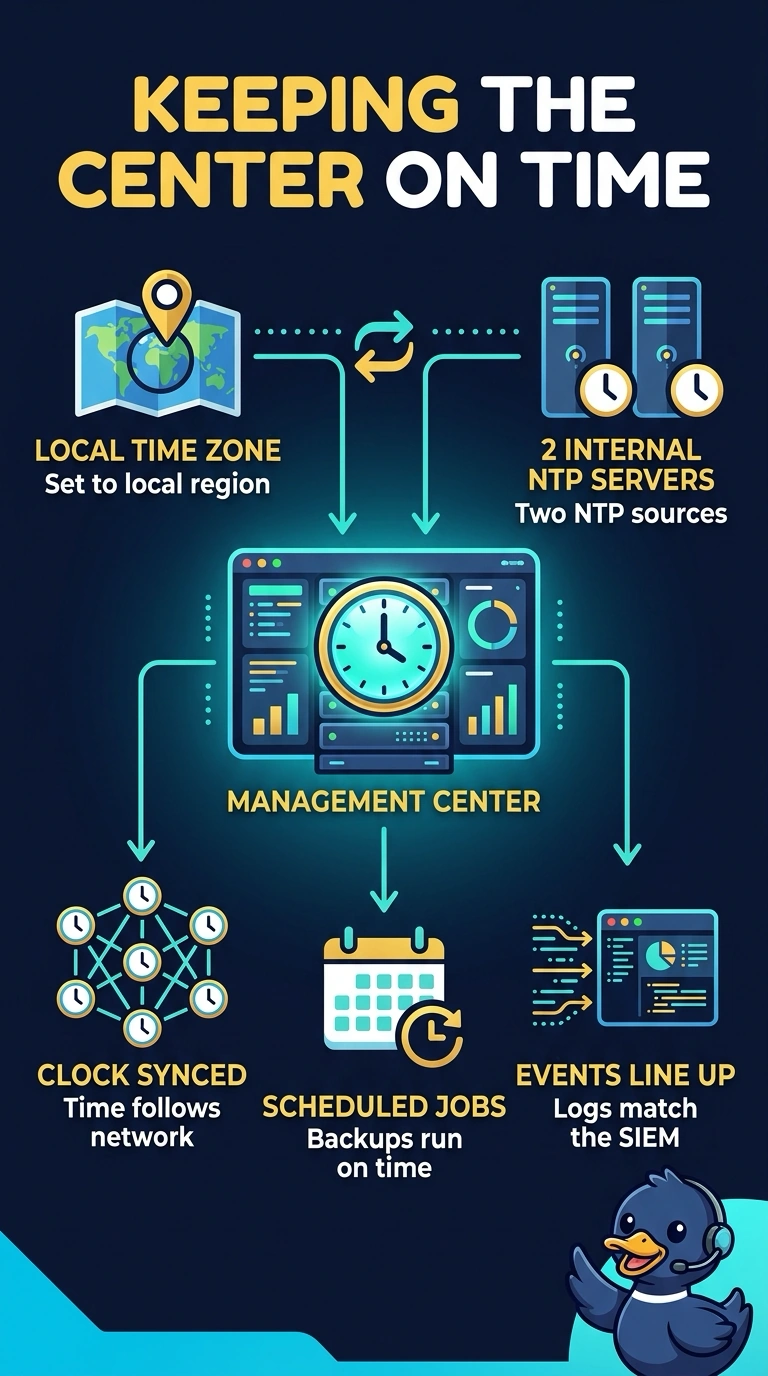
You’ve corrected the clock at its source rather than patching the symptoms. The time zone sets local time, while both internal NTP servers keep the clock synchronized. A certificate validates identity; it cannot correct a clock that is set incorrectly.
Full Explanation
Set the Management Center’s time zone to the firm’s intended local zone and configure both internal NTP servers as its time sources. NTP keeps the clock synchronized, while the time zone determines how timestamps are displayed and how local schedules and certificate validity periods are evaluated. Together, these settings address the persistent event offset and failures near midnight. Using only the primary internal NTP server may keep time accurate, but leaves out the second approved source and reduces resilience if the primary is unavailable. Keeping the Management Center in UTC while using both approved servers synchronizes the clock, but does not set the intended local time zone; local schedules and displayed timestamps may remain misaligned. Using the hypervisor host for automatic clock synchronization does not configure the two internal NTP servers as time sources and may rely on a separate synchronization path. Exam caveat: NTP generally distributes UTC; the time zone controls local display and calendar behavior, so do not shift the clock to compensate for an incorrect time zone. As a practical check, verify the configured time zone and that both internal servers are reachable and selected, then compare event timestamps and scheduled-job behavior around local midnight.