
A regional hospital must run NGIPS inline on its storage network links, where a sustained interruption during an appliance power failure would halt imaging transfers. While the sensor is operational, exploit attempts must be dropped as soon as they match an inspection rule. The team has budgeted fail-open bypass hardware for every link. Which Secure Firewall Threat Defense deployment design satisfies both requirements?
Select an answer to reveal the explanation.
Short Explanation
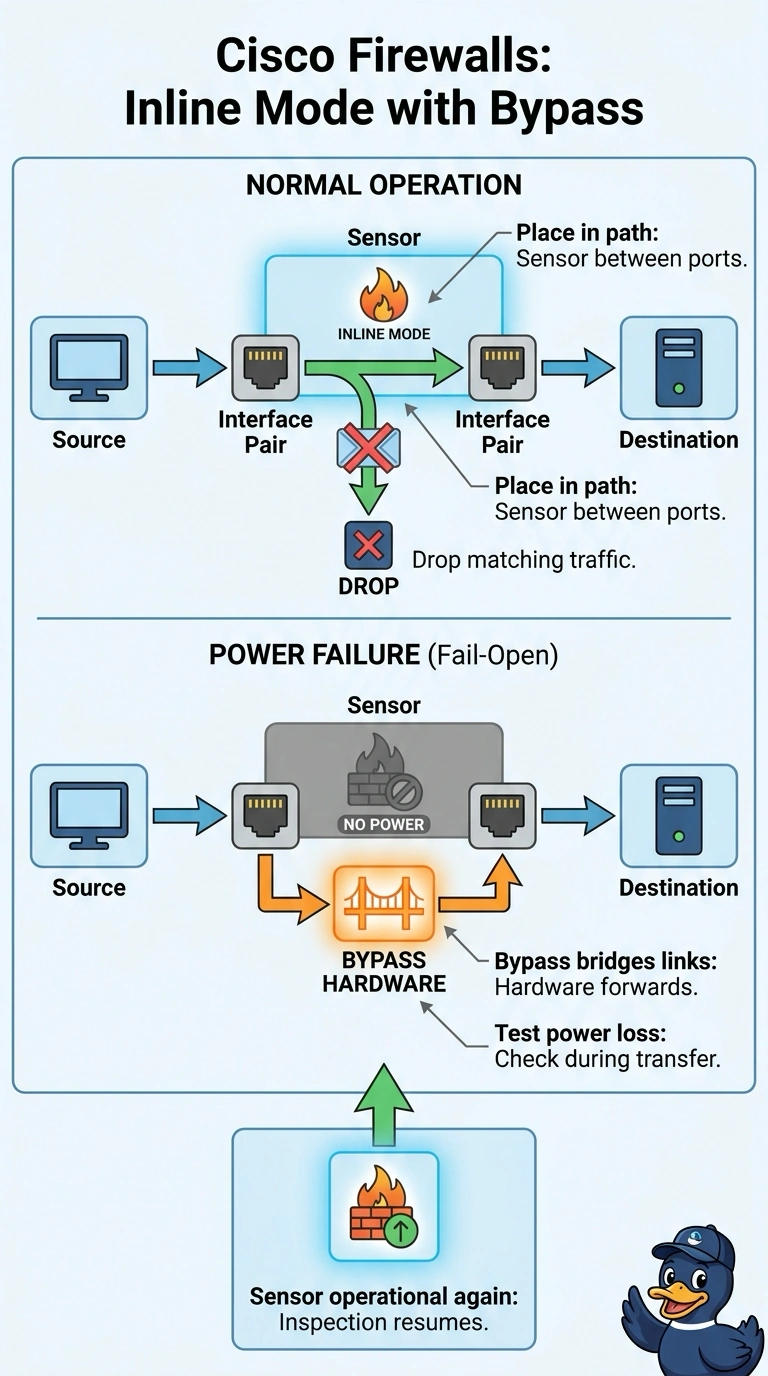
Use inline mode with interface pairs so you drop exploit traffic as soon as it matches an inspection rule. Fail-open bypass hardware keeps traffic flowing if the appliance loses power—the two features work like a bridge that blocks threats while the sensor is up but opens if it fails.
Full Explanation
Inline mode puts the sensor in the forwarding path through interface pairs, allowing a matching inspection rule to drop a packet. The bypass hardware addresses availability during an appliance power failure: it bridges the pair so transfers can continue without inspection, and inspection resumes when the appliance is operational again. Passive mode on taps provides visibility but does not let the sensor drop traffic inline. Inline pairs set to fail closed preserve inspection during a fault but can interrupt transfers. Snort fail open can allow traffic to pass when Snort is unavailable, but it does not replace hardware bypass for an appliance power failure. During bypass, the sensor cannot inspect or drop traffic; the design meets the requirements only while the sensor is operational for enforcement and during the specified power failure for availability.