
A warehouse reports that the label printer protocol on TCP 8899 from 10.20.4.11 to 10.20.9.5 sometimes fails to reach its server, and no spare switch ports can be used for mirroring. Which packet captures should the engineer run to check the data path and traffic to the FTD management interface?
Select an answer to reveal the explanation.
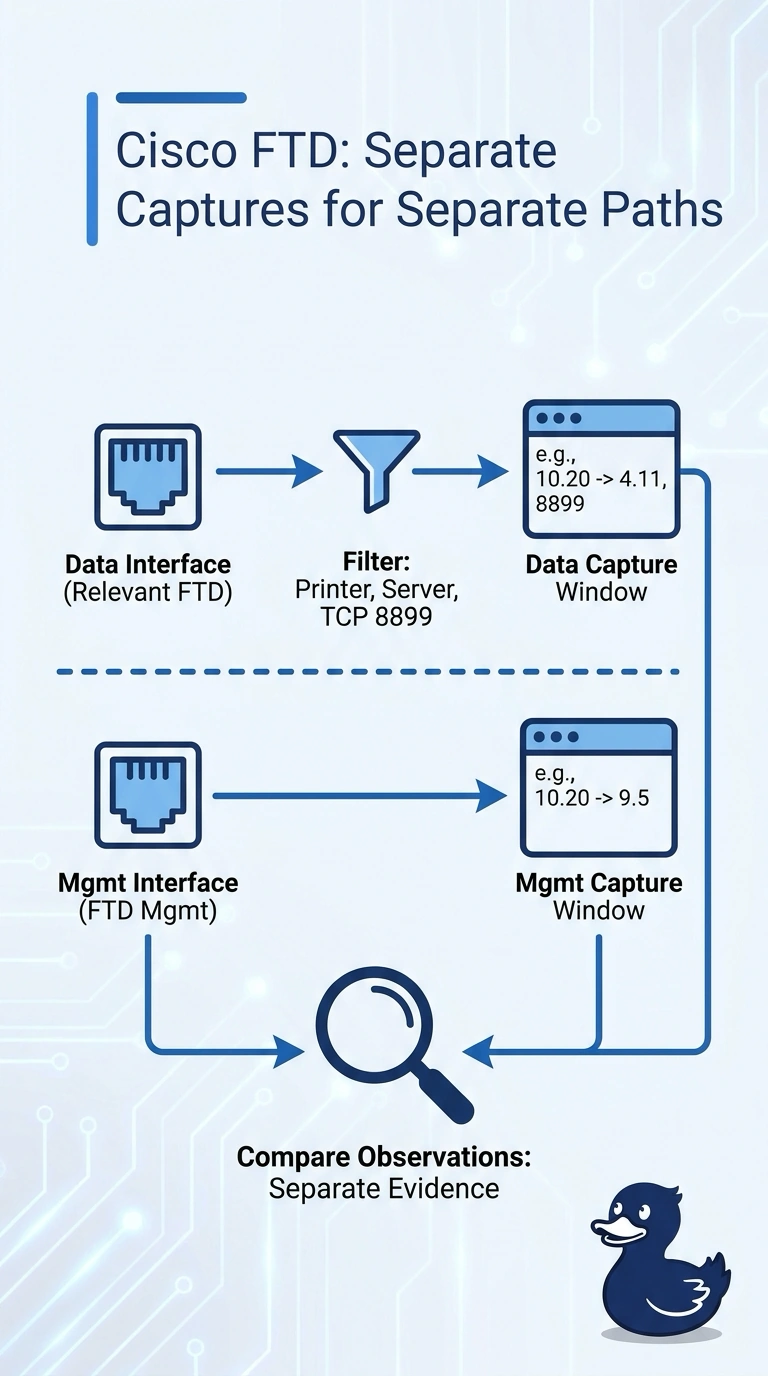
Short Explanation
Run a filtered capture on the relevant FTD data interface or interfaces, then a separate capture on the management interface. You’re checking two routes separately, and keeping each capture focused helps prevent a broad capture from filling its buffer and overwriting earlier packets.
Full Explanation
The correct approach uses filtered captures on the FTD data interface or interfaces that carry the printer-to-server flow, plus a distinct capture on the management interface. This observes packets at the firewall’s data plane while independently checking traffic addressed to or leaving its management plane; the two planes are separate, so a data-interface capture cannot substitute for a management-interface capture. Capturing only ingress and management traffic can miss whether packets leave the FTD on the expected egress interface, so it does not fully check the path through the appliance. Filtering data-interface captures only for packets sourced by the printer omits server replies; a one-way view cannot establish whether the return path is failing. Endpoint captures are useful for confirming what each host sends or receives, but they do not show whether or where the FTD forwards or drops the packets between those hosts. Exam caveat: a capture point sees only traffic traversing that interface and matching its filter, and capture direction or platform syntax can affect what is recorded. Practical check: confirm the FTD interfaces and routing for this flow, then verify the capture filters include both directions of TCP 8899 and that the management capture is configured on the management interface.