
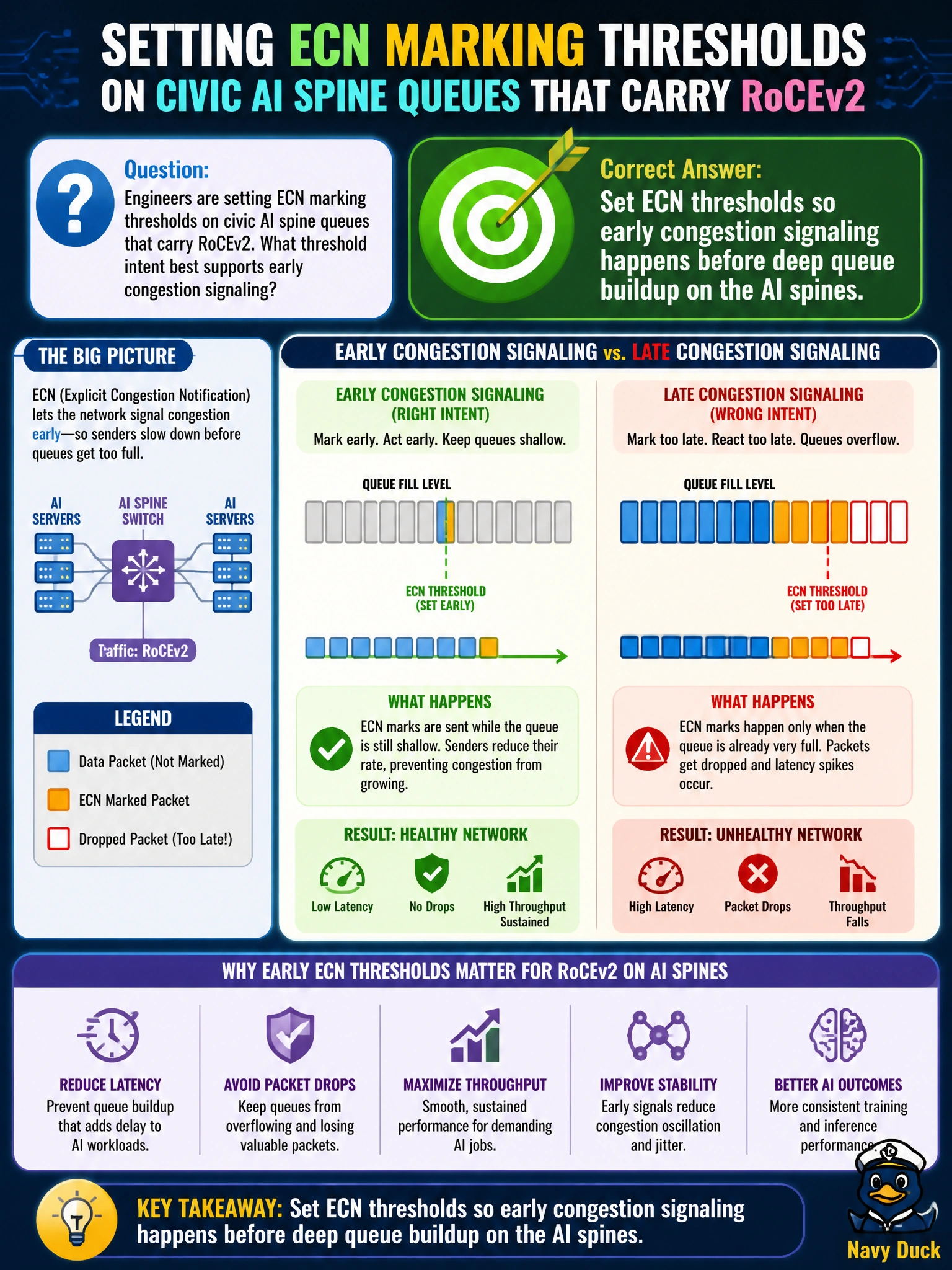
Engineers are setting ECN marking thresholds on civic AI spine queues that carry RoCEv2. What threshold intent best supports early congestion signaling?
Select an answer to reveal the explanation.
Short Explanation
ECN thresholds are the early-warning tripwire—you want the yellow light before the spine queue is already a parking lot. Mark soon enough that RoCEv2 can ease off, not after the buffer is already gasping.
Full Explanation
ECN marking thresholds on civic AI spine queues that carry RoCEv2 should be set so early congestion signaling happens before deep queue buildup. The intent is a yellow-light tripwire: mark soon enough that endpoints can ease off while latency and buffer headroom remain usable, rather than waiting until the spine queue is already saturated. Waiting to signal until after PFC pause activates means marking starts only after lossless backpressure has already fired, leaving RoCEv2 with no early signal and forcing pause to absorb congestion that ECN should have eased earlier. Signaling with WRED drops during bursts means marking coincides with discards instead of preceding them, losing the early warning and imposing drops on a lossless RoCEv2 fabric where ECN should trigger endpoint slowdown before packets are lost. Waiting to signal until shared buffer exhaustion means marking starts only when shared buffers are already depleted, which burns headroom during large AI collective bursts instead of giving endpoints an early signal to slow down. Exam caveat: "early" still must be high enough to avoid marking on trivial bursts—validate thresholds with representative trainer loads, not idle fabric. Operational check: configure ECN thresholds on AI spine queues for early marking, generate controlled RoCEv2 load, confirm CE marks appear before deep queue saturation, and verify GPU endpoints reduce rate without waiting for buffer exhaustion on the civic spines.
Prefer to study offline? Printable PDF study book + test engine ($7.50, unofficial). These questions stay free here.