
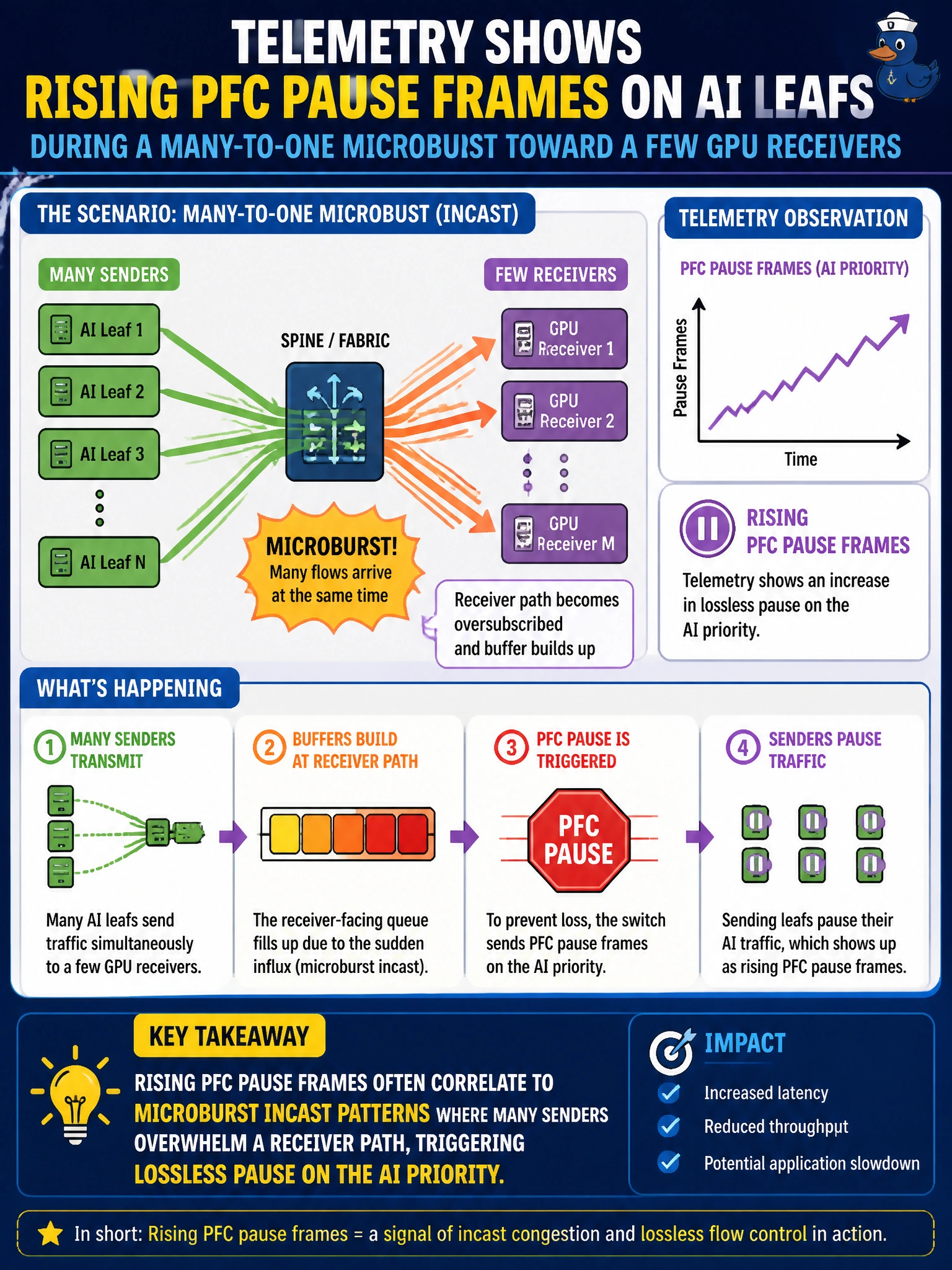
Telemetry shows rising PFC pause frames on AI leafs during a many-to-one microburst toward a few GPU receivers. What is the most accurate interpretation?
Select an answer to reveal the explanation.
Short Explanation
Lots of trainers yelling into one GPU doorway causes a microburst incast—and PFC pause counters climb because the lossless class is telling senders to hold. That's a congestion pattern to understand, not proof that buffers are soaking up the burst to keep line-rate moving; it means the receiver is holding senders back, not that headroom is growing.
Full Explanation
Rising PFC pause frames on AI leafs during a many-to-one microburst toward a few GPU receivers most accurately indicate an incast congestion pattern: many senders overwhelm a receiver path and the lossless AI priority pauses ingress rather than dropping. Pause counters climbing in that scenario are not ECN marking feedback throttling RoCEv2 senders; they are link-level PFC pause frames from the congested receiver priority, while ECN is a separate end-to-end congestion signal. Reading any single pause-counter increment as ECN feedback throttling RoCEv2 senders confuses hop-by-hop PFC backpressure with end-to-end ECN marking; the pause reflects receiver-path incast, not ECN throttle of the senders. Treating rising pause frames as proof of growing ingress buffer headroom absorbing microburst incast to sustain line-rate throughput gets the signal backward; the frames show the receiver priority is congested and pausing ingress, not that headroom is expanding to keep traffic flowing. Claiming rising PFC pause frames track lossless priority re-mapping across leaf uplinks balancing RoCEv2 flows confuses hop-by-hop pause with a re-mapping or load-balancing function; PFC pause is per-priority link-level flow control, not a mechanism for balancing fan-in collective bursts across uplinks. Exam caveat: chronic or deadlock-like pause without recovery is a problem—distinguish healthy brief pause under microburst from stuck pause loops that need watchdog attention. Operational check: correlate rising pause counters with many-to-one fan-in toward few GPU receivers, inspect queue and ECN marks on that path, tune thresholds or fan-in patterns as needed, and disable PFC only if analysis shows misconfiguration—not merely because counters incremented.
Prefer to study offline? Printable PDF study book + test engine ($7.50, unofficial). These questions stay free here.