
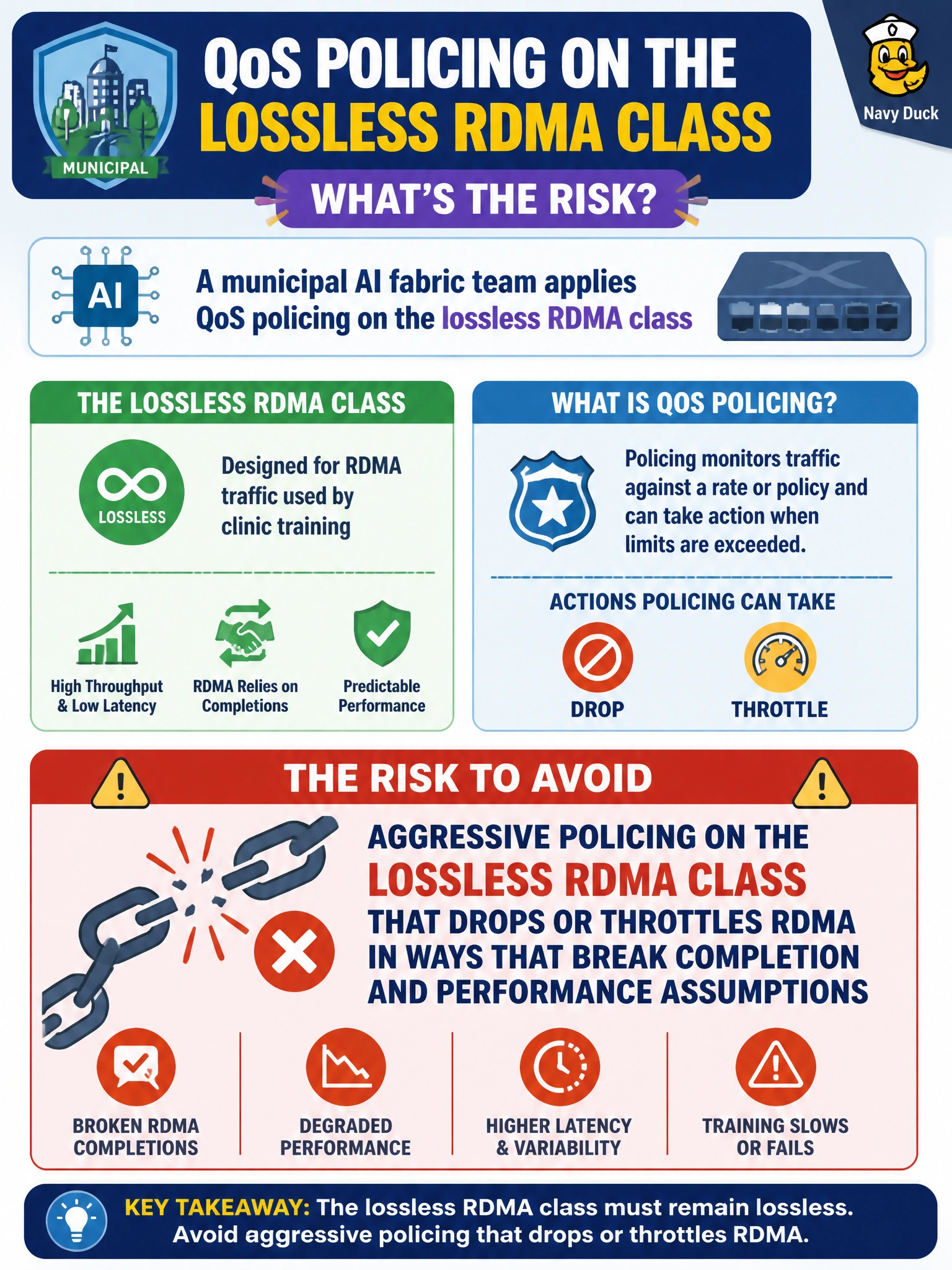
A municipal AI fabric team applies QoS policing on the lossless RDMA class used by clinic training. Which risk should they avoid?
Select an answer to reveal the explanation.
Short Explanation
Policing the lossless RDMA class is like putting a speed bump on the ambulance lane. RDMA hates surprise drops and throttles that break its completion model. You'll spot the fakes because RDMA doesn't need TCP reassembly, its ACKs don't deliver syslog, and it doesn't recover with TCP slow-start.
Full Explanation
On a municipal AI fabric that carries clinic training RDMA, QoS policing on the lossless RDMA class is a high-risk control. Aggressive policing that drops or hard-throttles that class can violate RDMA completion, latency, and retransmission assumptions that RoCE workloads rely on. Domain 3.1.c expects QoS tooling to protect AI RDMA classes—PFC, ECN, and carefully sized ETS shares—rather than treating the lossless training class like best-effort IP that can be bluntly rate-limited. Aggressive policing on the lossless RDMA class that fragments RDMA payloads in ways that force TCP reassembly and checksum recovery delays, aggressive policing on the lossless RDMA class that throttles RDMA acknowledgments in ways that delay syslog delivery and obscure telemetry visibility, or aggressive policing on the lossless RDMA class that rate-limits RDMA flows in ways that trigger TCP slow-start recovery for bulk backup transfers misstate the failure; RoCE RDMA bypasses TCP segmentation/reassembly and slow-start, policers drop rather than fragment, and syslog/telemetry travel in a separate best-effort class, so none captures the true completion and performance risk to the clinic all-reduce path. The distractors that invoke RDMA fragmentation forcing TCP reassembly, RDMA-acknowledgment throttling delaying syslog, or RDMA rate-limiting triggering TCP slow-start for backups are transport-confused and do not state the RDMA-completion risk the stem asks you to avoid. Exam caveat: light shaping or admission control at the edge of an AI class may still appear in vendor designs, but exam intent treats aggressive drop/throttle policing on the lossless RDMA class as the failure mode to refuse. Operational check: before any police statement touches the clinic RDMA class, review class-maps and policy-maps for drop/police actions on that CoS/DSCP, confirm PFC/ECN remain enabled for RDMA, discard answers that confuse the impact with TCP fragmentation/reassembly, syslog delivery via RDMA ACKs, or TCP slow-start for backups, and validate all-reduce completion times and pause/drop counters during a controlled training run.
Prefer to study offline? Printable PDF study book + test engine ($7.50, unofficial). These questions stay free here.