
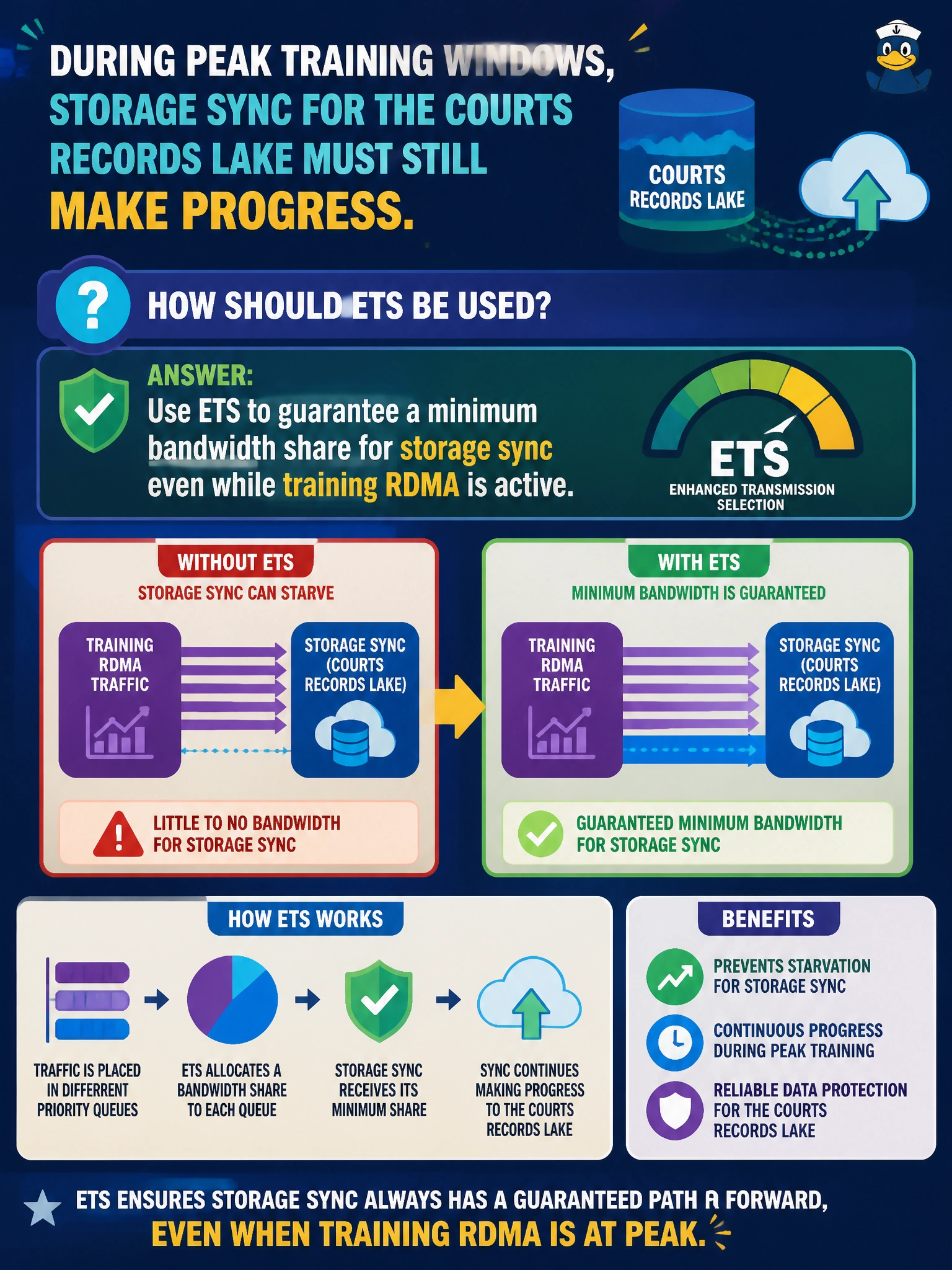
During peak training windows, storage sync for the courts records lake must still make progress. How should ETS be used?
Select an answer to reveal the explanation.
Short Explanation
Trainers can be hungry without locking the pantry. You'll still guarantee storage sync its own minimum slice so the courts lake keeps moving — not by pooling its guarantee with training RDMA, not by letting training borrow it when congested, and not by trying to guarantee it with ECN on the training queues.
Full Explanation
During peak training windows, storage sync for the courts records lake must still make progress. ETS should guarantee a minimum bandwidth share for storage sync even while training RDMA is active, so trainers get strong treatment without locking storage out entirely on shared municipal uplinks. Using ETS to guarantee a shared minimum bandwidth pool for storage sync with training RDMA combined leaves no dedicated protection for storage sync, so peak training RDMA can consume the combined pool and stall sync, violating the requirement that sync must still make progress. Configuring ETS weights to guarantee storage sync a minimum share that training RDMA may borrow when congested defeats the guarantee when it matters most, because during peak training congestion RDMA would take storage's share and storage sync would stall instead of maintaining progress. Using ETS to guarantee storage sync bandwidth by enabling ECN marking on training RDMA queues confuses ETS bandwidth scheduling with congestion notification, since ECN only signals RDMA senders to slow and does not provide storage sync a scheduled minimum share, so it fails to ensure progress on shared uplinks. Exam caveat: a dedicated minimum share for storage is not the same as a shared minimum pool combined with training RDMA—keep guarantees separate and use ETS bandwidth guarantees. Operational check: configure an ETS minimum for courts storage sync alongside the training RDMA class, run peak training plus sync, and verify storage throughput stays at or above the guaranteed share while RDMA retains its protected treatment.
Prefer to study offline? Printable PDF study book + test engine ($7.50, unofficial). These questions stay free here.