
Trainers use PFC-enabled priorities on Nexus leaves. How should queuing policy relate to those lossless AI classes?
Select an answer to reveal the explanation.
Short Explanation
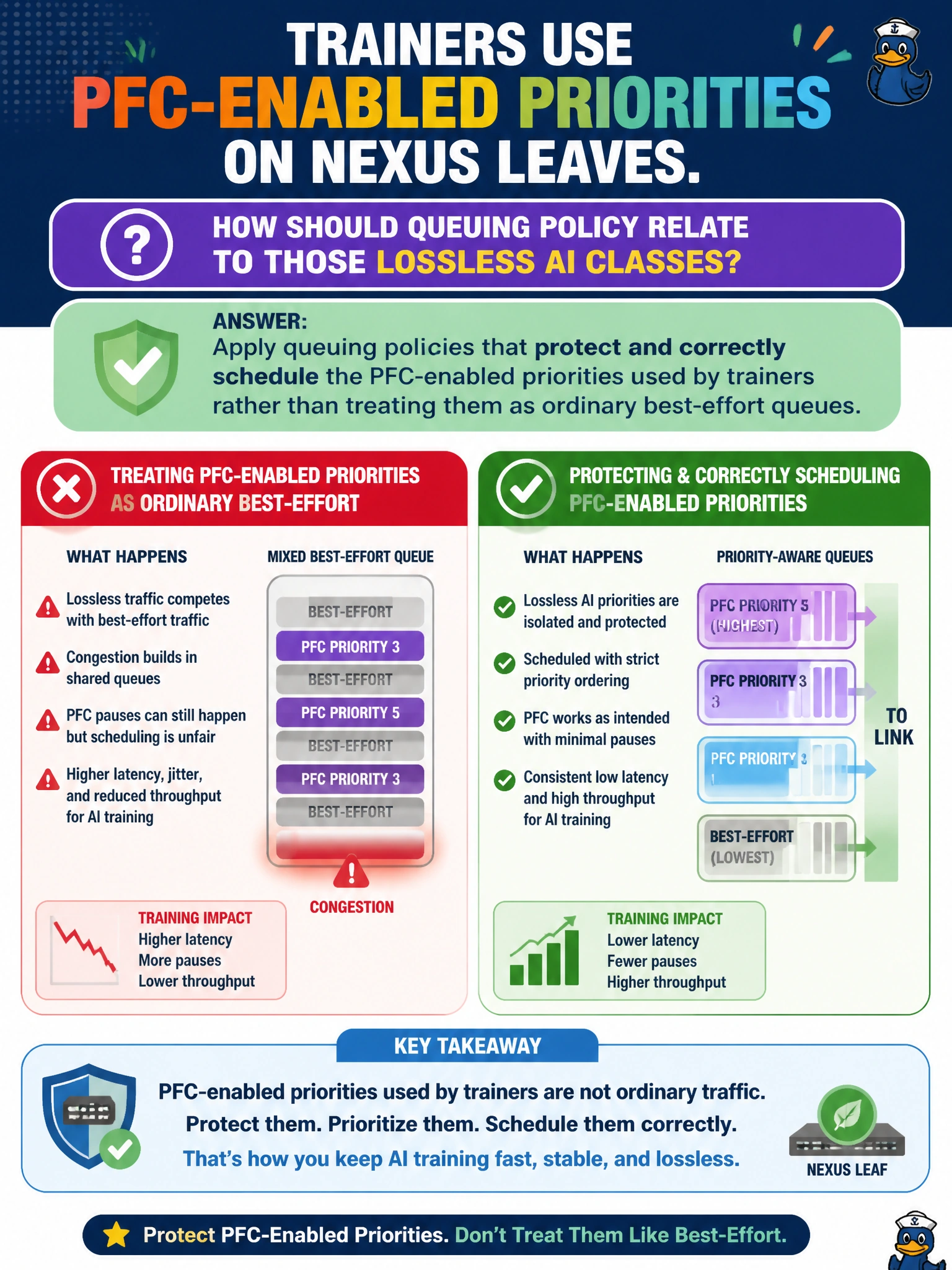
PFC says "don't drop this class," but queues still need the right scheduling so those lossless trainer priorities aren't buried under junk. Give those PFC classes real protection in your queuing policy — you'll still drop packets if you keep tail-drop thresholds on a lossless queue, even with guaranteed DWRR and tuned no-drop buffers.
Full Explanation
When trainers use PFC-enabled priorities on Nexus leaves, queuing policy must protect and correctly schedule those lossless AI classes rather than treating them as ordinary best-effort queues. PFC prevents drops on the priority, but scheduling and bandwidth treatment still determine whether that class is served promptly amid other civic traffic. Configuring strict-priority scheduling with tuned no-drop buffers for the PFC-enabled classes used by trainers to minimize communication latency during training fails because unbounded strict priority can starve other municipal traffic; tuned buffers support no-drop behavior but do not justify strict priority over everything, and lossless AI classes need protected bandwidth shares with correct scheduling. Reserving guaranteed DWRR bandwidth with tuned no-drop buffers for the PFC-enabled priorities used by trainers while retaining tail-drop thresholds for congestion control defeats lossless intent; tail-drop still permits drops on a no-drop PFC priority where pause should prevent loss, so the reservation and buffers do not make the class truly lossless. Enabling tuned ECN thresholds with dedicated ingress buffers for the PFC-enabled queues used by trainers to deliver lossless transport using sender rate control confuses ECN with PFC; ECN only marks congestion to trigger sender rate reduction and dedicated buffers do not make it no-drop, whereas PFC-enabled priorities require pause-based lossless behavior. Exam caveat: protect PFC classes without necessarily giving them unbounded strict priority with tuned no-drop buffers to minimize latency over all other municipal traffic—combine correct lossless treatment with sensible bandwidth shares. Operational check: identify PFC-enabled Cos on Nexus leaves, ensure queuing policies schedule those classes appropriately (not strict-priority with tuned no-drop buffers to minimize latency, not guaranteed DWRR with tuned no-drop buffers while retaining tail-drop thresholds, not tuned ECN thresholds with dedicated buffers as lossless via sender rate control), and validate under mixed load that trainer priorities are served without unexpected drops on the lossless Cos.
Prefer to study offline? Printable PDF study book + test engine ($7.50, unofficial). These questions stay free here.