
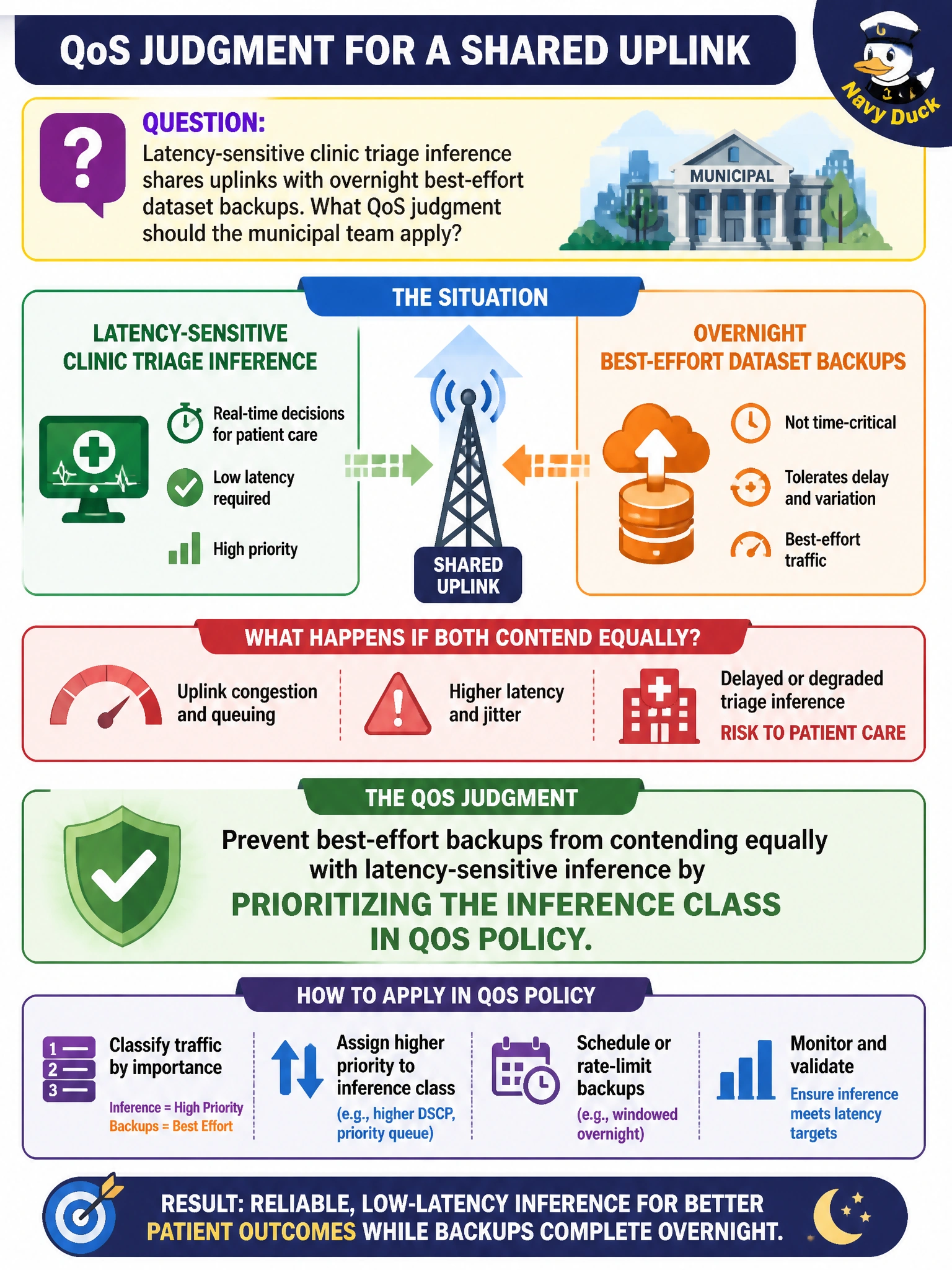
Latency-sensitive clinic triage inference shares uplinks with overnight best-effort dataset backups. What QoS judgment should the municipal team apply?
Select an answer to reveal the explanation.
Short Explanation
Backups can wait; a triage score in a clinic kiosk can't. QoS should keep best-effort backup trucks out of the fast lane so inference stays snappy when both hit the same uplink.
Full Explanation
Latency-sensitive clinic triage inference sharing uplinks with overnight best-effort dataset backups requires QoS that prevents backups from contending equally with inference. Prioritizing the inference class (and treating backups as best-effort with lower scheduling preference) keeps triage responses snappy when both workloads hit the same municipal uplinks. Prioritizing latency-sensitive inference by shaping the inference class to a capped rate while allowing backups to burst inverts the intended preference by throttling triage traffic and letting bulk backups burst into the shared uplink, which can delay clinical decision support during backup windows. Prioritizing latency-sensitive inference by honoring endpoint DSCP markings at the access edge for uplink scheduling decisions trusts untrusted endpoint markings instead of enforcing trusted classification, so mis-marked backup traffic can gain unintended scheduling preference on the uplink. Prioritizing latency-sensitive inference by applying low-latency queuing inbound on LAN access ports for uplink contention applies the mechanism in the wrong direction and location, because shared-uplink contention is resolved by outbound scheduling on the uplink egress, not by inbound queuing on access ingress. Exam caveat: prioritizing inference does not require placing backups in a lossless PFC class—keep backups best-effort and sized so they still complete overnight without owning the uplink. Operational check: classify triage inference above best-effort backups on shared uplinks, run a concurrent backup-plus-inference test, and confirm inference latency stays within clinic targets while backup throughput remains nonzero but subordinate.
Prefer to study offline? Printable PDF study book + test engine ($7.50, unofficial). These questions stay free here.