
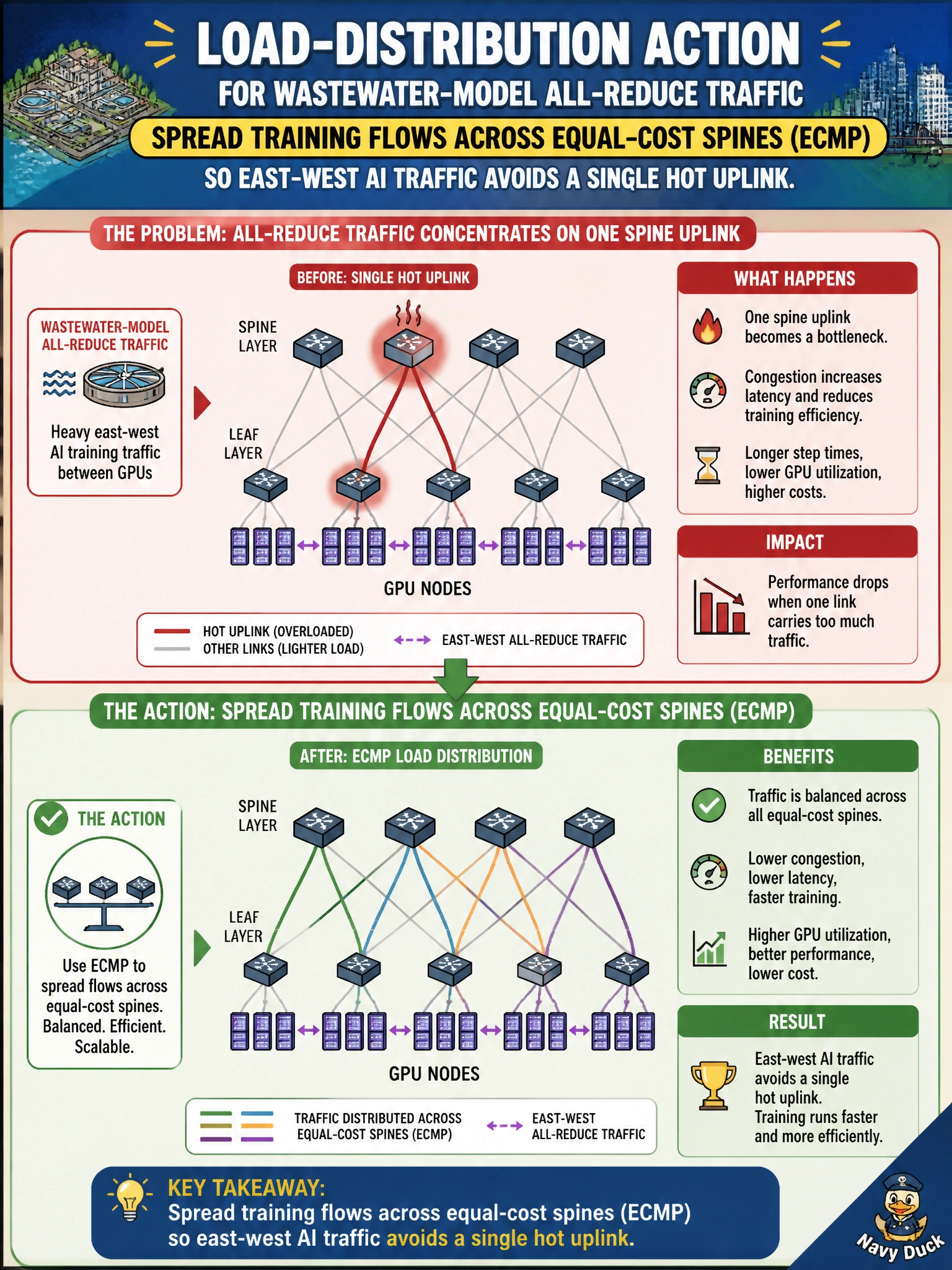
Wastewater-model all-reduce traffic concentrates on one spine uplink during peak training. What load-distribution action should the municipal fabric team take?
Select an answer to reveal the explanation.
Short Explanation
Collectives don't mind taking different paths as long as the load spreads evenly. When all-reduce traffic concentrates, use full ECMP so spines share the burden, not just a few lucky ports.
Full Explanation
Wastewater-model all-reduce traffic concentrates on one spine uplink during peak collective operations. Full ECMP across all available spines spreads the training-flow load so no single path becomes a bottleneck and each spine carries its fair share of the all-reduce. Programming uniform ECMP hash seeds across leaf switches keeps path selection consistent, but that uniformity can hash many training flows onto the same spine, leaving the hot uplink unchanged and failing to spread the all-reduce load. Applying strict priority queuing for all-reduce traffic on congested uplinks only changes which packets get sent first on the same hot link; it does not spread traffic across additional spines, so the single congested uplink remains the bottleneck. Enabling Spanning Tree Protocol between leaf and spine layers blocks redundant links to prevent loops, so it cannot actively use all available spines for forwarding and may leave the congested uplink carrying the collective traffic alone. Exam caveat: ECMP hashing must properly distribute all-reduce frames across spines; poor hash entropy that maps all flows to one spine defeats the load distribution ECMP offers. Operational check: enable ECMP to all spines from the GPU leaf, run a live all-reduce collective, and show that spine uplinks carry roughly equal traffic rather than one spine at saturation.
Prefer to study offline? Printable PDF study book + test engine ($7.50, unofficial). These questions stay free here.