
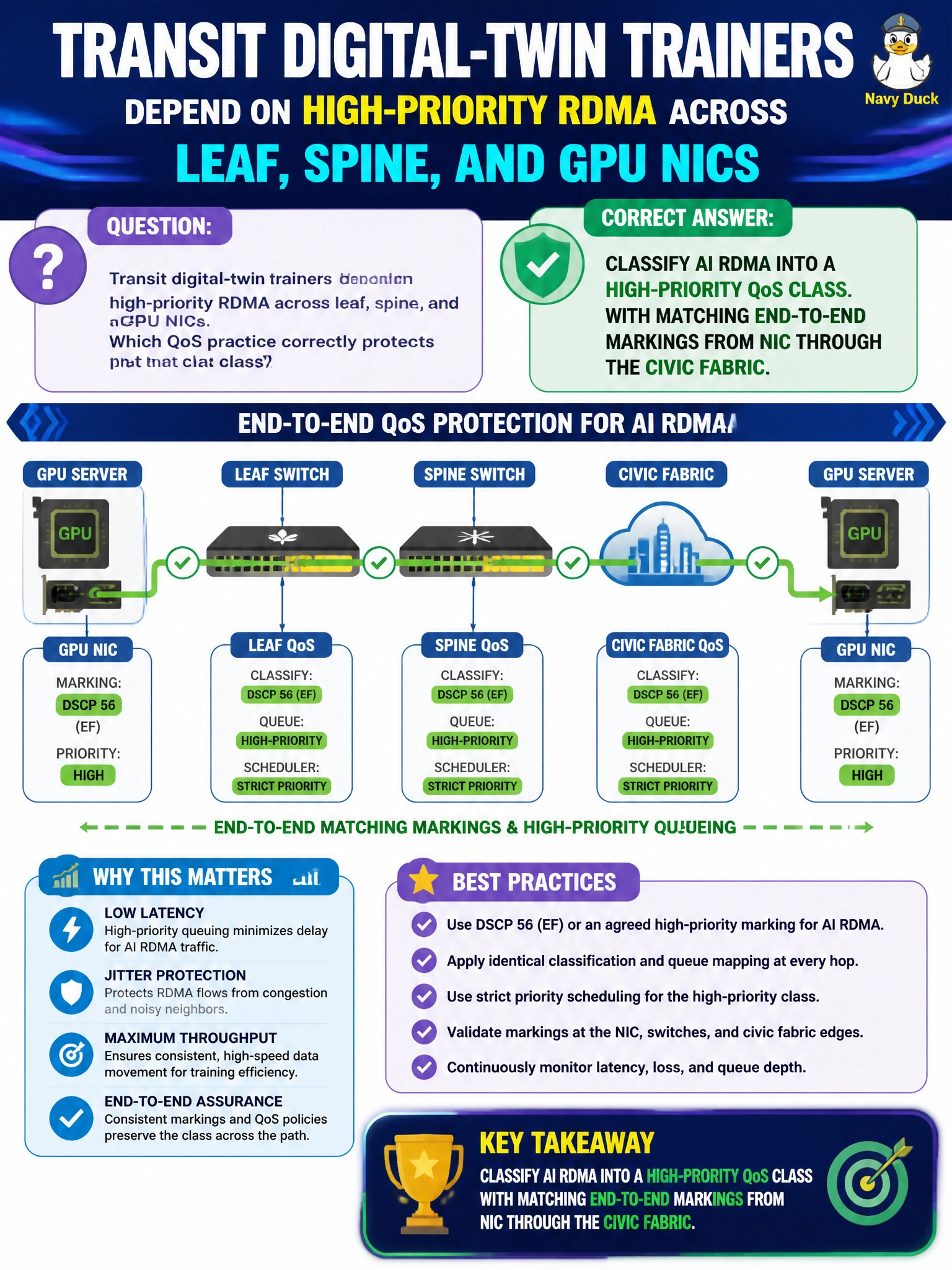
Transit digital-twin trainers depend on high-priority RDMA across leaf, spine, and GPU NICs. Which QoS practice correctly protects that class?
Select an answer to reveal the explanation.
Short Explanation
Priority only works if every hop tells the same story. Put RDMA in a high-priority class and keep the markings consistent from GPU NIC to leaf to spine—trusting NIC markings at the leaf won't save it if you map RDMA into the default data queue for east-west flows.
Full Explanation
Transit digital-twin trainers that depend on high-priority RDMA need classification into a high-priority QoS class with matching end-to-end markings from the GPU NIC through leaf and spine on the civic fabric. Priority only works when every hop honors the same Cos/DSCP story; inconsistent marking lets intermediate devices treat RDMA as ordinary traffic and defeats the protection the trainers require. Trusting NIC DSCP markings at leaf ingress while mapping RDMA into the default data queue for east-west flows still exposes the class to drops—RDMA needs lossless, dedicated treatment, and the default data queue treats it as best-effort contention even when the markings are trusted, so the digital-twin trainers are left unprotected. Classifying RDMA by UDP port into a priority class while applying WRED profiles for congestion handling on the spines defeats the purpose—WRED is designed to discard packets during congestion, which directly threatens the lossless behavior RDMA trainers require. Honoring NIC priority markings end to end is not enough while enabling PFC on a converged queue for storage and RDMA traffic—storage can trigger pauses or head-of-line blocking that starves RDMA, and the AI class needs its own lossless queue rather than a shared converged queue. Exam caveat: end-to-end means NIC, leaf, spine, and peer NIC—trust-boundary remark policies must preserve the AI class, not flatten it. Operational check: capture markings at NIC egress and at each civic hop for a digital-twin RDMA flow, confirm the high-priority class is unchanged across the path, and verify queuing counters increment on the intended AI class rather than best-effort.
Prefer to study offline? Printable PDF study book + test engine ($7.50, unofficial). These questions stay free here.