
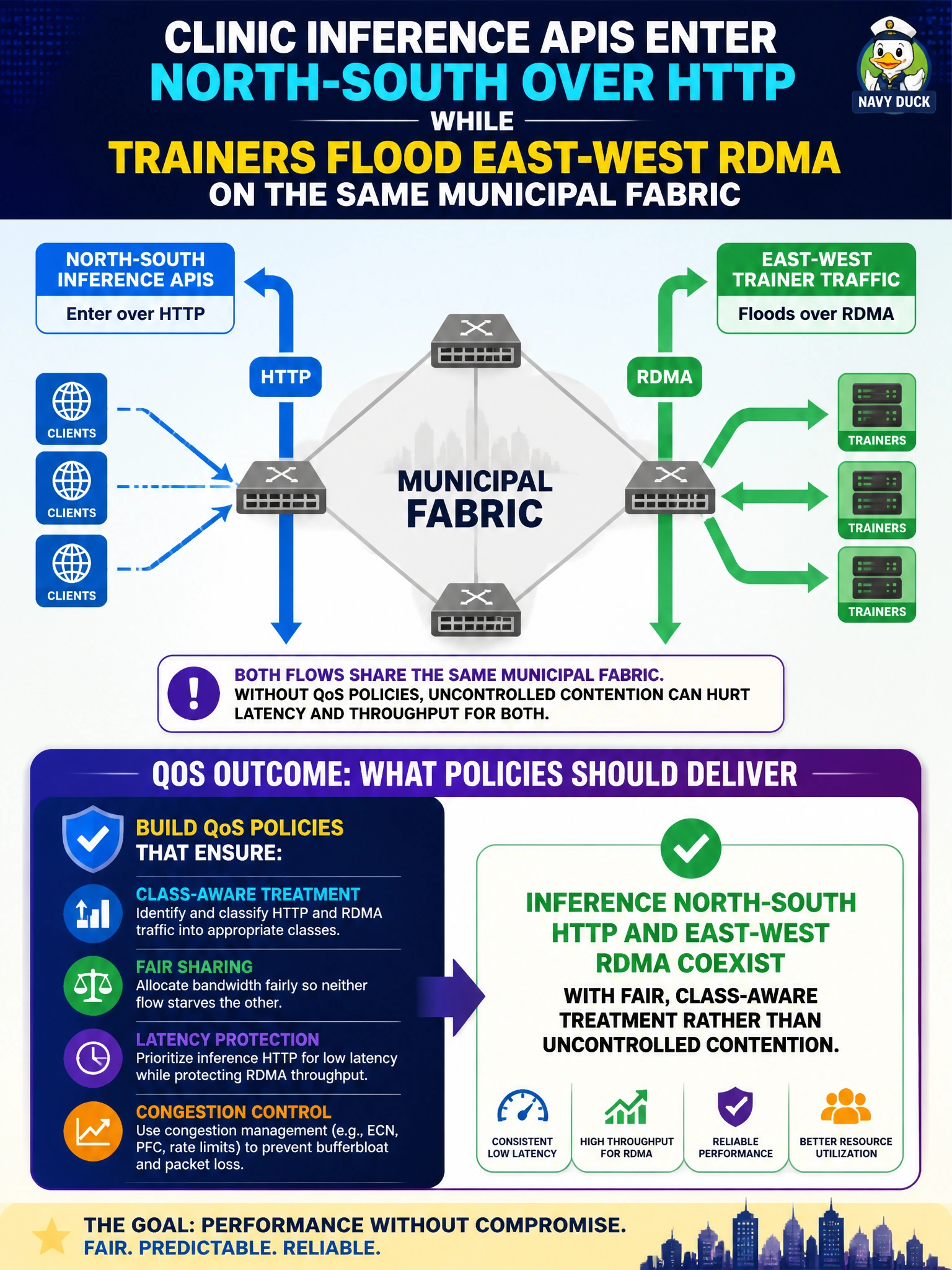
Clinic inference APIs enter north-south over HTTP while trainers flood east-west RDMA on the same municipal fabric. What QoS outcome should policies deliver?
Select an answer to reveal the explanation.
Short Explanation
HTTP clinic calls and RDMA trainers are different animals sharing one zoo. Good QoS keeps both fed—class-aware shares—so one burst doesn't trample the other into silence.
Full Explanation
Clinic inference APIs arriving north-south over HTTP and trainers flooding east-west RDMA share the same municipal fabric but have different latency and loss profiles. The QoS outcome policies should deliver is coexistence with fair, class-aware treatment so neither workload window silently destroys the other through uncontrolled contention. Class-aware shares and scheduling let civic clinics keep answering while trainers still get protected RDMA behavior. Shaping QoS classes so north-south HTTP inference and east-west RDMA training share lossless PFC queues for consistent fair delivery under contention fails because PFC lossless service is intended for RDMA, and placing loss-tolerant HTTP in the same paused queues causes pause propagation, head-of-line blocking, and buffer exhaustion that harms both clinic responsiveness and training stability. Assigning distinct DSCP markings for HTTP inference and RDMA training but servicing both from a common best-effort queue provides no class-aware protection, because markings without separate queues and scheduling leave both workloads contending in one queue with uncontrolled contention rather than fair treatment. Tuning ECN thresholds and DCQCN response for east-west RDMA training and extending coupled thresholds to north-south HTTP does not create coherent fair congestion signals, because DCQCN is an RDMA-specific control loop that HTTP TCP congestion control does not follow, so coupled tuning cannot replace fabric-level class-aware queuing and scheduling. Exam caveat: "fair" does not mean identical shares—RDMA may still need lossless Cos and stronger protection than HTTP, while inference still needs a non-starved minimum. Operational check: define distinct classes for north-south clinic HTTP and east-west RDMA, apply coexistence policies under concurrent load, and verify inference latency and RDMA progress both remain within municipal service targets.
Prefer to study offline? Printable PDF study book + test engine ($7.50, unofficial). These questions stay free here.