
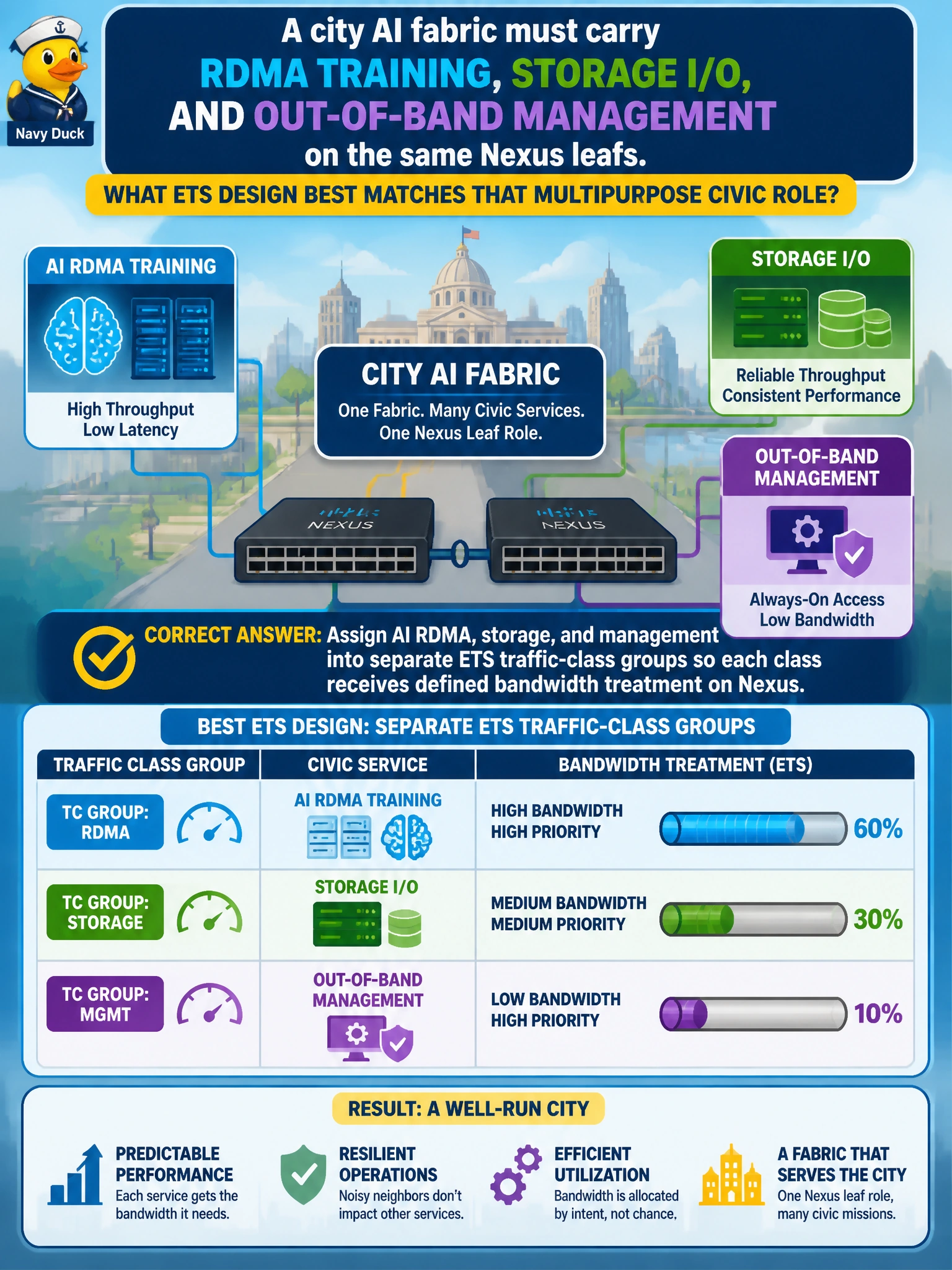
A city AI fabric must carry RDMA training, storage I/O, and out-of-band management on the same Nexus leafs. What ETS design best matches that multipurpose civic role?
Select an answer to reveal the explanation.
Short Explanation
You don't want RDMA sitting on strict priority, since it'll starve storage and management and you'll lose the defined bandwidth treatment ETS gives each class. Separate ETS groups for RDMA, storage, and management let Nexus treat each class with its own bandwidth story.
Full Explanation
A multipurpose city AI fabric on the same Nexus leafs must carry RDMA training, storage I/O, and out-of-band management as distinct traffic classes. The ETS design that matches that civic role assigns each into separate ETS traffic-class groups so Nexus can apply defined bandwidth treatment per class rather than letting one role crowd out the others. Separation is what makes concurrent municipal workloads operable on shared leaf uplinks. Placing AI RDMA and storage in a shared lossless ETS group with PFC while giving management defined bandwidth treatment still merges RDMA and storage into one queue, so storage congestion that triggers PFC pauses will stall RDMA training and the two roles never receive separate defined bandwidth shares. Mapping AI RDMA, storage, and management to separate classes with RDMA on strict priority instead of ETS bandwidth shares lets RDMA bursts starve storage and management during training, so the fabric loses the defined bandwidth treatment per class that the multipurpose civic role requires. Assigning AI RDMA, storage, and management into separate ETS groups with PFC enabled for lossless treatment on three classes makes even management lossless, so management pauses can propagate unnecessarily and waste Nexus buffers when management only needs defined bandwidth treatment, not PFC-driven no-drop behavior. Exam caveat: separate ETS groups still require correct classification and marking into those groups; empty or mis-mapped classes do not protect RDMA merely because the group names exist in the policy. Operational check: document Cos-to-ETS mappings for RDMA, storage, and management on Nexus leafs, apply non-overlapping bandwidth shares, and validate under mixed load that each civic class receives its defined treatment.
Prefer to study offline? Printable PDF study book + test engine ($7.50, unofficial). These questions stay free here.