
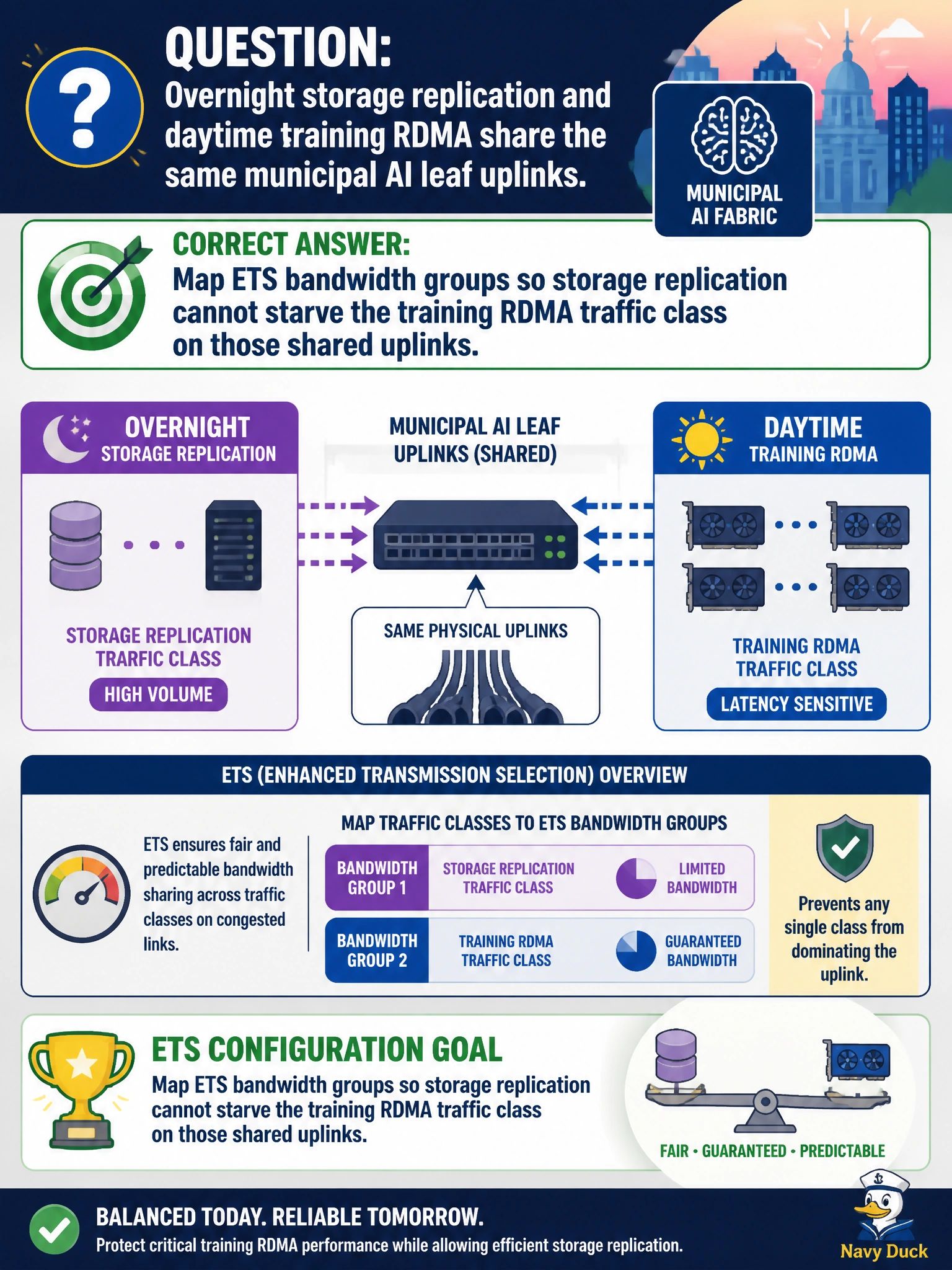
Overnight storage replication and daytime training RDMA share the same municipal AI leaf uplinks. Which ETS configuration goal should the fabric team enforce?
Select an answer to reveal the explanation.
Short Explanation
Shared uplinks are like one freeway with HOV and regular lanes. ETS sets how much bandwidth each class gets so overnight storage trucks don't flatten the training RDMA lane when both run.
Full Explanation
Enhanced Transmission Selection (ETS) allocates bandwidth among traffic-class groups so shared links can protect one class from another. When overnight storage replication and daytime training RDMA share municipal AI leaf uplinks, the configuration goal is to map ETS bandwidth groups so storage cannot starve the training RDMA class on those uplinks. Defined shares keep public-sector trainers progressing even when replication windows overlap training. Assigning ETS strict priority to the storage replication traffic class would let backup flows preempt daytime training RDMA on shared uplinks, starving the very class that needs protected bandwidth. Adjusting ETS bandwidth shares using daytime ECN telemetry to proportionally balance storage replication with training RDMA throughput is reactive and does not guarantee RDMA retains a protected minimum share when replication and training overlap. Enabling PFC on the storage replication traffic class gives backup flows lossless transport but provides no bandwidth separation; it can still allow storage to saturate the uplink and introduce head-of-line blocking that hurts training RDMA. Exam caveat: ETS shares are not a substitute for correct Cos classification—storage and RDMA must first be in distinct classes, then given appropriate minimum/maximum bandwidth treatment. Operational check: place storage and training RDMA in separate ETS groups on the shared AI leaf uplinks, run concurrent replication and training, and verify RDMA retains its configured share while storage is limited from starving that class.
Prefer to study offline? Printable PDF study book + test engine ($7.50, unofficial). These questions stay free here.