
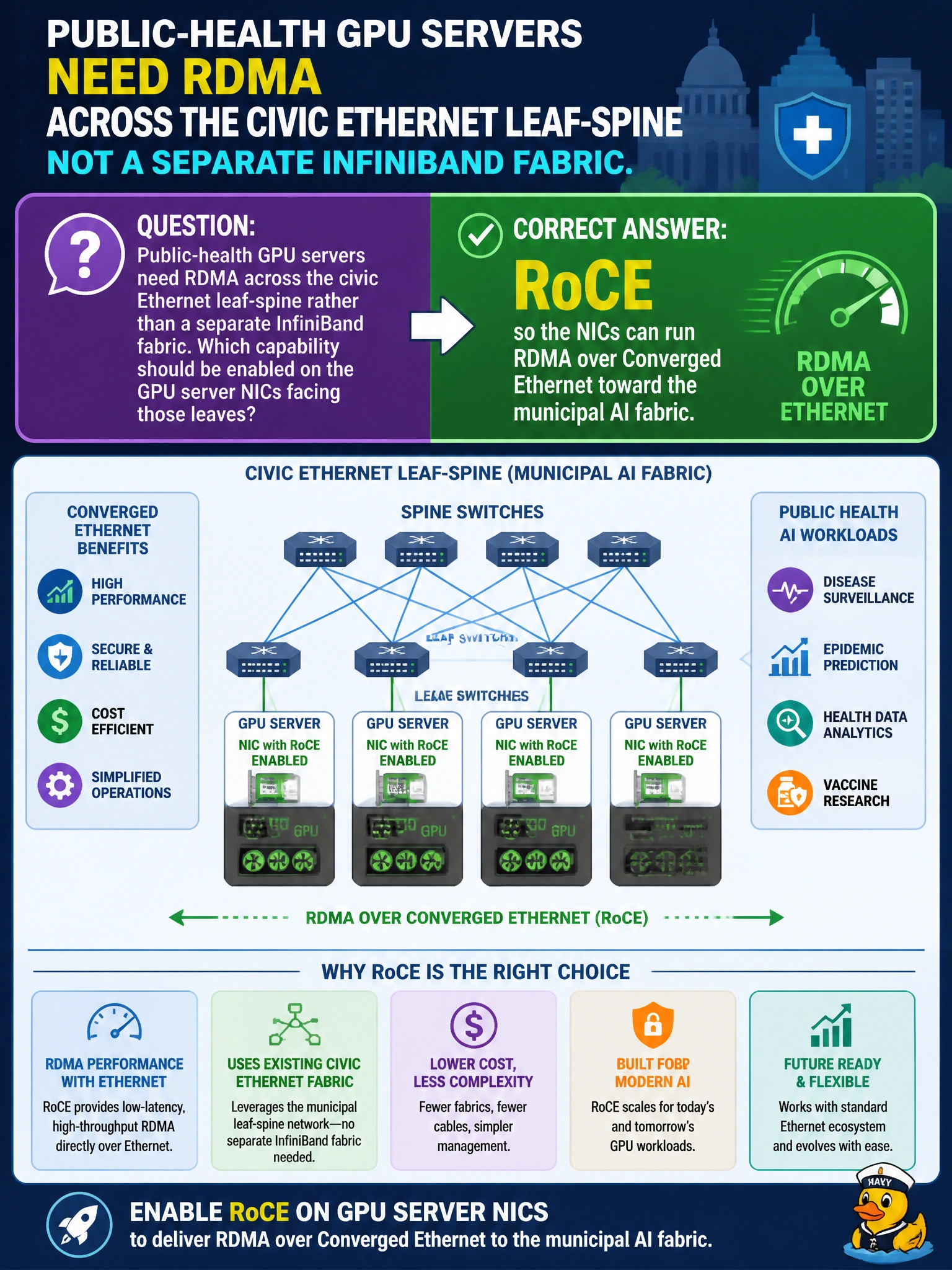
Public-health GPU servers need RDMA across the civic Ethernet leaf-spine rather than a separate InfiniBand fabric. Which capability should be enabled on the GPU server NICs facing those leaves?
Select an answer to reveal the explanation.
Short Explanation
RoCE is the "RDMA over the Ethernet you already built" path. You'll still get RDMA with iWARP over TCP, but it's not the Converged Ethernet path your leaf-spine GPUs are built to use.
Full Explanation
When public-health GPU servers need RDMA across an existing civic Ethernet leaf-spine, the NIC capability to enable is RDMA over Converged Ethernet (RoCE) so those servers can run RDMA semantics toward the municipal AI fabric without building a parallel InfiniBand island. RoCE (and commonly RoCEv2 in routed designs) is the Ethernet-aligned path for GPU collectives on Cisco Data Center AI PODs. iSER runs iSCSI Extensions for RDMA toward the municipal AI fabric for block storage access, but it does not provide the RDMA verbs and low-latency east-west transport that GPU training collectives require. PFC only provides lossless Ethernet flow control toward the municipal AI fabric; it does not enable RDMA semantics or GPU collective offload, so the NICs cannot run RDMA across the civic fabric. iWARP runs RDMA over TCP transport toward the municipal AI fabric, but it uses TCP-based delivery rather than the Converged Ethernet RDMA path required for GPU collectives on the civic leaf-spine. Exam caveat: enabling RoCE on NICs is necessary but not sufficient—lossless priorities, markings, and congestion controls on the civic fabric must match, or RoCE traffic still experiences drops. Operational check: enable RoCE on GPU NICs facing the municipal leaves, confirm RDMA connectivity to peer GPUs over the Ethernet POD, and verify the path uses the intended AI Cos/DSCP rather than relying on PFC lossless flow control alone.
Prefer to study offline? Printable PDF study book + test engine ($7.50, unofficial). These questions stay free here.