
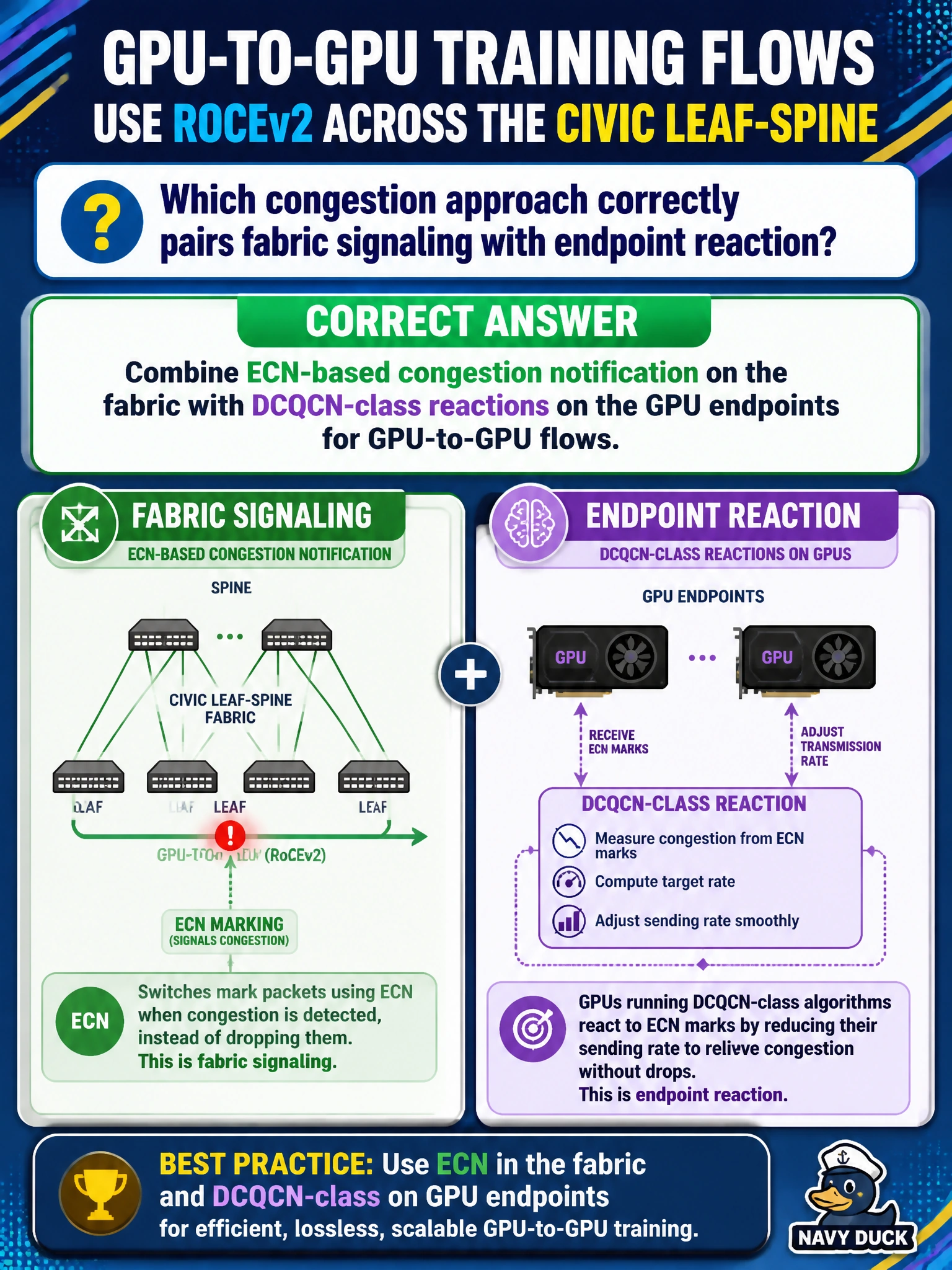
County GPU-to-GPU training flows use RoCEv2 across the civic leaf-spine. Which congestion approach correctly pairs fabric signaling with endpoint reaction?
Select an answer to reveal the explanation.
Short Explanation
It's a two-way radio: the fabric marks "we're congested" with ECN, and the GPU NICs answer by throttling the way DCQCN-style RoCE congestion control expects. One side yelling into the void isn't enough for those county trainers.
Full Explanation
Correct RoCEv2 congestion design pairs fabric signaling with endpoint reaction: the civic leaf-spine marks Explicit Congestion Notification when AI queues congest, and GPU endpoints apply DCQCN-class congestion control to reduce rate on those GPU-to-GPU flows. That closed loop lets county training absorb bursts without depending on endless buffering or blind Layer-2 flooding. Enabling PFC-based pause signaling on the fabric with static rate limiters on the GPU endpoints for GPU-to-GPU flows depends on pause and static caps instead of ECN-driven endpoint feedback, which can stall links, cause head-of-line blocking, and fail to teach endpoints to slow down dynamically. Applying ECN-based congestion notification on the fabric with TCP-style slow-start reactions on the GPU endpoints for GPU-to-GPU flows uses the wrong endpoint reaction, because TCP slow-start is tuned for loss recovery rather than the DCQCN-class rate control RoCEv2 collectives require, so the fabric signal is not matched to an appropriate endpoint throttle. Combining ECN-based marking notification on the fabric with PFC-threshold tuning reactions on the GPU endpoints for GPU-to-GPU flows keeps the right fabric signal but uses the wrong endpoint reaction, because PFC-threshold tuning is hop-by-hop pause tuning rather than DCQCN-class rate control, so it cannot close the feedback loop and risks pause propagation instead of endpoint throttling. Exam caveat: DCQCN-class behavior and ECN thresholds must be validated together—fabric marks that NICs ignore, or NIC reactions without consistent Cos/DSCP, still leave county trainers unprotected. Operational check: confirm ECN marking on civic AI queues, verify GPU NIC RoCE congestion control is enabled, run a GPU-to-GPU burst test, and show rate reduction correlated with CE marks rather than only rising PFC pause counters.
Prefer to study offline? Printable PDF study book + test engine ($7.50, unofficial). These questions stay free here.