
Civic spine queues that carry RoCEv2 GPU traffic are filling during wastewater-model training. How should the municipal fabric team use Explicit Congestion Notification so endpoints can slow down before hard drops?
Select an answer to reveal the explanation.
Short Explanation
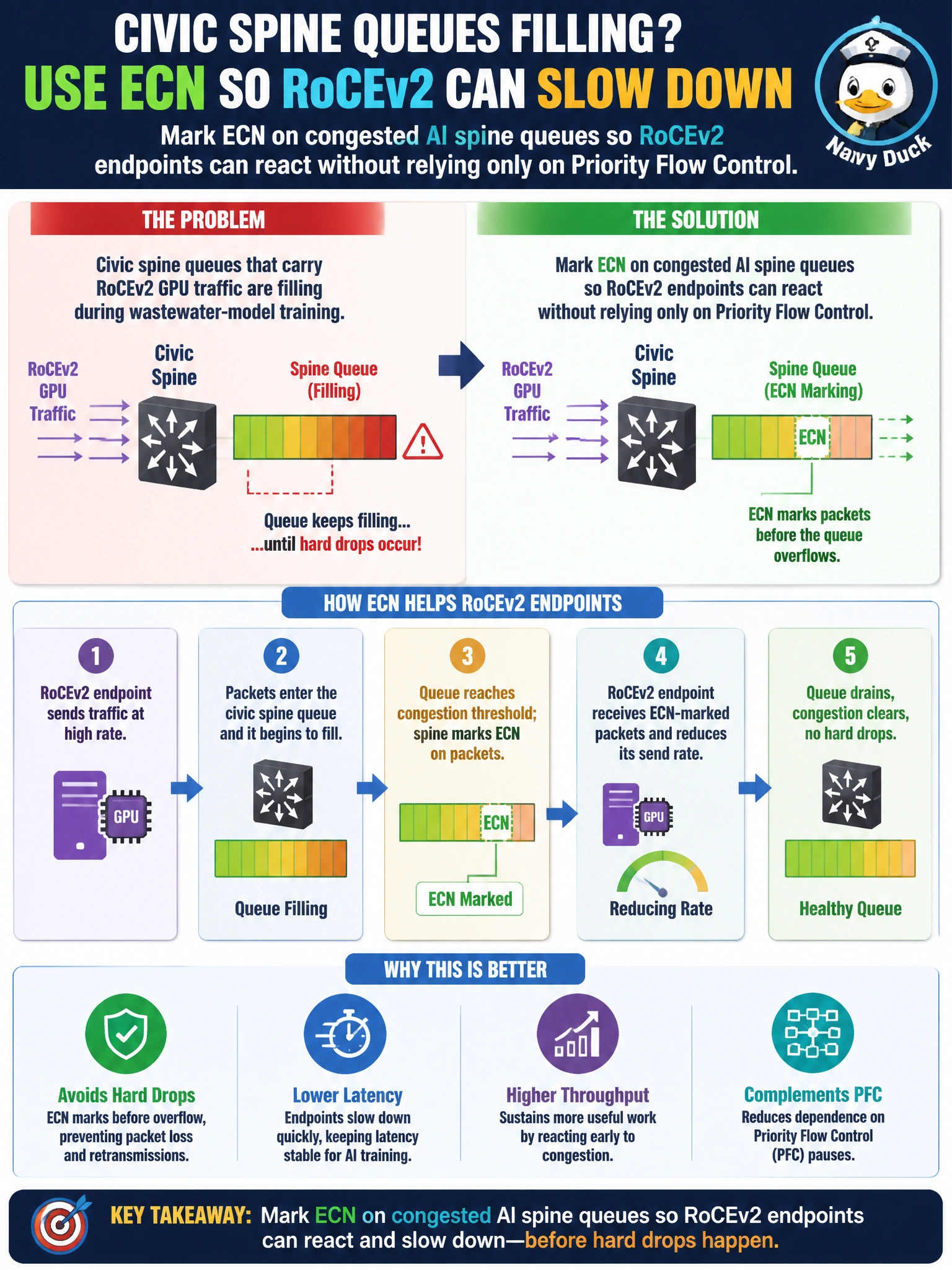
Think of ECN as a yellow light before the red—queues say "slow down" by marking packets so RoCEv2 NICs ease off. That way the civic spines don't have to lean only on PFC pause when trainers surge.
Full Explanation
Explicit Congestion Notification (ECN) marks packets when queues approach congestion so capable endpoints can reduce send rate before buffers overflow or hard drops occur. On civic spines carrying RoCEv2 GPU traffic during wastewater-model training, marking ECN on the congested AI queues gives RoCEv2 endpoints an early signal so they can react without relying solely on Priority Flow Control pause. That pairing—early mark plus lossless pause when needed—is how municipal Ethernet AI fabrics keep trainers moving as queues fill. Enabling Priority Flow Control on congested AI spine queues so RoCEv2 endpoints pause before ECN marking thresholds engage inverts the correct threshold order and forces hop-by-hop pause first instead of end-to-end rate reduction, triggering PFC storms and head-of-line blocking rather than letting ECN marks throttle senders early. Configuring congested AI spine queues to generate Congestion Notification Packets to RoCEv2 senders when ECN thresholds are exceeded misplaces DCQCN roles because spine switches should mark CE bits on data packets while the RoCEv2 receiver generates the CNPs that tell the sender to slow down. Applying Weighted Random Early Detection with ECN marking on AI spine queues using TCP-oriented thresholds for RoCEv2 traffic marks too late for lossless RDMA because RoCEv2 needs shallow DCQCN-tuned thresholds for early feedback, not deep TCP thresholds that let queues fill toward drops. Exam caveat: ECN is useful only when both fabric queues mark and GPU NICs honor marks (for example via DCQCN-class behavior); marking alone without endpoint reaction does not slow RDMA senders. Operational check: enable ECN on the AI spine queues that carry RoCEv2, generate a controlled fill of those queues, confirm CE marks reach GPU NICs, and verify training rates throttle before deep buffer exhaustion or widespread PFC storms on the municipal spines.
Prefer to study offline? Printable PDF study book + test engine ($7.50, unofficial). These questions stay free here.