
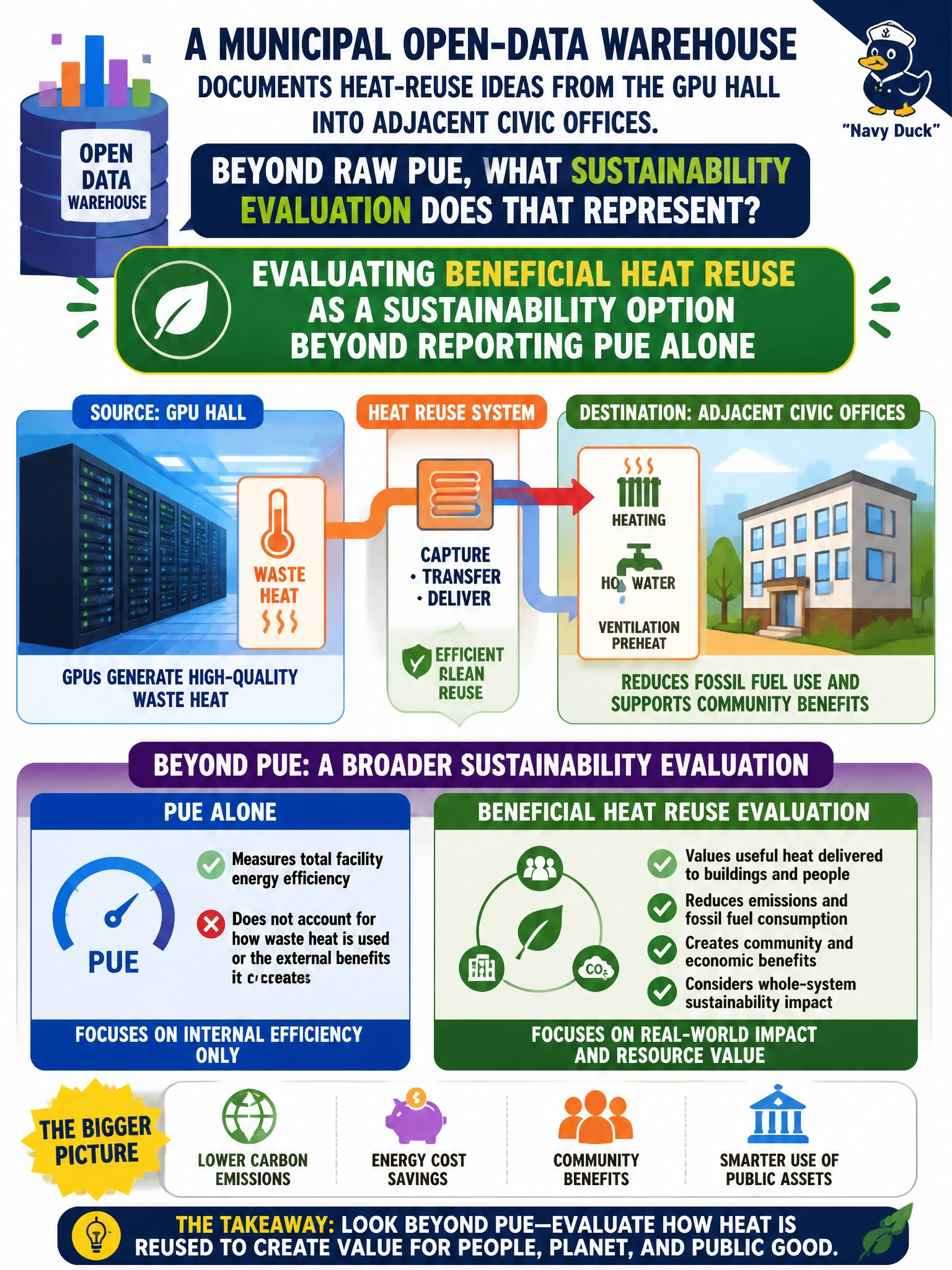
A municipal open-data warehouse documents heat-reuse ideas from the GPU hall into adjacent civic offices. Beyond raw PUE, what sustainability evaluation does that represent?
Select an answer to reveal the explanation.
Short Explanation
PUE's useful, but you can't just subtract reused heat from its energy totals since reuse is tracked separately. You can think past the single ratio by capturing GPU hall heat for nearby offices. Civic facilities can score points with reuse ideas when they are realistic.
Full Explanation
When a municipal open-data warehouse documents heat-reuse ideas from the GPU hall into adjacent civic offices, the sustainability evaluation beyond raw PUE is evaluating beneficial heat reuse as an option when engineering allows. PUE remains useful, but civic sustainability can also score recovered heat that offsets office heating rather than only minimizing the overhead ratio. Documenting reuse concepts keeps that option in the design conversation for the open-data facility.
Crediting beneficial heat reuse as a direct deduction from PUE numerator energy totals misapplies PUE accounting, which must report total facility energy as consumed and track reuse separately rather than netting heat out of the ratio. Counting beneficial heat reuse as avoided cooling tower makeup to improve WUE ratios misstates WUE, which measures actual makeup water consumed and cannot be improved by hypothetical water savings from office heating reuse. Treating beneficial heat reuse as displaced grid electricity to lower reported CUE values overstates CUE accounting, which reflects emissions from energy actually consumed and does not allow unverified grid displacement credits for recovered heat.
Exam caveat: heat reuse is complementary to—not a substitute for—sound PUE, power, and cooling design; Domain 2.4-style reviews may accept reuse as an efficiency narrative only with credible mechanical paths.
Operational check: with facilities engineering, quantify recoverable GPU hall heat versus adjacent office demand and seasonal feasibility, then record whether reuse warrants further design or remains a documented non-selected option.
Prefer to study offline? Printable PDF study book + test engine ($7.50, unofficial). These questions stay free here.