
A fire CAD analytics VLAN measures facility overhead watts versus IT load after GPU install. Which statement correctly describes a PUE-relevant measurement?
Select an answer to reveal the explanation.
Short Explanation
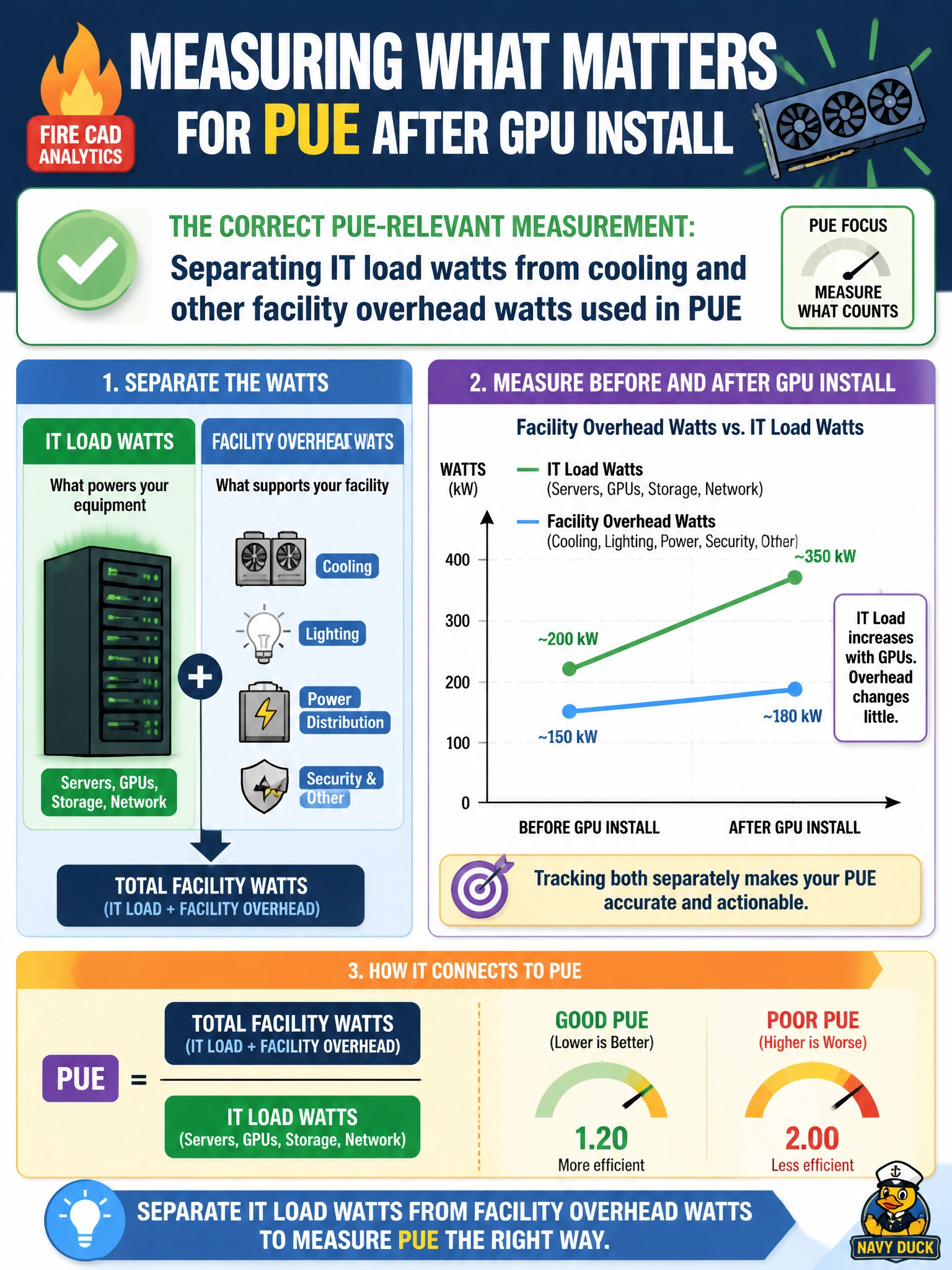
PUE needs two buckets: the IT gear's watts and everything else the building burns to keep that gear happy. Mix those up and your efficiency story falls apart. Dividing metered IT load watts by total metered facility watts to calculate PUE flips the ratio, so you'll get the wrong number.
Full Explanation
On a fire CAD analytics VLAN that measures facility overhead watts versus IT load after GPU install, a PUE-relevant measurement correctly separates IT load watts from cooling and other facility overhead watts used in PUE. The ratio only means something when the denominator is IT equipment power and the numerator includes the overhead required to support that IT—cooling, distribution losses, and similar facility loads—for the municipal hall under study. Dividing metered IT load watts by total metered facility watts to calculate PUE inverts the PUE ratio and reports the wrong metric. Separating IT load watts from cooling watts plus lighting watts for PUE total misdefines the PUE numerator as only cooling plus lighting instead of total metered facility watts. Averaging sampled GPU utilization percentages to derive metered IT load watts for PUE substitutes utilization percentages for actual measured watts. Exam caveat: after GPU install, re-baseline both IT and overhead meters; otherwise PUE comparisons pre/post AI densification are not commensurate for Domain 2.4-style review. Operational check: tag fire CAD hall circuits into IT versus overhead buckets, sample coincident watts under representative GPU load, compute PUE, and archive the metering map so future aisle or cooling changes use the same separation.
Prefer to study offline? Printable PDF study book + test engine ($7.50, unofficial). These questions stay free here.