
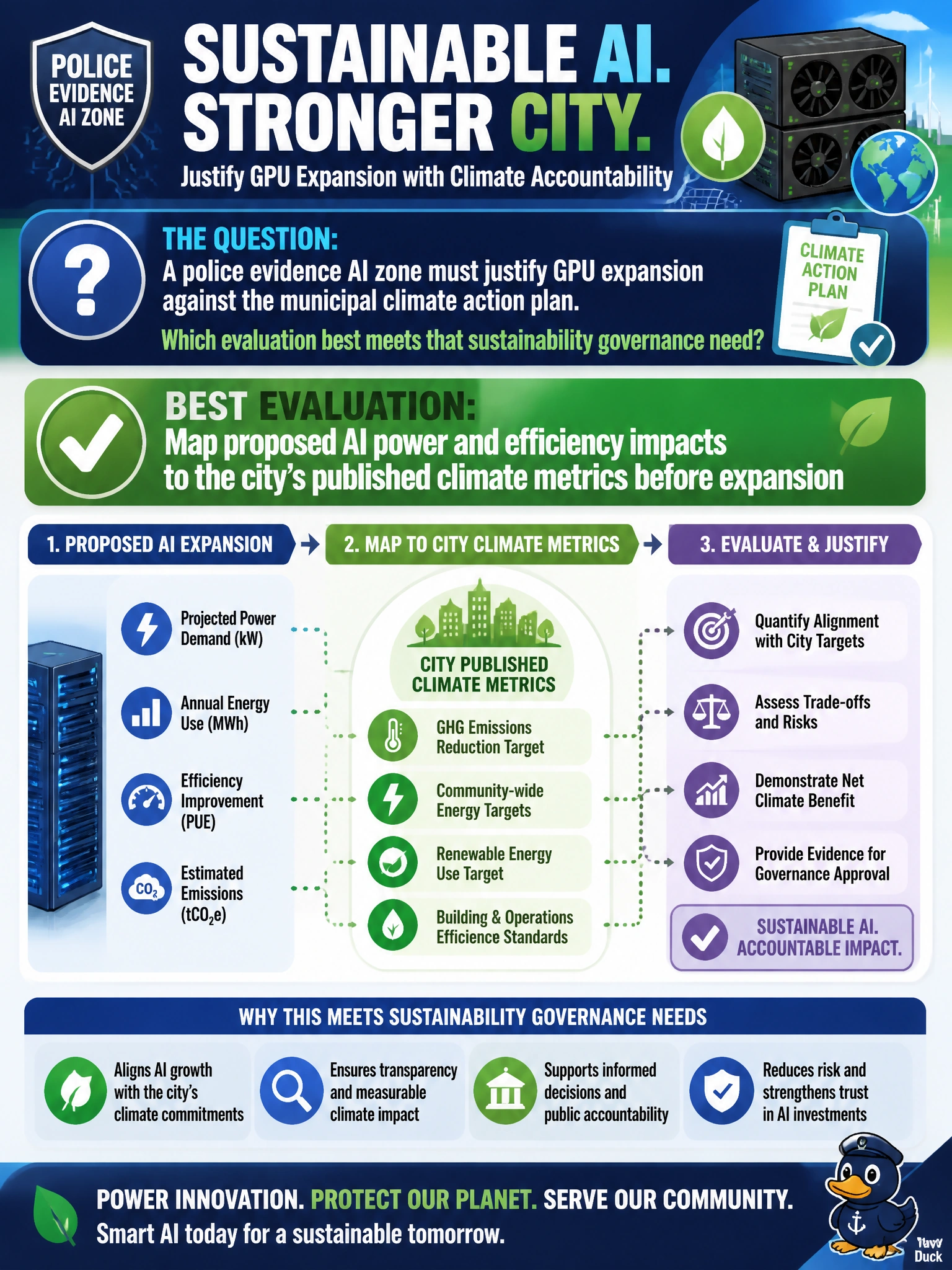
A police evidence AI zone must justify GPU expansion against the municipal climate action plan. Which evaluation best meets that sustainability governance need?
Select an answer to reveal the explanation.
Short Explanation
City climate plans are not decorative PDFs. Before you add another GPU hall, show how power and efficiency land against those metrics. Skipping the paperwork is how expansions get blocked later.
Full Explanation
A police evidence AI zone that must justify GPU expansion against the municipal climate action plan meets the governance need by mapping proposed AI power and efficiency impacts to the city's published climate metrics before expansion. Capital approval for more accelerators should arrive with projected kWh, PUE or equivalent efficiency effects, and how those numbers land on the city's climate scorecard—not after hardware is already shipping.
Tracking projected data center PUE and cooling energy overhead for internal efficiency benchmarking before expansion misses the sustainability governance need, because internal benchmarking alone does not map proposed AI power impacts to the city's published climate metrics for justification. Estimating lifecycle GPU carbon emissions and grid intensity using generic industry average factors before expansion falls short for sustainability governance, because generic averages do not map proposed impacts to the city's published climate metrics for justification. Verifying supplier ISO 14001 certification and hardware e-waste recycling claims for procurement compliance before expansion misses the governance need: supplier paperwork is not a substitute for mapping proposed GPU power and efficiency to the city's climate scorecard before expansion.
Exam caveat: Domain 2.4-style evaluations treat sustainability and efficiency as design inputs for AI facilities, including civic programs where published climate plans constrain IT growth; "AI is special" is not an exemption from those metrics.
Operational check: before PO, produce a short impact sheet tying evidence-zone GPU draw and expected efficiency measures to named city climate KPIs, circulate to reporting owners, and gate expansion on documented alignment rather than verbal intent.
Prefer to study offline? Printable PDF study book + test engine ($7.50, unofficial). These questions stay free here.