
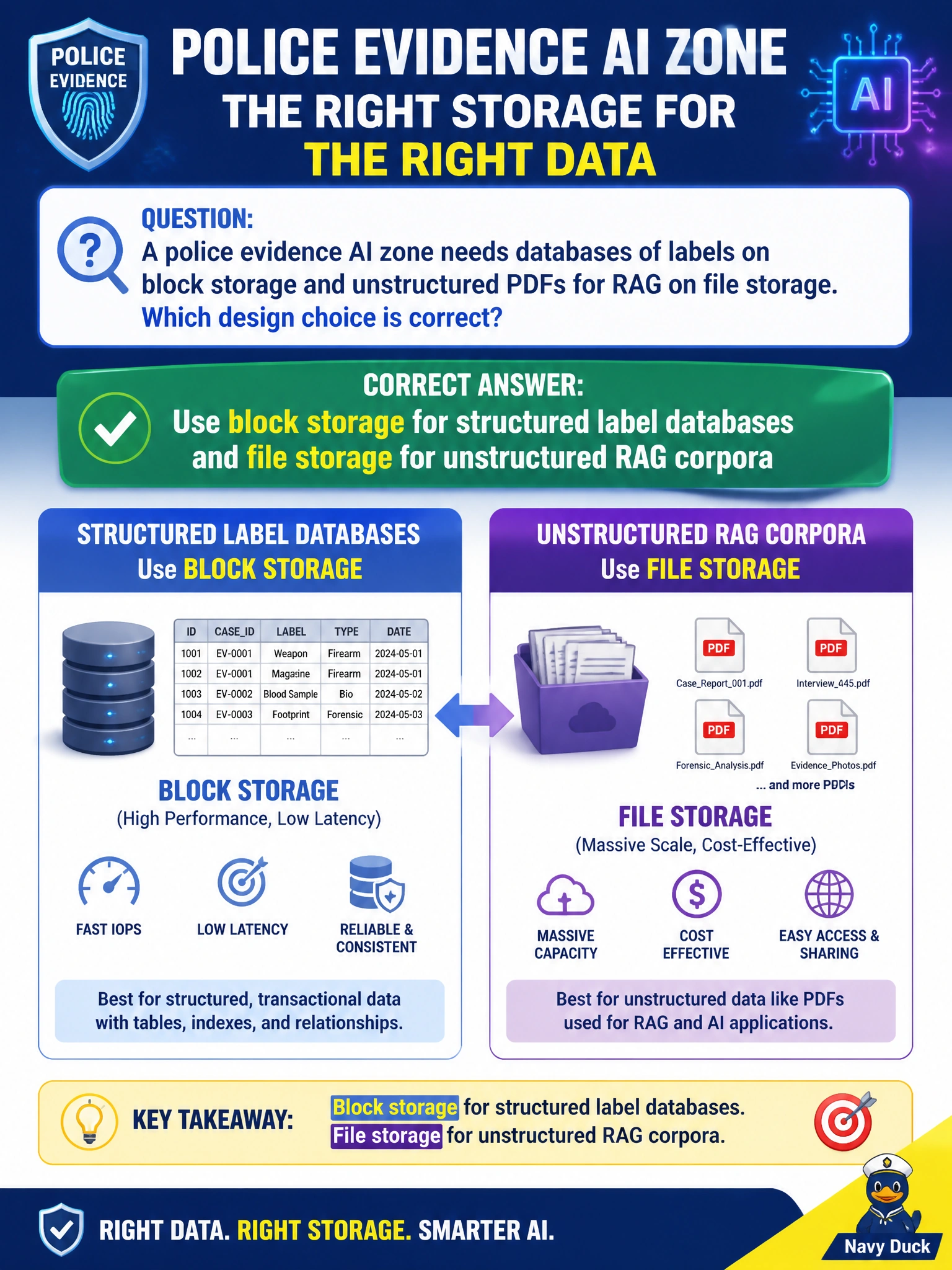
A police evidence AI zone needs databases of labels on block storage and unstructured PDFs for RAG on file storage. Which design choice is correct?
Select an answer to reveal the explanation.
Short Explanation
Labels in a database like a card catalog want block; PDFs for RAG are the stacks on a shared file shelf. Match the medium to the data type. Don't shove labels and PDFs onto the same file share.
Full Explanation
A police evidence AI zone that keeps structured label databases on block storage and unstructured PDFs for RAG on file storage is correctly matching storage types to data types. Relational label stores typically want block semantics, consistency, and database-friendly volumes; shared unstructured document corpora for retrieval-augmented generation fit file (or object-plus-file gateway) access for multi-reader sharing. Protocol choice follows data shape and access pattern.
Using file shares for label databases and PDF corpora for unified shared access across analyst nodes fails by concept: structured label databases need block semantics and database-friendly volumes, while unstructured PDFs for RAG need shared file-tier access; forcing both onto file shares ignores data shape and access pattern. Using file storage for structured label databases and block storage for unstructured RAG corpora inverts the correct mapping: label databases need block semantics, while shared unstructured PDF corpora fit file access for multi-reader sharing. Using block volumes attached to database hosts for label databases and PDF corpora misapplies block storage to unstructured RAG corpora, which require shared file-tier access rather than database volumes.
Exam caveat: Modern platforms blur lines (databases on files, objects for documents), but the exam still expects the classic mapping—structured DB → block, shared unstructured corpus → file—when the stem presents both needs.
Operational check: place label DBs on monitored block volumes with snapshots; place RAG PDF corpora on shared file tiers with appropriate permissions; prove evidence trainers and RAG services meet I/O SLOs without forcing both workloads onto one shared file tier.
Prefer to study offline? Printable PDF study book + test engine ($7.50, unofficial). These questions stay free here.