
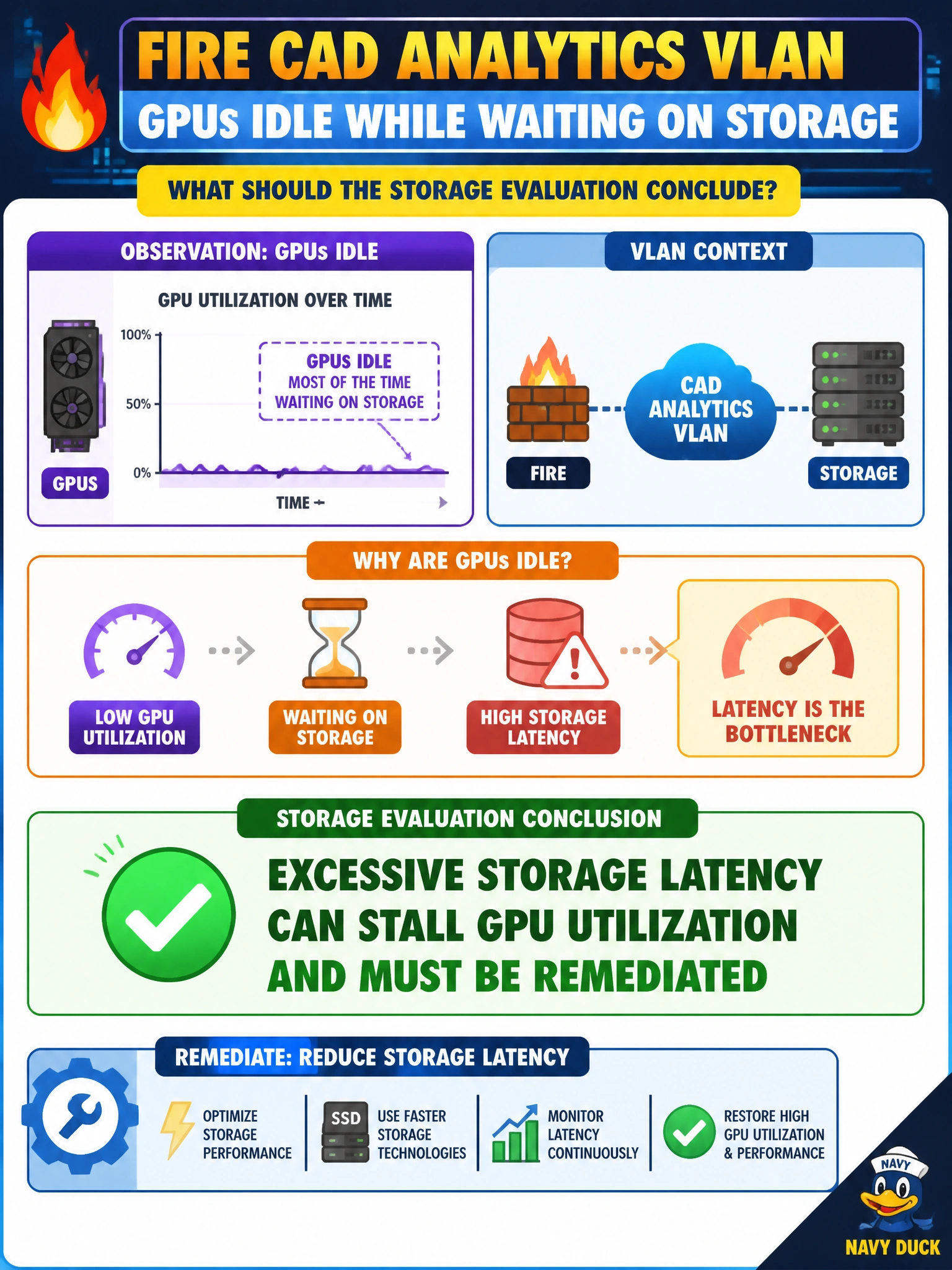
A fire CAD analytics VLAN shows GPUs idle while waiting on storage. What should the storage evaluation conclude?
Select an answer to reveal the explanation.
Short Explanation
GPUs twiddling their thumbs while disks catch up is like fire engines waiting on a locked supply closet. Storage latency can tank utilization even when the GPUs are fine. Don't count on remote synchronous replication to keep you fed—it adds ack latency and overhead that'll leave your GPUs waiting.
Full Explanation
When a fire CAD analytics VLAN shows GPUs idle while waiting on storage, the storage evaluation must conclude that excessive storage latency can stall GPU utilization and must be remediated. AI efficiency is a system property: fast GPUs behind slow reads, metadata stalls, or checkpoint waits deliver poor tokens-per-dollar and delayed municipal analytics. Domain 2.3 treats storage latency as a first-class impact on accelerator productivity.
Claiming limited GPU HBM capacity stalls pipelines and requires expanded device memory fails by concept—the observed wait-on-storage pattern points at the I/O path, not at device memory capacity, and adding HBM does not unblock reads stalled on latency. Asserting sustained sequential throughput at ingest rate confirms storage meets GPU demand fails established AI infrastructure practice: sequential throughput can hide latency spikes, metadata stalls, small random reads, and checkpoint waits that starve GPUs between bursts. Claiming remote synchronous replication sustains GPU ingest throughput with low overhead fails operations: synchronous replication adds round-trip acknowledgment latency and fabric overhead that throttles ingest and worsens the CAD analytics backlog.
Exam caveat: Not every GPU idle second is storage-caused (could be CPU preprocessing, network, or synchronization), but when evidence shows wait-on-storage, remediation belongs in the storage/network data path evaluation—not in enabling remote synchronous replication, which adds overhead rather than feeding GPUs.
Operational check: correlate GPU utilization with storage latency and queue depth on the fire CAD path; remediate hot tier, fabric, or queueing; re-measure idle-from-I/O after changes so the city confirms accelerators are fed rather than parked.
Prefer to study offline? Printable PDF study book + test engine ($7.50, unofficial). These questions stay free here.