
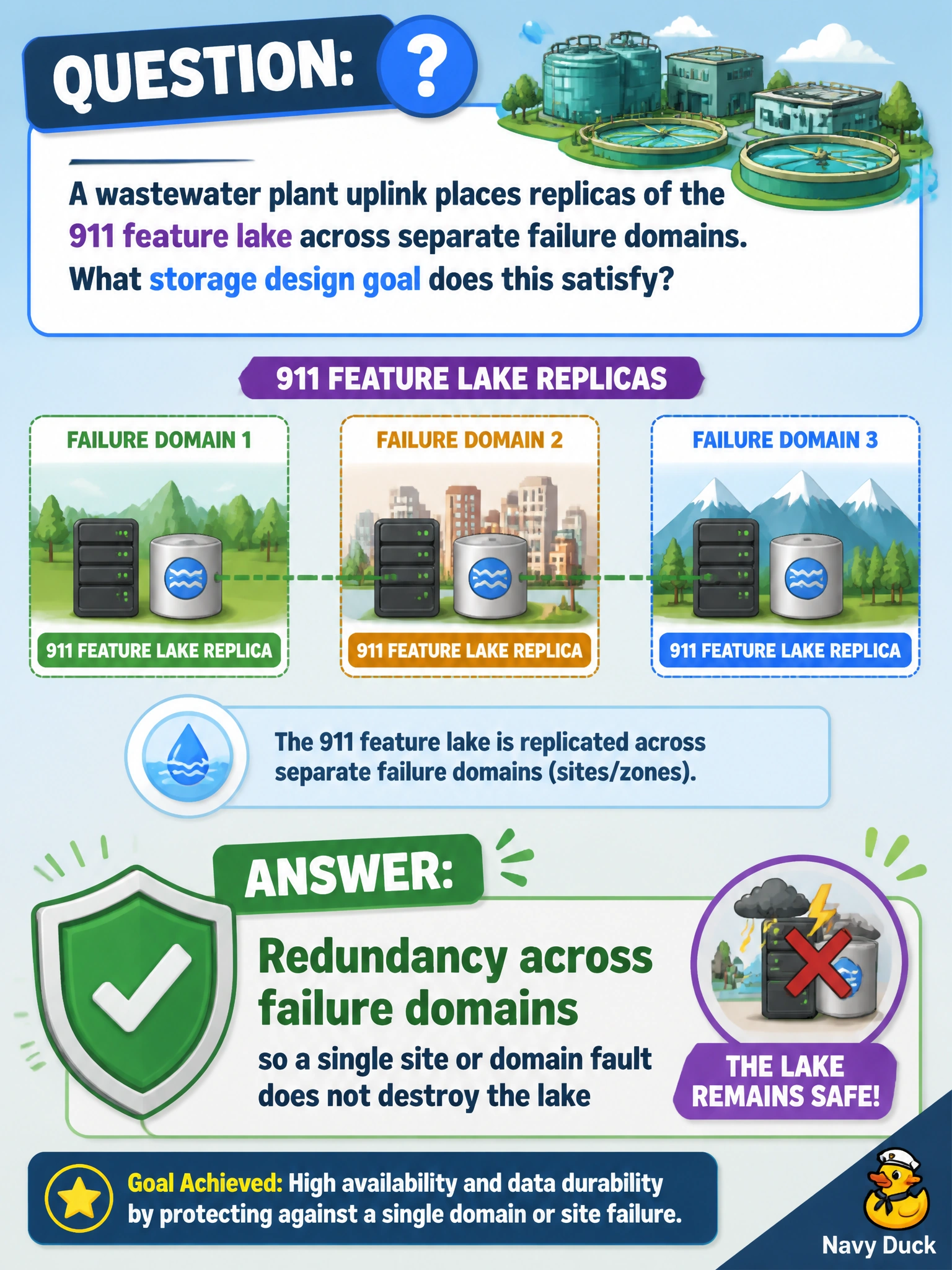
A wastewater plant uplink places replicas of the 911 feature lake across separate failure domains. What storage design goal does this satisfy?
Select an answer to reveal the explanation.
Short Explanation
Replicas in separate failure domains are like spare pumps in different pump houses — one flood does not take out every spare. Spreading the 911 feature lake copies protects availability. You'll still be stuck if you think that redundancy is so you'll get faster striped queries, a smaller deduped footprint, or a hotter cache near compute — it's there so you've got a usable copy when a domain fails.
Full Explanation
A wastewater plant uplink that places replicas of the 911 feature lake across separate failure domains is satisfying redundancy so a single site, shelf, or domain fault does not destroy the lake. Cross-domain replicas are how critical public-safety AI features survive localized power, flood, controller, or rack events. Redundancy is geographic or failure-domain diversity for survival, not redundancy across failure domains so lake partitions stripe for parallel query throughput, which describes speed, not protection from a domain fault. Redundancy across failure domains so lake partitions stripe for parallel query throughput fails by concept: striping spreads reads for speed but does not create survivable copies in separate domains, so one domain fault can still destroy the lake. Redundancy across failure domains so lake segments deduplicate for lower storage footprint is not the cross-domain survival the stem calls for—deduplicated segments in one domain stay vulnerable to a site fault, and replicas actually increase footprint to buy survival, with space savings unable to restore the lake after a domain failure. Redundancy across failure domains so hot partitions cache near compute for lower query latency fails the protection goal—caching speeds reuse but does not place a survivable replica in a separate domain, and faster access is meaningless if the 911 feature lake is unrecoverable after a domain fault.
Exam caveat: Domain 2.3 redundancy expects failure-domain separation appropriate to the data's criticality. This item focuses on placing replicas across domains to survive a domain fault, not on redundancy across failure domains so partitions stripe, deduplicate, or cache for throughput, footprint, or latency gains.
Operational check: document failure domains for each 911 feature replica; test restore from the remote domain; monitor replication lag and checksum health so wastewater/public-safety operators know the second copy is actually usable.
Prefer to study offline? Printable PDF study book + test engine ($7.50, unofficial). These questions stay free here.