
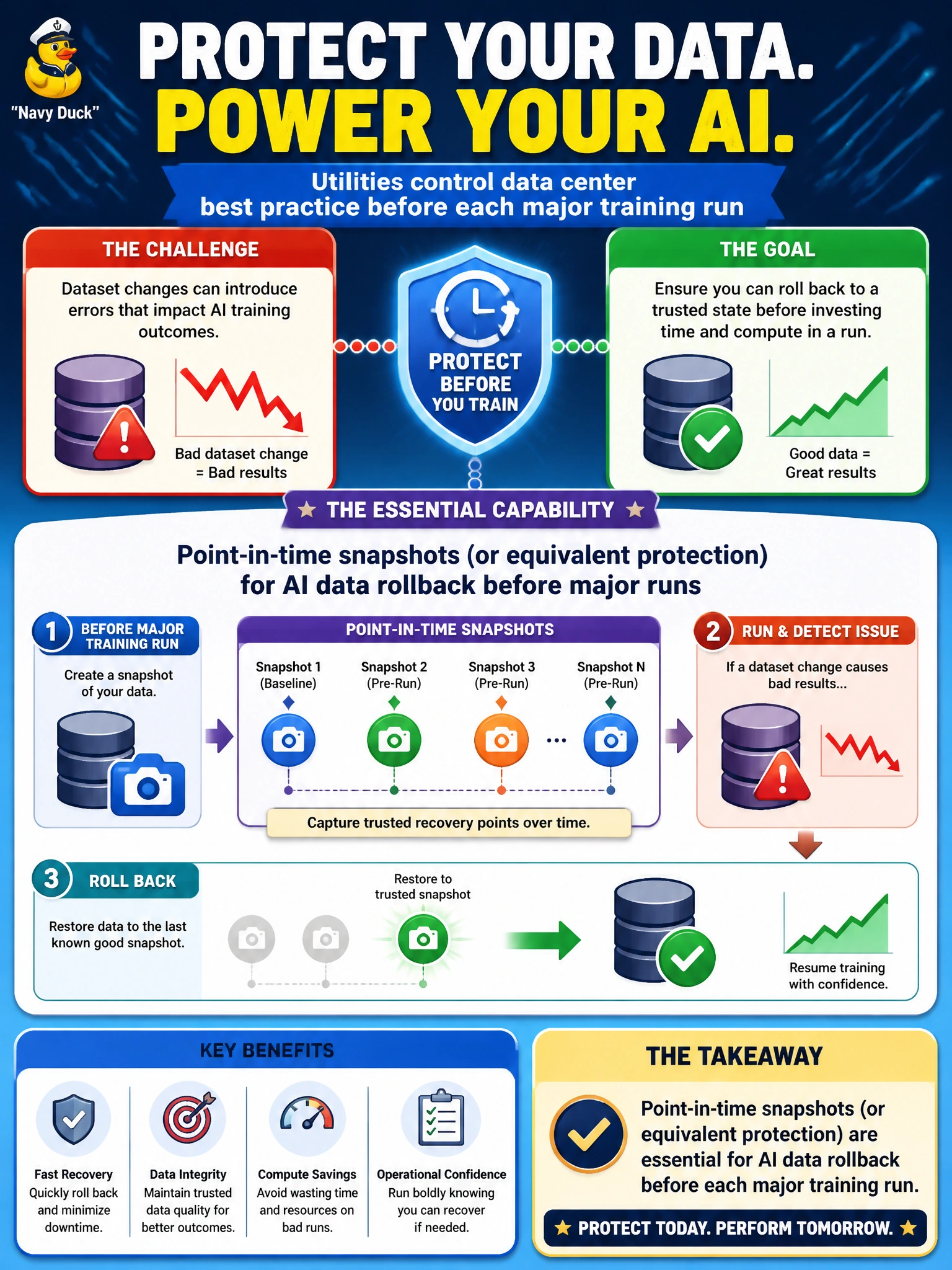
A utilities control data center requires storage snapshots before each major training run so operators can roll back a bad dataset change. Which capability is essential?
Select an answer to reveal the explanation.
Short Explanation
Snapshots before a big training run are like saving a clean blueprint before renovations — if the new dataset is a mess, you roll back. Protection features are part of availability for AI data. Weekly full backups (or equivalent archive copies) for AI data rollback before major runs won't help you because they're too slow and infrequent to roll back a bad dataset change before your next run.
Full Explanation
A utilities control data center that requires storage snapshots before each major training run is demanding point-in-time protection so operators can roll back a bad dataset change. Snapshots (or equivalent immutable/protected recovery points) are part of availability for AI data: they let municipal teams revert a corrupted label set, botched ETL, or accidental delete without rebuilding the lake from scratch. Protection features belong in Domain 2.3 alongside raw capacity.
Synchronous storage mirroring (or equivalent replication) for AI data rollback before major runs fails by concept—mirroring copies live changes in real time, so a bad dataset change is replicated immediately and cannot be rolled back to a pre-run snapshot. Weekly full backups (or equivalent archive copies) for AI data rollback before major runs fails recoverability for this scenario; weekly copies are too slow and infrequent for pre-run dataset rollback and cannot provide immediate point-in-time recovery. Inline data deduplication (or equivalent compression) for AI data rollback before major runs fails by concept; deduplication saves capacity but does not create a protected pre-run point and cannot roll back a corrupted dataset change.
Exam caveat: Snapshots address dataset/time-point rollback; synchronous storage mirroring (or equivalent replication) for AI data rollback before major runs does not preserve a pre-run point because it replicates the bad change immediately rather than retaining a restorable copy. The stem's 'before each major training run' language targets pre-change protection.
Operational check: automate a verified snapshot (or immutable copy) before dataset promotion; test restore time against the utilities change window; monitor snapshot space so protection is retained rather than silently expired when free-space alarms fire.
Prefer to study offline? Printable PDF study book + test engine ($7.50, unofficial). These questions stay free here.