
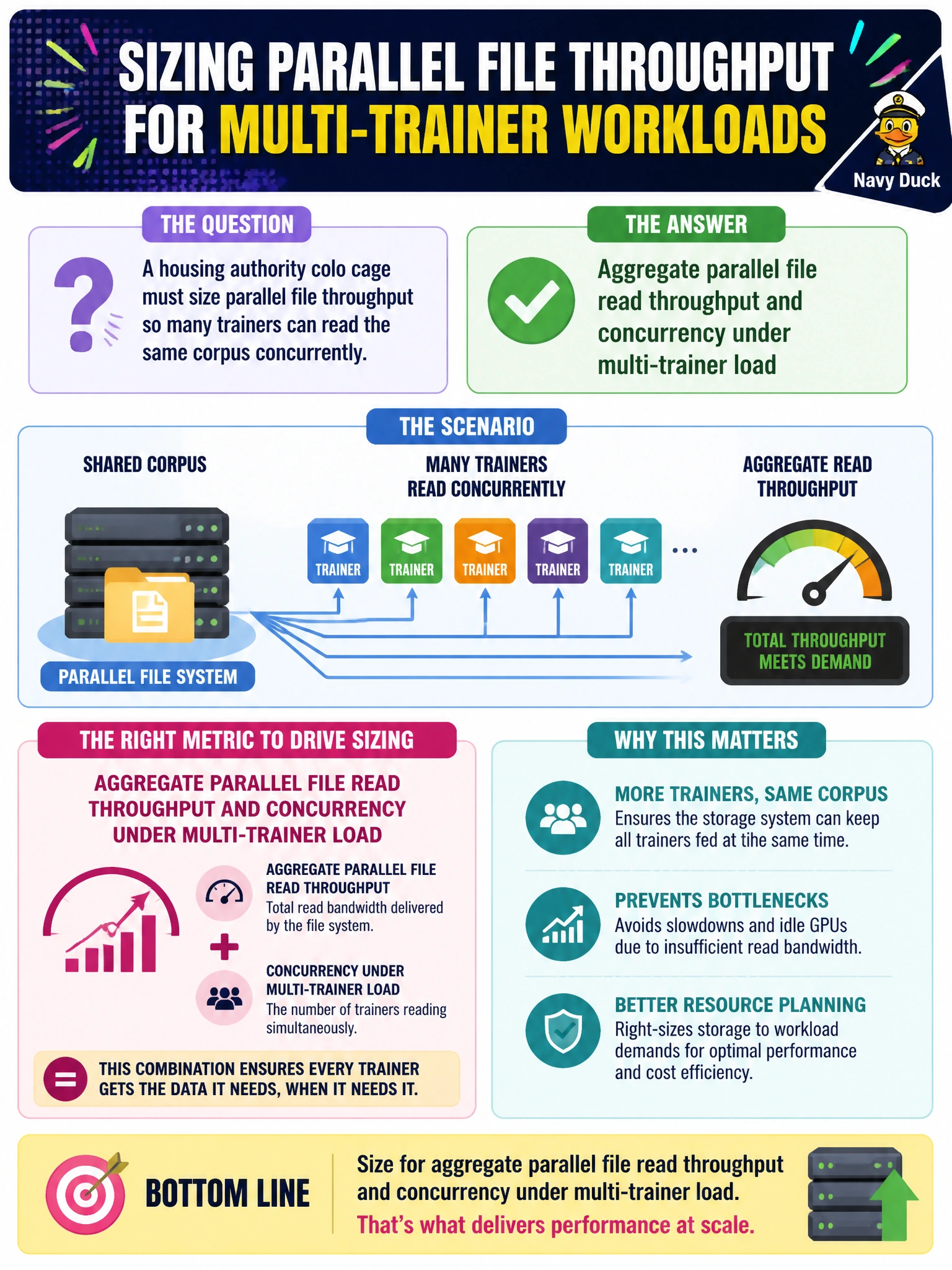
A housing authority colo cage must size parallel file throughput so many trainers can read the same corpus concurrently. Which storage metric should drive that sizing?
Select an answer to reveal the explanation.
Short Explanation
Many trainers hitting one corpus is like a dozen librarians all grabbing the same reference shelf — you size the aisle for parallel traffic. It's aggregate throughput and concurrency that keep you fed, since read IOPS and concurrency can't prove you've got enough bulk GB/s and single-client warm-cache throughput won't show contention when everyone's reading. File performance at scale is the real gate.
Full Explanation
A housing authority colo cage that must serve the same corpus to many concurrent trainers should size storage by aggregate parallel file read throughput and concurrency under multi-trainer load. Parallel file systems or scale-out NAS succeed when the shared aisle can deliver enough simultaneous readers without collapsing into per-client serialization. For civic AI, that metric—not vanity single-stream demos—gates whether GPUs stay fed during corpus-wide epochs.
Sizing only by aggregate parallel file metadata throughput and concurrency under multi-trainer load fails by concept: metadata operations measure namespace access, not bulk data delivery, so it says nothing about whether the file system can sustain concurrent read GB/s to keep trainers fed. Aggregate parallel file read IOPS and concurrency under multi-trainer load fails similarly—it measures operation rate for small reads, not the sustained bulk GB/s throughput the concurrent multi-reader corpus access the stem requires. Aggregate parallel file read throughput and concurrency in single-client warm-cache load fails representativeness: a single warm-cache client hides backend and fabric limits and ignores contention under many readers and the aggregate parallel read pattern the stem describes.
Exam caveat: Domain 2.3 file performance evaluation for AI emphasizes aggregate throughput and concurrency. Single-client warm-cache read throughput can be marketing-useful but is an insufficient acceptance criterion for shared corpora.
Operational check: run multi-reader benchmarks matching trainer count and corpus layout; capture aggregate GB/s and per-client tail latency; expand file nodes or network before housing-authority jobs show GPU idle-from-I/O during concurrent corpus reads.
Prefer to study offline? Printable PDF study book + test engine ($7.50, unofficial). These questions stay free here.