
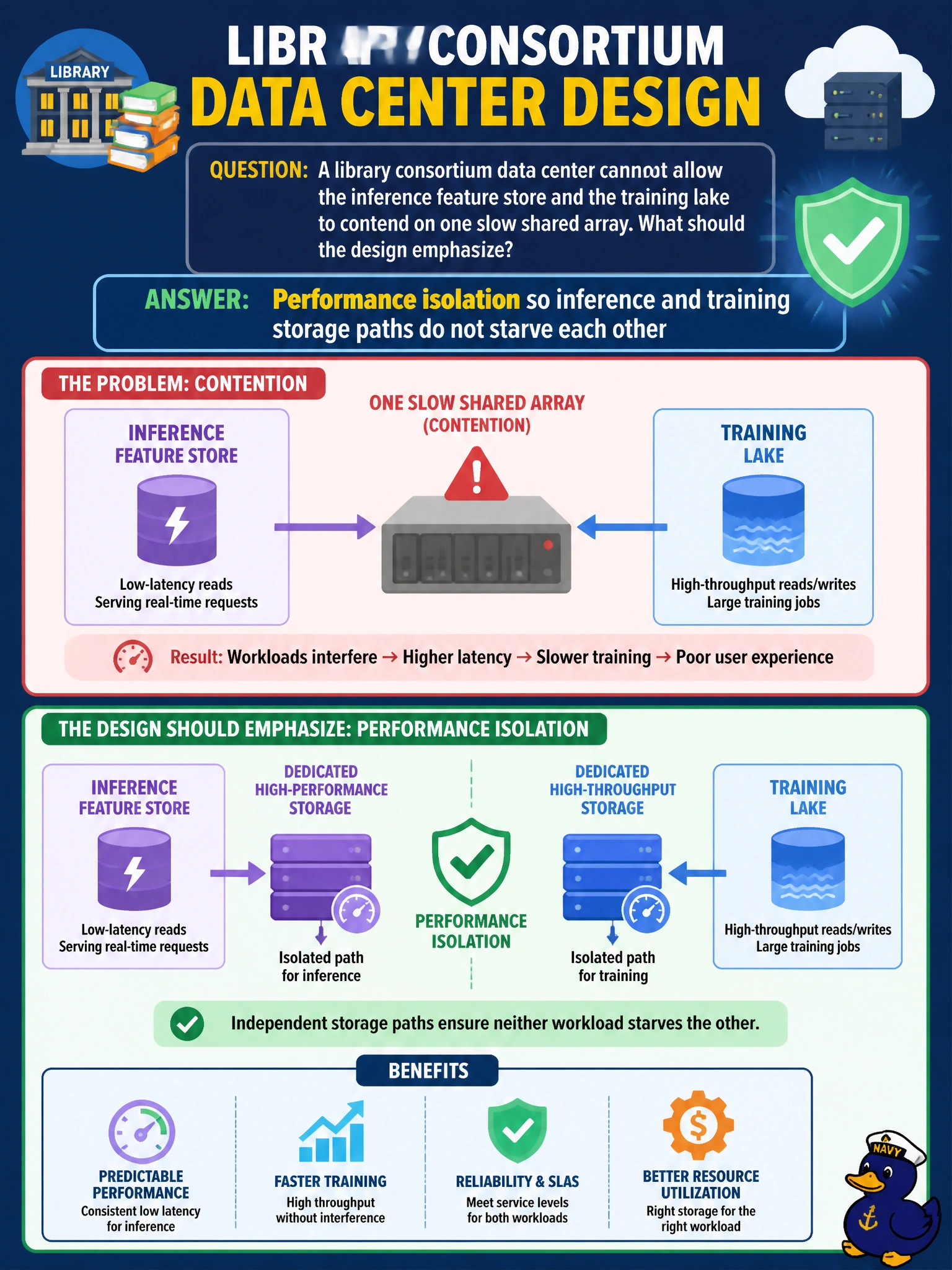
A library consortium data center cannot allow the inference feature store and the training lake to contend on one slow shared array. What should the design emphasize?
Select an answer to reveal the explanation.
Short Explanation
Inference and training fighting one slow array is like checkout and cataloging sharing one clogged hallway — nobody moves. Separate paths or tiers give performance isolation. You'll stall checkout if you park the feature store on slow HDDs with the training lake, since it's got no isolation and can't meet inference latency.
Full Explanation
A library consortium data center cannot allow the inference feature store and the training lake to fight on one slow shared array. The design must emphasize performance isolation so latency-sensitive inference paths are not starved by heavy training I/O, and training is not jittered by bursty feature reads. Separate volumes, tiers, QoS, or fabrics keep civic inference SLAs intact while research training still runs.
Enforcing inline deduplication across inference and training volumes fails performance isolation: it adds latency overhead to sensitive feature reads, deduplicates poorly across dissimilar datasets, and still leaves both workloads contending for the same array resources instead of isolating them. Configuring shared NVMe namespaces with round-robin multipathing fails isolation: multipathing improves combined path throughput but provides no QoS or performance domains, so heavy training I/O can still starve latency-sensitive inference on the same namespaces. Migrating the inference feature store to the capacity HDD tier to align with training lake locality fails tiering for isolation: it places latency-sensitive feature reads on slow throughput-optimized HDDs and collapses both workloads into the same contention domain.
Exam caveat: Domain 2.3 performance isolation is about protecting distinct AI data paths, not about never sharing a platform. Shared systems can work if tiers/QoS/paths enforce isolation; the wrong answers leave shared contention without isolation, whether through shared namespaces, shared dedup processing, or a shared HDD tier.
Operational check: map inference feature-store and training-lake I/O to separate performance domains; set latency SLOs and QoS; alert when cross-workload queue depth rises so library production inference is remediated before patrons' models miss SLA.
Prefer to study offline? Printable PDF study book + test engine ($7.50, unofficial). These questions stay free here.