
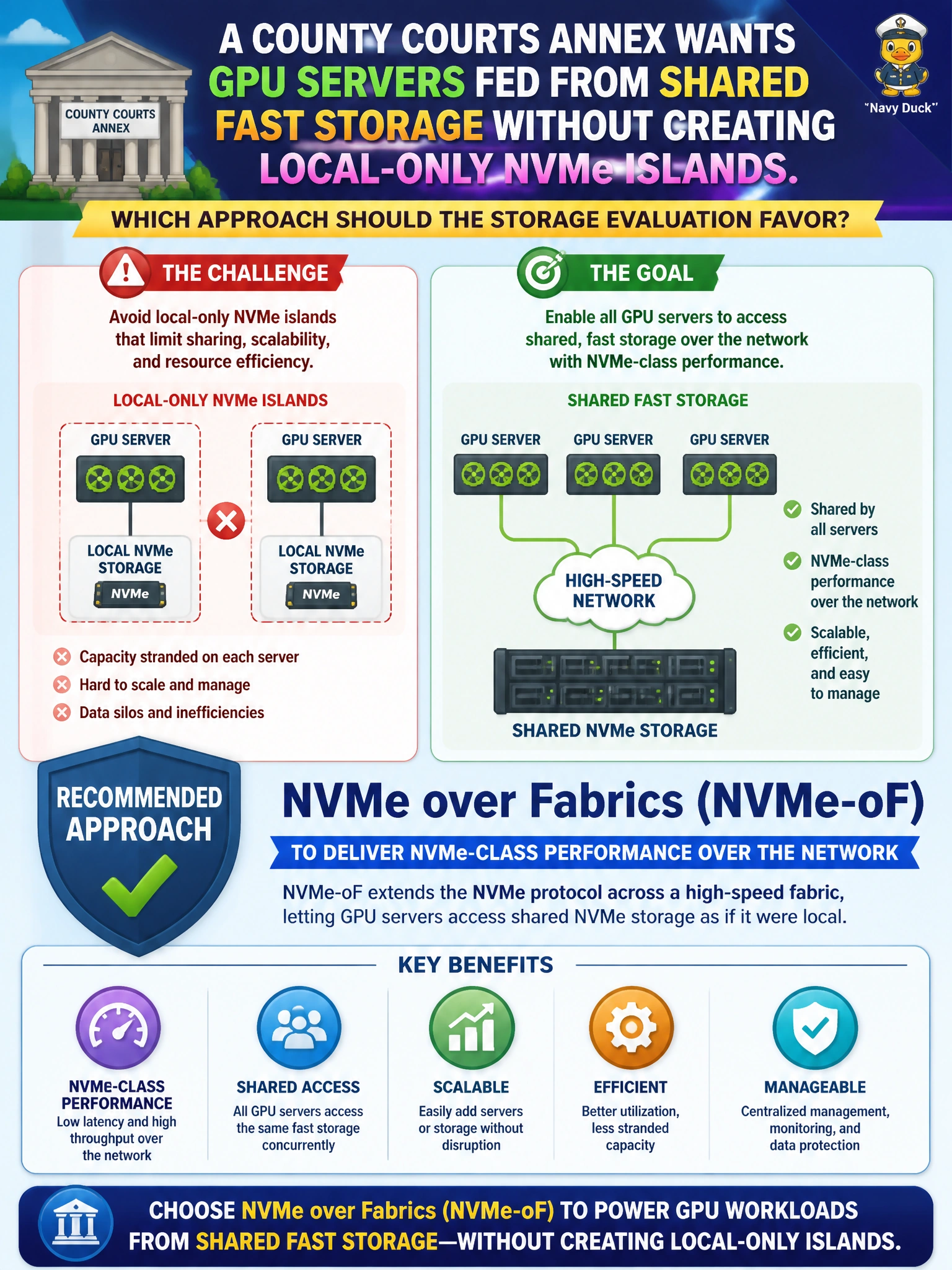
A county courts annex wants GPU servers fed from shared fast storage without creating local-only NVMe islands. Which approach should the storage evaluation favor?
Select an answer to reveal the explanation.
Short Explanation
You'll lose that speed if you settle for SCSI LUNs or HDD-backed NFS, since they can't deliver NVMe-class latency. NVMe-oF keeps the NVMe zip while the fabric shares it. You'll still stall on S3 gateway caching because it's not a fast NVMe feed for epoch reads.
Full Explanation
A county courts annex that wants GPU servers fed from shared fast storage without local-only NVMe islands should favor NVMe over Fabrics (NVMe-oF). NVMe-oF extends NVMe-class latency and IOPS across the network so multiple trainers share a coherent fast pool instead of trapping datasets on per-server drives. That preserves performance while enabling the shared fabric path municipal training platforms need for corpora, checkpoints, and fair scheduling.
Fibre Channel SAN with SCSI LUNs to share centralized flash across trainers fails the NVMe-class requirement: it centralizes capacity but SCSI translation limits queue depth and adds latency versus NVMe-oF, so it cannot deliver NVMe-class IOPS and latency to GPU trainers. S3-compatible object storage with gateway caching for shared epoch reads fails the fast-storage requirement: object protocol overhead and cache misses add latency and cannot match NVMe-class random-read performance, so per-epoch GPU feed stalls. Scale-out NFS over 25GbE to serve POSIX datasets from HDD-backed NAS pools fails performance: it provides shared POSIX access but HDD-backed latency and NAS/NFS overhead cannot meet NVMe-class epoch-read and checkpoint targets.
Exam caveat: Domain 2.3 performance-path evaluation includes networked NVMe options alongside local NVMe and traditional SAN/NAS. Fibre Channel SAN can still share centralized flash, but the stem requires NVMe-class performance over the network, not SCSI LUN access.
Operational check: prove NVMe-oF (or equivalent shared NVMe path) meets courts' epoch-read and checkpoint latency targets across GPU servers; confirm multipathing and namespace sharing; measure copy/skew overhead if any residual local staging remains so islands do not reappear operationally.
Fibre Channel SAN improves sharing but still falls short: SCSI LUN mapping limits parallelism and adds latency, so trainers cannot feed epochs and coordinate checkpoints at NVMe-oF rates. A fabric path between trainers is essential for collaborative AI infrastructure where models train on shared datasets.
Prefer to study offline? Printable PDF study book + test engine ($7.50, unofficial). These questions stay free here.