
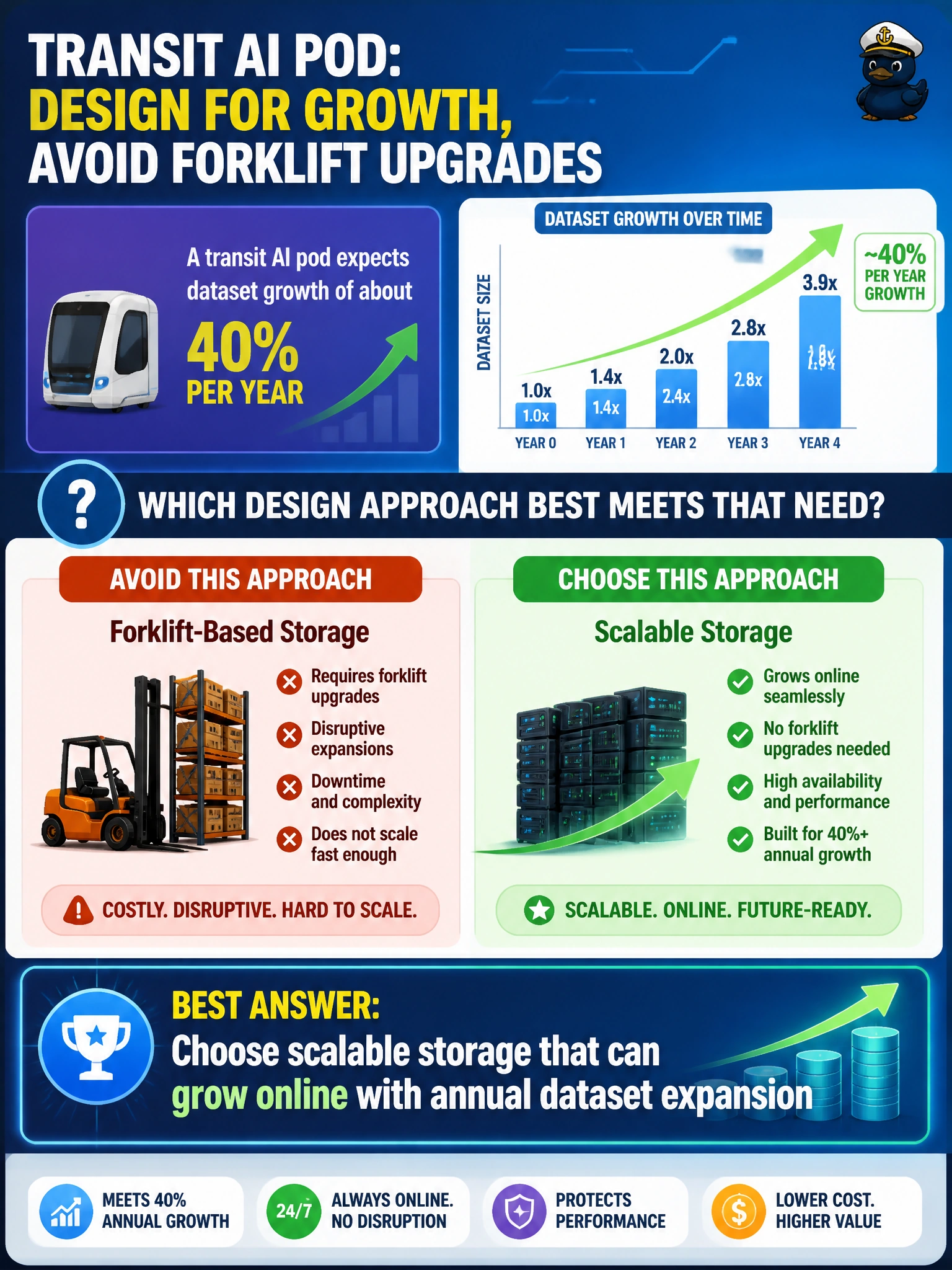
A transit AI pod expects dataset growth of about 40% per year and must avoid forklift storage upgrades. Which design approach best meets that need?
Select an answer to reveal the explanation.
Short Explanation
Forty percent growth every year is like a bus fleet that keeps getting longer — you need a garage that can add bays, not a one-shot shed. Scale-out or expandable storage avoids the forklift upgrade. Adding inline deduplication just reclaims space in today's volumes, but it won't add online capacity, so you'll still outgrow it and face a rip-and-replace later.
Full Explanation
A transit AI pod expecting roughly 40% annual dataset growth needs storage that can expand online so the city avoids forklift rip-and-replace upgrades. The correct design approach is scalable storage—scale-out nodes, expandable shelves, or equivalent—that grows with annual transit video and telemetry expansion while jobs keep running. Scalability is how municipal AI keeps pace with fleet cameras and longer retention without a capital cliff every year.
Adding inline deduplication to reclaim capacity within existing volumes fails by concept: it only reclaims space from data already on disk and does not add online capacity, so the 40% annual growth still forces a forklift upgrade once the box is full. Selecting scale-up storage that expands with offline controller replacements fails the mission—requiring controllers to go offline to expand does not provide online growth, so the expanding corpus still forces disruptive downtime as the dataset grows 40% per year. Reserving thick-provisioned volumes sized for yearly transit data increases does not address the 40% annual growth problem at all: pre-allocating fixed thick volumes is one-time sizing that wastes capacity upfront, not an answer to where the ever-growing training corpus itself gets stored and scaled online.
Exam caveat: Domain 2.3 treats scalability as its own evaluation axis. Online growth capability is distinct from buying a larger static array once; the exam looks for designs that expand with AI dataset growth rather than one-time sizing.
Operational check: forecast three-year transit corpus growth at ~40% compounded; confirm the chosen platform can add capacity online without full replacement; schedule expansion triggers (for example at 70% usable) before trainers hit ENOSPC during peak video ingest.
Prefer to study offline? Printable PDF study book + test engine ($7.50, unofficial). These questions stay free here.