
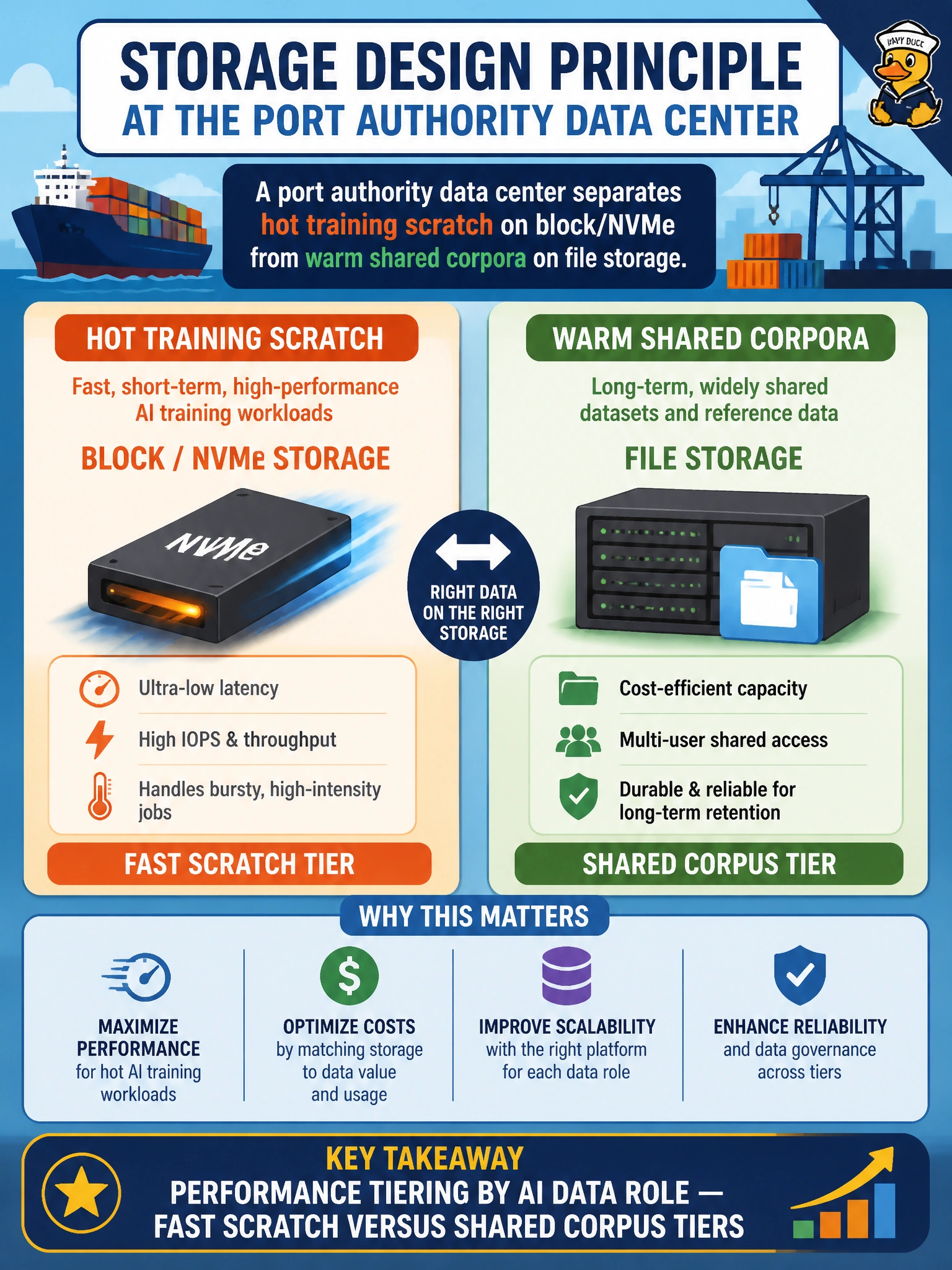
A port authority data center separates hot training scratch on block/NVMe from warm shared corpora on file storage. What storage design principle does this apply?
Select an answer to reveal the explanation.
Short Explanation
Hot scratch is the prep kitchen; the shared corpus is the walk-in pantry — different jobs, different shelves. Block/NVMe for frantic checkpoints and file for shared corpora is smart tiering by data role. Flipping it to file for scratch and block for the corpus won't work — you'll stall your checkpoints on slow file and waste pricey block on bulk reads.
Full Explanation
A port authority data center that puts hot training scratch on block/NVMe while keeping warm shared corpora on file storage is applying performance tiering by AI data role. Scratch and checkpoints need low-latency, high-IOPS block semantics; shared corpora need concurrent multi-trainer file access at lower cost per terabyte. Matching medium and protocol to each role preserves GPU efficiency without wasting scarce NVMe on warm, bulk data.
Inverting the tiers to file scratch versus block corpus misapplies role fit: file latency would stall GPU-driven training and checkpoint writes, while placing warm bulk corpora on expensive block wastes scarce IOPS and loses efficient concurrent shared access. Unifying to a single NVMe tier for scratch and corpus defeats tiering: it wastes scarce NVMe on warm bulk data and forces hot checkpoint paths to contend with bulk corpus reads instead of separating performance and cost by AI data role. Splitting as NVMe scratch versus object corpus gets scratch right but misplaces the corpus: object storage lacks concurrent multi-trainer file semantics and adds fetch latency for warm shared reads, so it fails the shared-corpus half of role-based tiering.
Exam caveat: Domain 2.3 expects candidates to evaluate storage types against AI data roles, not to pick a single protocol for every object. Tiering is about role fit, not about never using block or never using file.
Operational check: inventory datasets by role (scratch/checkpoint vs shared corpus vs archive); place hot paths on measured NVMe/block tiers and corpora on sized file tiers; monitor per-tier latency and capacity so port trainers do not silently collapse back onto one contended volume or invert the tiers with file scratch versus block corpus, which stalls latency-sensitive scratch on slower shared media and wastes expensive block on bulk corpora.
Prefer to study offline? Printable PDF study book + test engine ($7.50, unofficial). These questions stay free here.