
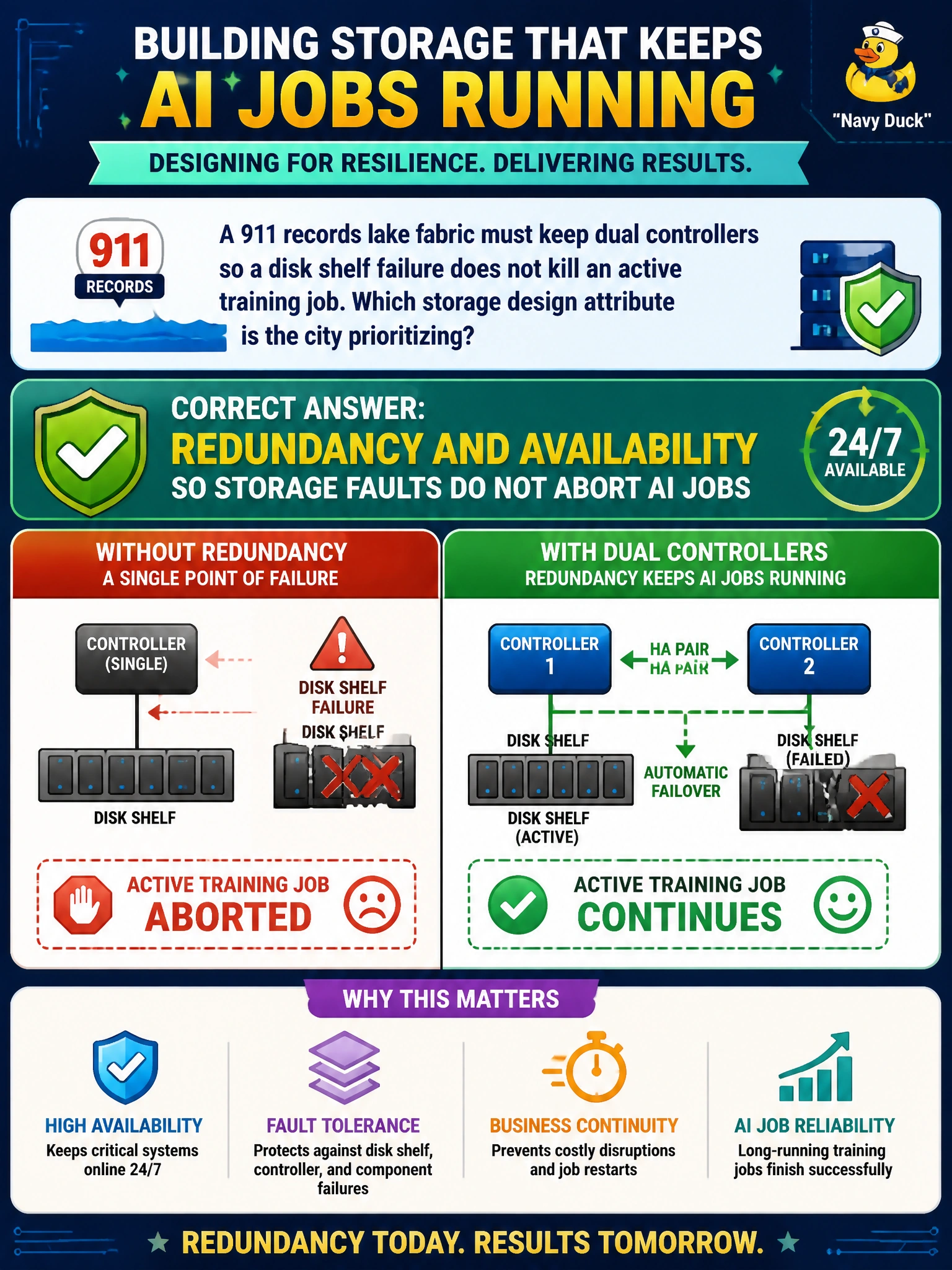
A 911 records lake fabric must keep dual controllers so a disk shelf failure does not kill an active training job. Which storage design attribute is the city prioritizing?
Select an answer to reveal the explanation.
Short Explanation
Think dual fire trucks at the station — if one shelf or controller is out, the other still answers the call. Dual controllers and redundancy keep the 911 training job alive through a shelf failure. Availability is not optional when public-safety models are on the clock.
Full Explanation
A 911 records lake fabric that must survive a disk shelf failure without killing an active training job is prioritizing redundancy and availability in the storage design. Dual controllers, multipathing, and protected shelves exist so a component fault does not abort civic AI work that depends on continuous access to records. Availability here is an operational property of the training path, not provided by storage density and capacity so disk faults do not stall AI jobs, since raw terabytes alone do not keep I/O alive through a fault.
Prioritizing throughput and speed so rebuild streams do not stall AI jobs helps rebuilds move faster, but it does not address active-job resilience: a single-controller primary array still means a shelf failure halts the training job running against it right now. Prioritizing storage density and capacity so disk faults do not stall AI jobs fails because density and availability are separate concerns—raw terabytes without redundant controllers or shelves still drop jobs when hardware fails. Choosing scalability and elasticity so added shelves do not pause AI jobs fails protection: expanding capacity without redundant controllers or shelves still leaves active jobs exposed when hardware fails.
Exam caveat: Domain 2.3 evaluates redundancy and availability alongside capacity and performance. The stem's dual-controller and shelf-failure language points specifically at availability design, not at throughput and speed or scalability and elasticity alone.
Operational check: verify dual-controller failover and shelf rebuild/protect policies in a maintenance window; confirm active 911-adjacent training jobs continue I/O through a simulated path or shelf event; track RAID/erasure and replica health so pressure to scale elastically never tempts operators to drop the redundancy the fabric depends on.
Prefer to study offline? Printable PDF study book + test engine ($7.50, unofficial). These questions stay free here.