
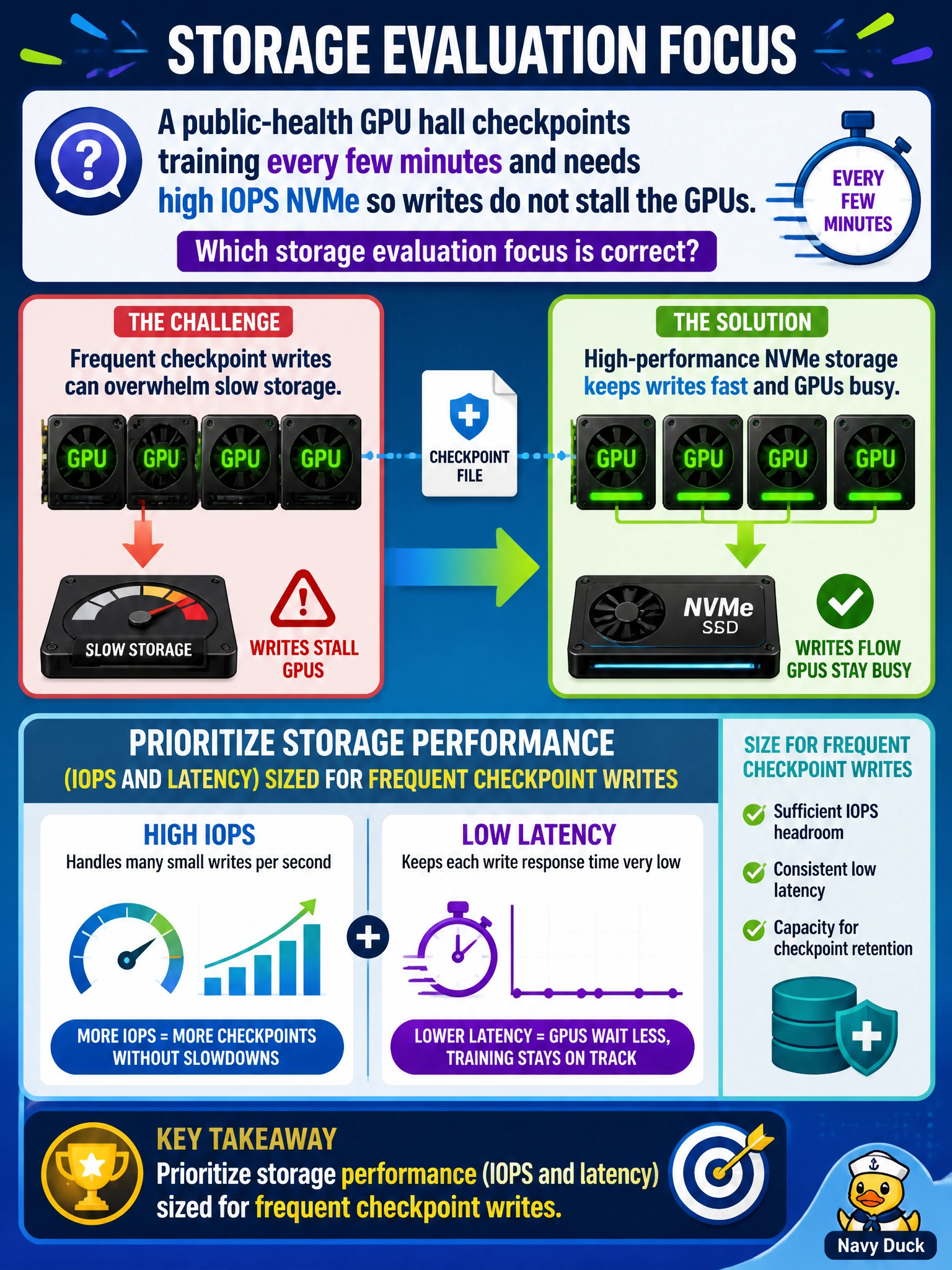
A public-health GPU hall checkpoints training every few minutes and needs high IOPS NVMe so writes do not stall the GPUs. Which storage evaluation focus is correct?
Select an answer to reveal the explanation.
Short Explanation
Frequent checkpoints are like saving a big game every few minutes — the save disk has to be fast or the game freezes. High-IOPS NVMe is how you keep GPUs busy instead of waiting on storage. You'll still stall if you chase raw sequential bandwidth when it's write IOPS and latency that keep you moving.
Full Explanation
A public-health GPU hall that checkpoints training every few minutes places a sustained write burden on storage. Correct evaluation prioritizes storage performance—IOPS and latency—sized so those frequent checkpoint writes complete without stalling GPUs. NVMe-class media on the hot path is the typical match because mid-epoch saves are latency- and IOPS-sensitive; when checkpoints lag, trainers block, iteration time stretches, and expensive accelerators sit underutilized.
Prioritizing sequential throughput (GB/s bandwidth) sized for frequent checkpoint writes fails by concept: high streaming bandwidth does not guarantee the write IOPS and low p99 latency that concurrent mid-epoch saves need, so trainers can still block while waiting for many small checkpoint commits to complete. Prioritizing read-cache IOPS (NVMe latency) sized for frequent checkpoint writes fails by concept: read-cache hits accelerate reads, not the sustained write burden of checkpoint persistence, so GPUs still stall when frequent mid-epoch writes wait on backend commit latency. Prioritizing backend NVMe IOPS (write latency) sized for infrequent checkpoint restores misses the use case: sizing for infrequent restores provisions for the rare read-back path and leaves no headroom for the write IOPS and latency a live checkpoint needs every few minutes.
Exam caveat: Domain 2.3 requires matching storage performance characteristics to AI I/O patterns. Capacity and archival tiers remain necessary for finished models and datasets, but they do not substitute for the hot checkpoint path described here.
Operational check: measure checkpoint write size and frequency under representative public-health jobs; confirm NVMe (or equivalent) delivers headroom on IOPS and p99 latency during concurrent saves; alert when GPU wait-on-I/O rises so storage, not model code, is investigated first.
Prefer to study offline? Printable PDF study book + test engine ($7.50, unofficial). These questions stay free here.