
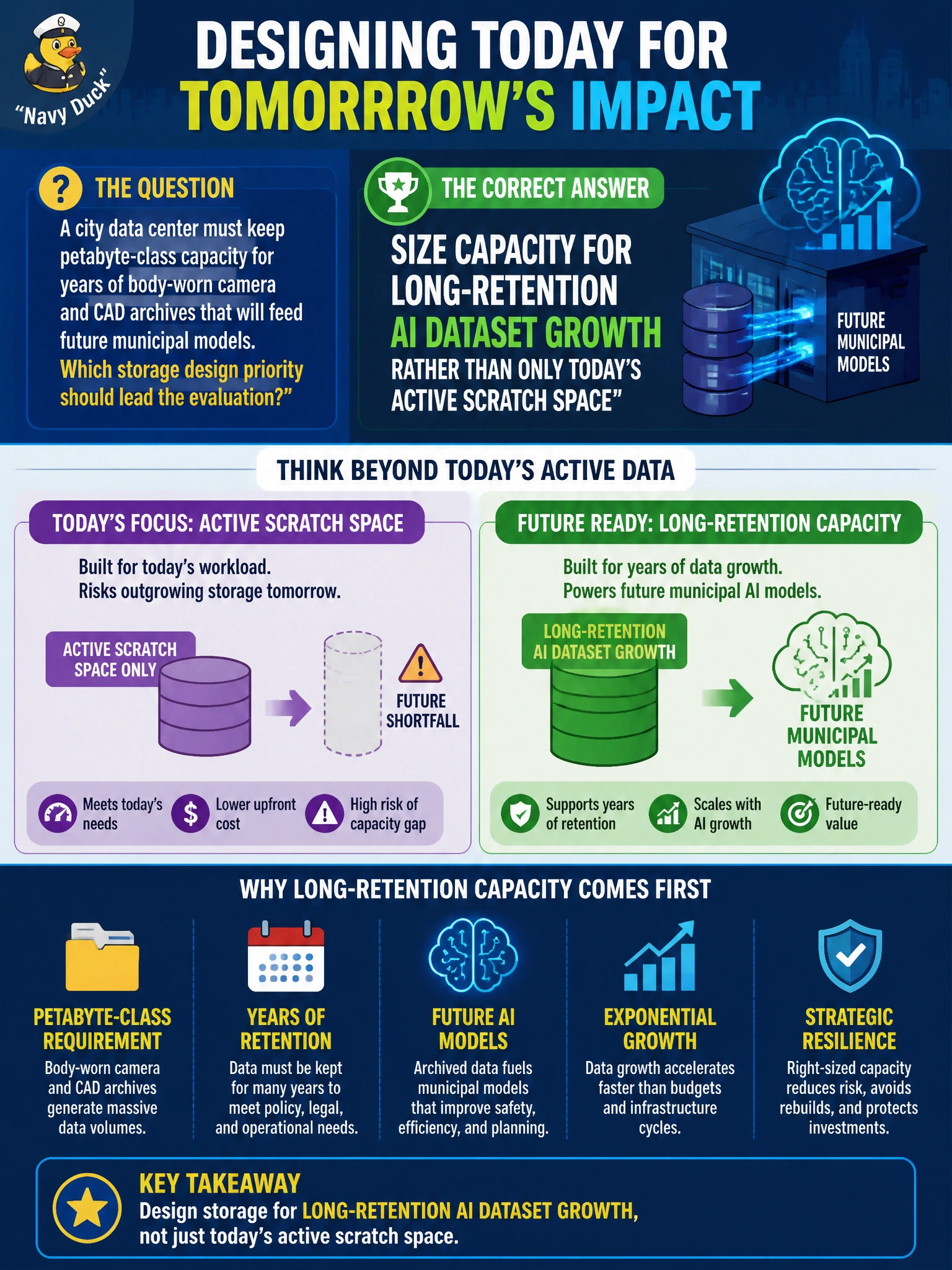
A city data center must keep petabyte-class capacity for years of body-worn camera and CAD archives that will feed future municipal models. Which storage design priority should lead the evaluation?
Select an answer to reveal the explanation.
Short Explanation
Body-cam and CAD archives are like a city warehouse that keeps filling — you plan floor space for years of boxes, not just today's open crate. Petabyte-class capacity for future model feeding is a storage capacity design call. Scratch-only thinking leaves the archive on the floor.
Full Explanation
Municipal AI programs that retain body-worn camera video and computer-aided dispatch (CAD) archives for years are building petabyte-class corpora that later feed training, retrieval, and audit workflows. Storage evaluation for that city data center must therefore lead with capacity sized for long-retention dataset growth, not only with today's ephemeral scratch space used during an active job. Correct capacity planning treats the archive as a durable AI asset whose footprint compounds with camera fleets, retention policy, and model-refresh cadence.
Archiving body-worn video to tape tiers after 90 days is cost-effective but misses the point: the stem says these archives will feed future models, so petabyte-class design must plan for that growth, not just minimize hot-storage spend. Using edge-node NVMe caches that sync nightly improves ingestion latency but does not solve the core design question—the city still has to provision central capacity for long-lived archives, and edge caches are an optimization layered on top of that plan, not a replacement for it. Provisioning high-IOPS flash tiers for concurrent ingest from precinct uploads speeds up uploads but does not answer the capacity question: fast ingest tiers cannot hold years of body-cam and CAD archives, and spending on flash before sizing the archive leaves the long-term dataset unplanned.
Exam caveat: Domain 2.3 storage evaluation for AI workloads separately weighs capacity, performance, redundancy/availability, and scalability; this item isolates capacity for long-lived AI datasets. Scratch performance still matters operationally, but it is not the lead priority when the stem emphasizes years of body-cam and CAD retention.
Operational check: project archive growth from camera count, bitrate, and retention years; compare usable capacity plus headroom against that curve before investing in high-IOPS flash tiers for precinct ingest; verify backup/replication targets match the same capacity plan so civic evidence remains trainable and recoverable.
Prefer to study offline? Printable PDF study book + test engine ($7.50, unofficial). These questions stay free here.