
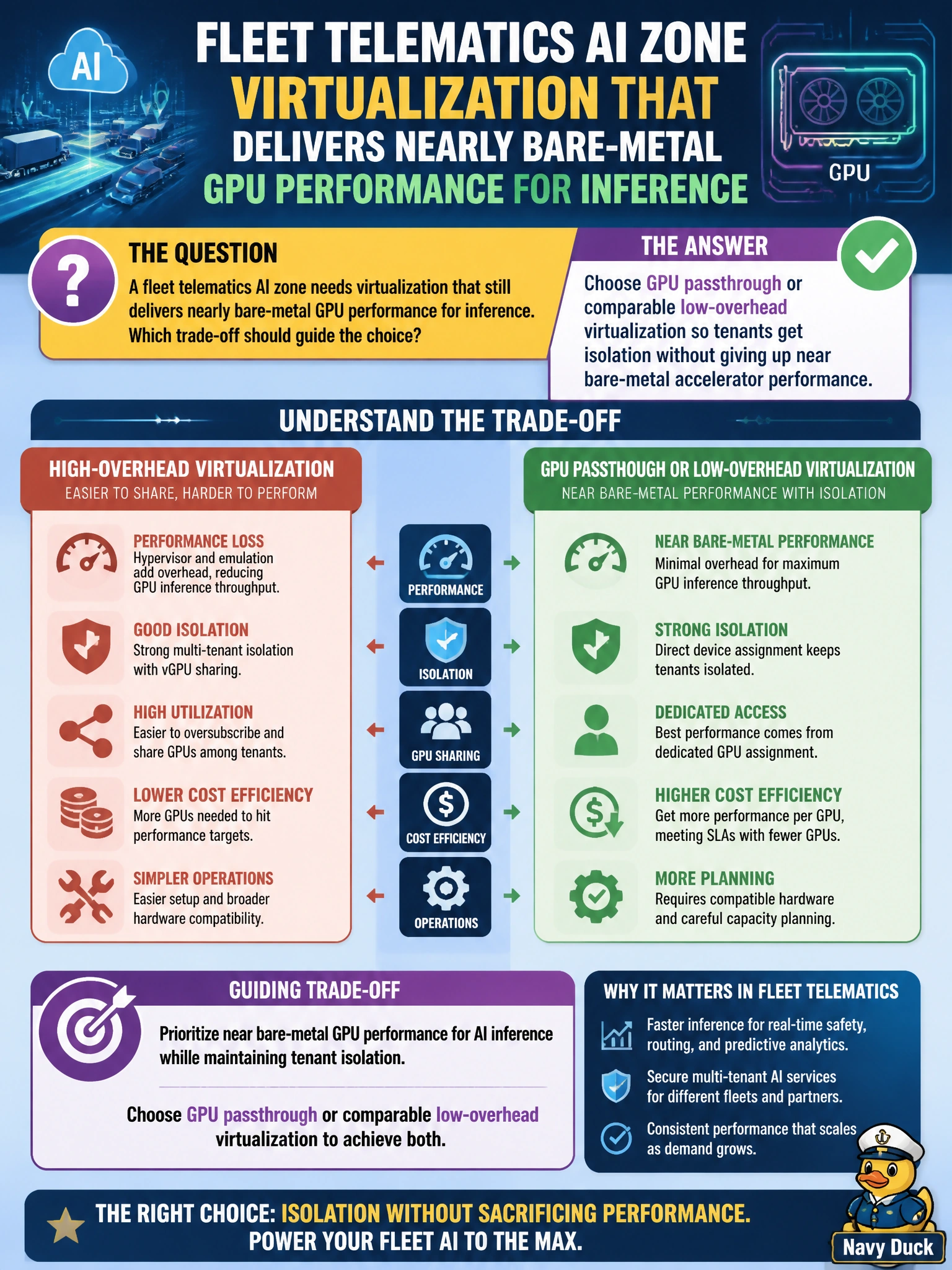
A fleet telematics AI zone needs virtualization that still delivers nearly bare-metal GPU performance for inference. Which trade-off should guide the choice?
Select an answer to reveal the explanation.
Short Explanation
You want a hotel key to your own room without rebuilding the whole hotel out of cardboard. GPU passthrough (or similarly lean virtualization) gives telematics tenants a locked door while the GPU still feels almost bare-metal fast.
Full Explanation
Favoring CPU-backed container pools with standard cluster autoscaling so tenants get isolation while delivering near bare-metal accelerator performance gives up the near bare-metal GPU performance target because CPU pools have no accelerator to deliver it; choose GPU passthrough or comparable low-overhead virtualization for nearly bare-metal telematics AI performance. That trade-off works because the evaluation of virtualization support for AI is explicitly isolation versus overhead: passthrough (or similarly lean mediation) keeps the inference hot path close to bare metal while still separating tenants on shared civic infrastructure.
Using mediated vGPU partitioning with strict hardware QoS caps so tenants get isolation while preserving near bare-metal accelerator performance fails conceptually — partitioning and mediation still impose scheduling overhead and split accelerator throughput, so it cannot preserve near bare-metal performance like passthrough. Relying on API remoting with CUDA forwarding layers so tenants get isolation while sustaining near bare-metal accelerator inference performance fails because forwarding adds translation latency on the inference path, so it cannot sustain near bare-metal performance without hurting telematics SLAs. Favoring CPU-backed container pools with standard cluster autoscaling so tenants get isolation while delivering near bare-metal accelerator performance offloads inference to CPUs, so it cannot deliver the near bare-metal GPU performance the fleet telematics zone explicitly needs—CPU containers simplify placement, but they are not a shared-GPU inference answer.
Exam caveat: passthrough reduces VM mobility and can complicate live migration/HA compared with mediated sharing; document those ops trade-offs when promising near bare-metal speed. Operational check: benchmark the same telematics inference model on bare metal, passthrough VM, and mediated vGPU partitioning; accept the virtualization mode only if p99 latency and throughput stay within the near bare-metal budget and tenant isolation requirements are met.
Prefer to study offline? Printable PDF study book + test engine ($7.50, unofficial). These questions stay free here.