
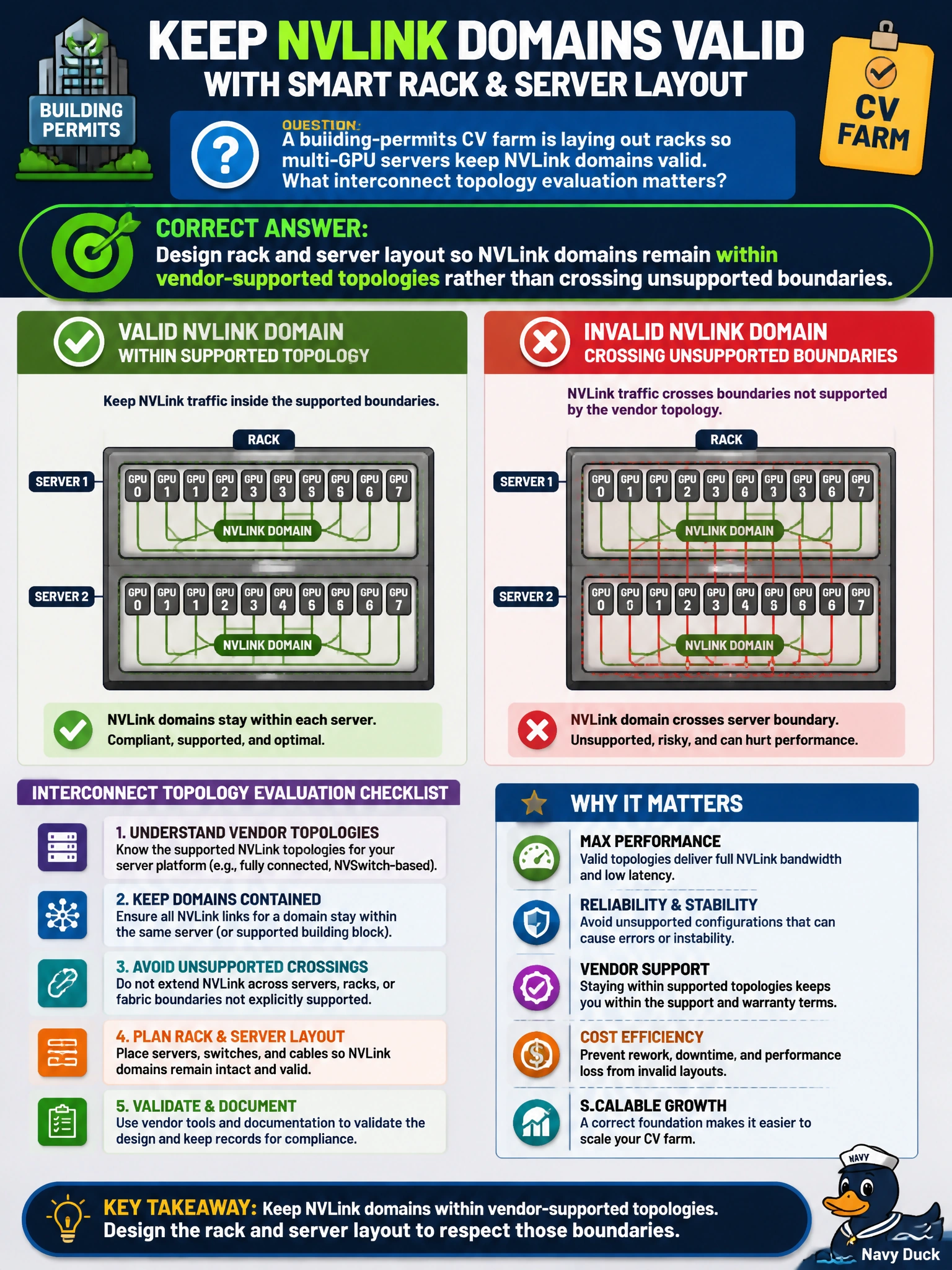
A building-permits CV farm is laying out racks so multi-GPU servers keep NVLink domains valid. What interconnect topology evaluation matters?
Select an answer to reveal the explanation.
Short Explanation
NVLink domains are like apartment wings with shared hallways—you don't stretch one to the next rack just to balance power and heat, and you can't fake one with Switch trays or leaf-spine Ethernet. Keep multi-GPU NVLink islands inside the rack and server layouts the vendor actually documents.
Full Explanation
Verifying leaf-spine Ethernet capacity is provisioned to preserve NVLink-level latency for distributed GPU collectives spanning racks conflates Ethernet capacity with GPU interconnect topology; Ethernet cannot preserve NVLink-level latency and NVLink domains must respect vendor-specified topology regardless of how well-provisioned the leaf-spine fabric is. Designing rack and server layout to extend NVLink domains across adjacent racks to balance power density while staying within thermal limits breaks NVLink domains if that extension crosses unsupported boundaries; design rack and server layout so NVLink domains remain within vendor topology specifications instead of stretching them for power or thermal balance. Keeping islands inside supported server/rack layouts preserves the bandwidth and correctness assumptions the CV training stack expects.
Designing rack and server layout to extend NVLink domains across adjacent racks to balance power density while staying within thermal limits fails conceptually: optimizing placement for power and thermal balance while merely stretching the domain says nothing about whether the resulting layout actually keeps NVLink domains inside vendor-supported boundaries. Planning NVLink Switch trays to interconnect servers across adjacent racks to form unified domains within supported power envelopes fails because power envelopes do not define NVLink validity; Switch trays only form unified domains within vendor-supported topologies, cabling and rack layouts, not arbitrary cross-rack spans. Verifying leaf-spine Ethernet capacity is provisioned to preserve NVLink-level latency for distributed GPU collectives spanning racks fails because Ethernet capacity does not validate unsupported NVLink domains; a fast leaf-spine fabric cannot deliver NVLink-level latency and says nothing about whether NVLink itself can span those racks.
Exam caveat: some multi-node GPU interconnect products differ from classic in-server NVLink; always apply the rules for the exact interconnect generation in the BOM, not a generic rumor about "NVLink everywhere." Operational check: validate rack elevations and server SKUs against the vendor topology guide, prevent scheduler placement that straddles unsupported domains, and benchmark collective performance for permits CV jobs inside approved islands.
Prefer to study offline? Printable PDF study book + test engine ($7.50, unofficial). These questions stay free here.