
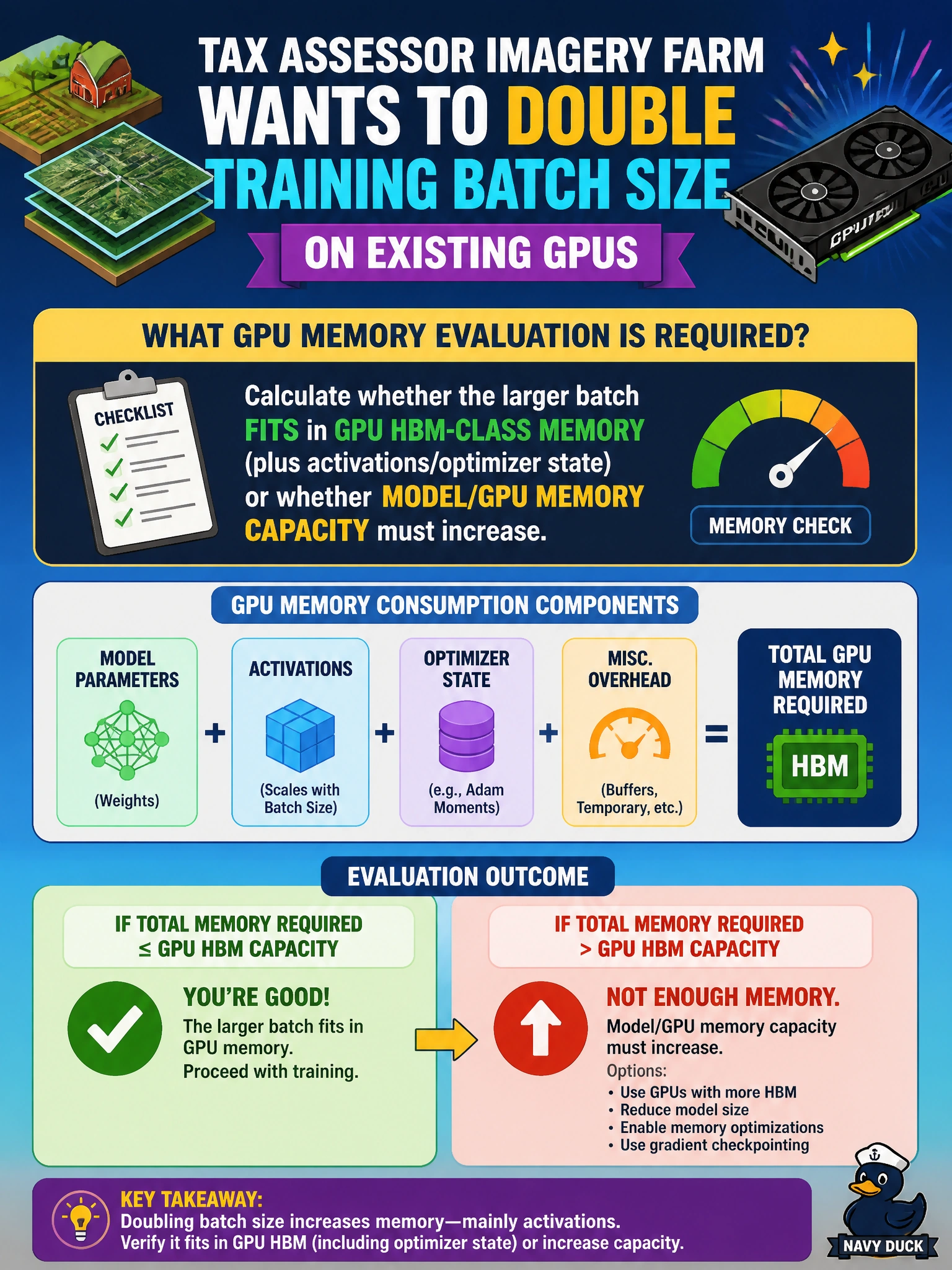
A tax assessor imagery farm wants to double training batch size on existing GPUs. What GPU memory evaluation is required?
Select an answer to reveal the explanation.
Short Explanation
Doubling the batch is like doubling the passengers in an elevator—you check the weight limit first. GPU HBM is that limit: activations and optimizer state grow with batch size, so you work out whether they fit before you push the button on a bigger batch.
Full Explanation
Calculating whether the larger batch fits in GPU HBM-class memory (plus activations/optimizer state), or whether model/GPU memory capacity must increase, is the correct way to evaluate doubling the training batch size. That GPU memory evaluation works because batch size multiplies activation footprint; host RAM cannot substitute for on-device HBM when the training step needs the larger batch resident on the GPU. Profiling sustained HBM bandwidth saturation to confirm doubled activations move within kernel time budgets on existing farm GPUs during training fails because it measures how fast data moves through HBM, not whether the larger batch's activations and optimizer state actually fit in HBM capacity. Benchmarking memory compression ratios and allocation reuse to verify extra samples compact efficiently per watt on existing GPUs during imagery training fails because packing efficiency and per-watt compactness do not guarantee capacity; they say nothing about whether HBM can actually hold the doubled activations and optimizer state. Measuring peer-to-peer NVLink memory pooling across workers to predict shared HBM availability for the doubled global batch footprint on existing farm GPUs fails because each GPU still needs its per-GPU batch resident in local HBM, and NVLink does not pool capacity for naive data-parallel doubling, so it cannot substitute for checking whether the per-GPU batch fits in HBM. Exam caveat: techniques such as gradient accumulation, activation checkpointing, or sharded optimizers can emulate larger effective batches without proportional HBM growth—but those are deliberate algorithm changes, not proof that naive batch doubling fits. Operational check: estimate or profile peak allocated HBM at current and 2× batch, include optimizer state, and either confirm headroom on existing GPUs or plan higher-memory GPUs/model parallelism before the imagery farm changes production configs.
Prefer to study offline? Printable PDF study book + test engine ($7.50, unofficial). These questions stay free here.