
A police evidence AI zone must keep inference available during 911 peak events. What compute redundancy design should be evaluated?
Select an answer to reveal the explanation.
Short Explanation
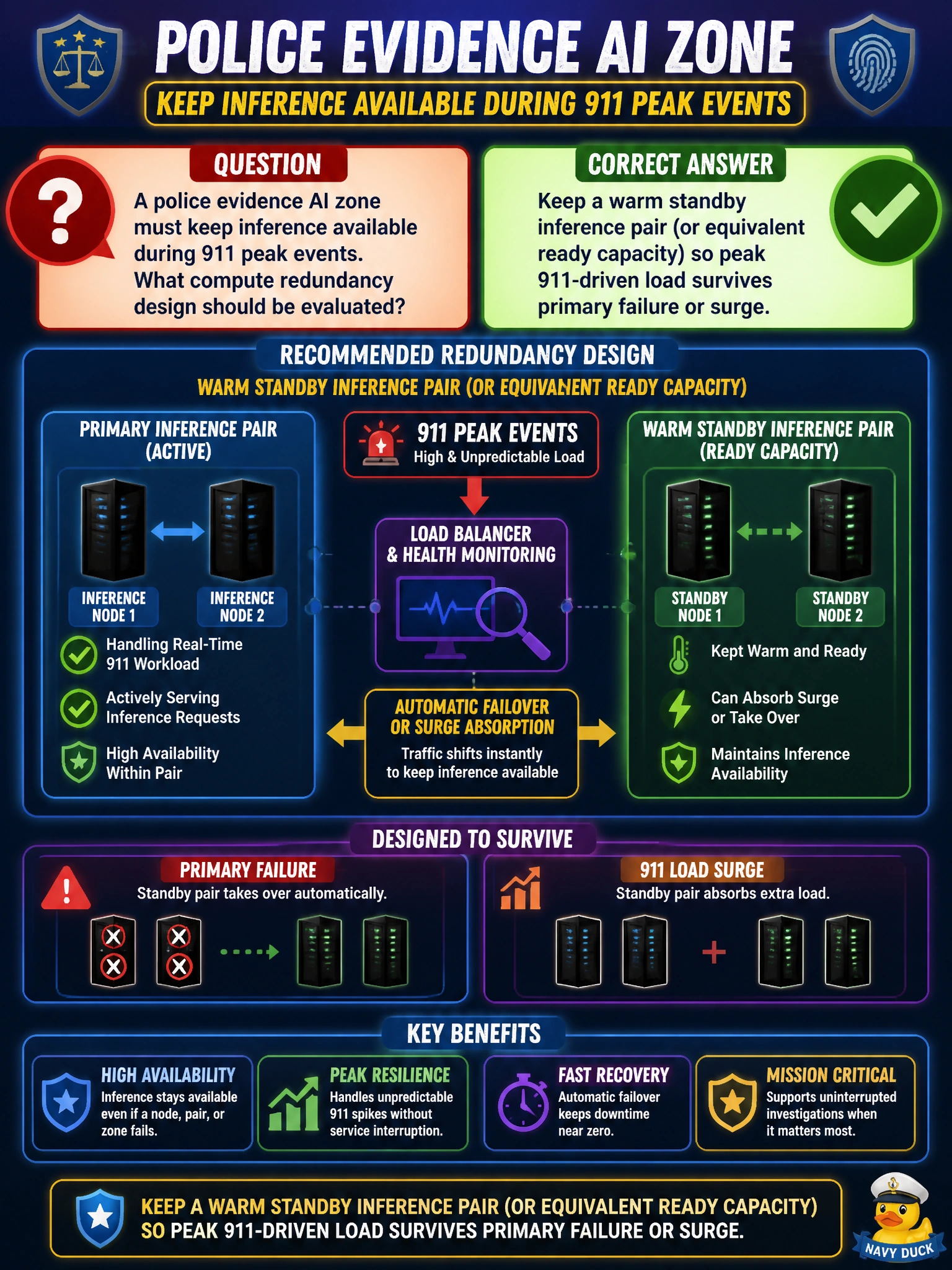
Peak 911 nights are when you'll least want to discover your backup is just a cold image on isolated storage, even with rapid restore validated, since it still isn't online when the surge hits. A warm standby pair is the spare ambulance already idling—ready when the primary can't keep up or fails.
Full Explanation
Police evidence AI zones that must keep inference available during 911 peak events need warm standby inference capacity (or equivalent ready spare) so peak load survives primary failure or surge. That compute redundancy design works because public-safety inference is time-critical: a cold standby inference image on isolated backup storage with rapid restore validated for peak 911 failover load still won't be online when the surge hits, and elastic burst inference capacity using preemptible spot nodes from the shared municipal pool scaled for 911 volume spikes can be reclaimed mid-spike, so neither can serve as dependable standby capacity.
Maintaining a cold standby inference image on isolated backup storage with rapid restore validated for peak 911 failover load fails conceptually—peaks are when capacity must already be online, not restored even rapidly during the surge. Hosting synchronized inference replicas on the evidence vault archive cluster with failover capacity reserved for peak load fails availability and operational control for 911-correlated load, because that cluster is built for archival durability and batch work, not time-critical inference. Adding elastic burst inference capacity using preemptible spot nodes from the shared municipal pool scaled for 911 volume spikes fails: preemptible nodes can be reclaimed exactly when volume spikes, so they cannot be the dependable replica the zone needs.
Exam caveat: warm standby must include model artifacts, licenses, and network path readiness—not only powered hardware—or failover still stalls on cold configuration. Operational check: fail the primary inference pair during a simulated 911 peak, confirm standby answers within the evidence zone's RTO/latency budget, and document auto-failover versus manual runbook steps for responding officers' support staff.
Prefer to study offline? Printable PDF study book + test engine ($7.50, unofficial). These questions stay free here.