
A fire CAD analytics VLAN team must grow training capacity. How should they evaluate scale-out versus scale-up GPU strategies?
Select an answer to reveal the explanation.
Short Explanation
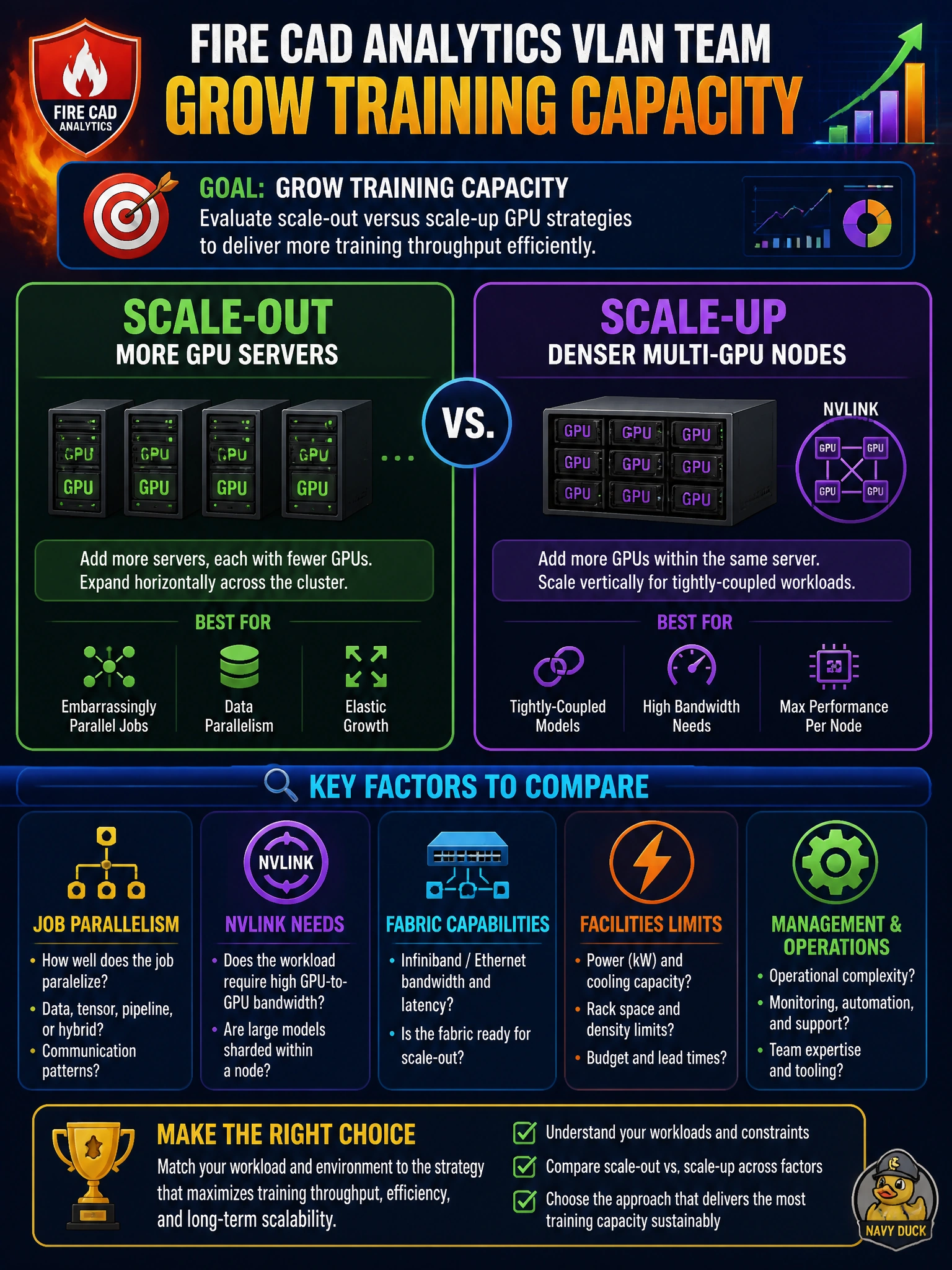
Scale-up is a bigger truck; scale-out is more trucks in a convoy. For fire CAD training you weigh denser GPU nodes against more servers—parallelism, NVLink appetite, fabric, and power all vote. You can't fix tensor-parallel jobs that crave NVLink locality by just adding more servers, as you'll trade fast local links for slower fabric.
Full Explanation
Evaluating scaling out with additional GPU servers for data-parallel throughput on cost per GPU while aligning NVLink domains with fabric, power and rack capacity evaluates only the scale-out side; without comparing against scaling up denser multi-GPU nodes for parallelism and NVLink needs, it cannot determine when fat nodes would be more efficient for fire CAD training. That evaluation works because neither strategy is universally correct: some CAD models scale across nodes; others prefer fat NVLink islands; power, cooling, and spine bandwidth constrain both paths. DCAI compute scalability judgment is comparative analysis, not a slogan. Prioritizing scaling out across more GPU servers for tensor-parallel jobs needing NVLink locality while balancing fabric bandwidth against power and cooling limits misplaces tightly coupled shards off the high-bandwidth NVLink island onto slower inter-node fabric; tensor-parallel work prefers dense scale-up nodes, and fabric plus facilities must be compared across both paths, not within scale-out alone. Evaluating scale-out alone for data-parallel throughput on cost per GPU, even while aligning NVLink domains with fabric, power and rack capacity, omits the required scale-out versus scale-up comparison and fails to test how mixed CAD parallelism would behave on denser nodes. Expanding per-GPU HBM capacity to fit larger model batches onto fewer multi-GPU nodes while tuning NVLink topology with fabric, power and thermal headroom tunes only the scale-up path; without comparing to scaling out additional servers, it cannot choose the efficient growth plan across parallelism types and facilities limits.
Exam caveat: hybrid answers are normal—scale up to the NVLink sweet spot, then scale out—so "compare" may yield a sequenced plan rather than a single purchase. Operational check: for the fire CAD training job, measure scaling efficiency on denser nodes versus more nodes, overlay PDU/cooling and fabric headroom, and pick the path (or sequence) that hits accuracy/time goals within facilities budget.
Prefer to study offline? Printable PDF study book + test engine ($7.50, unofficial). These questions stay free here.